VIPSolutions logo ✨ VIPSolutions

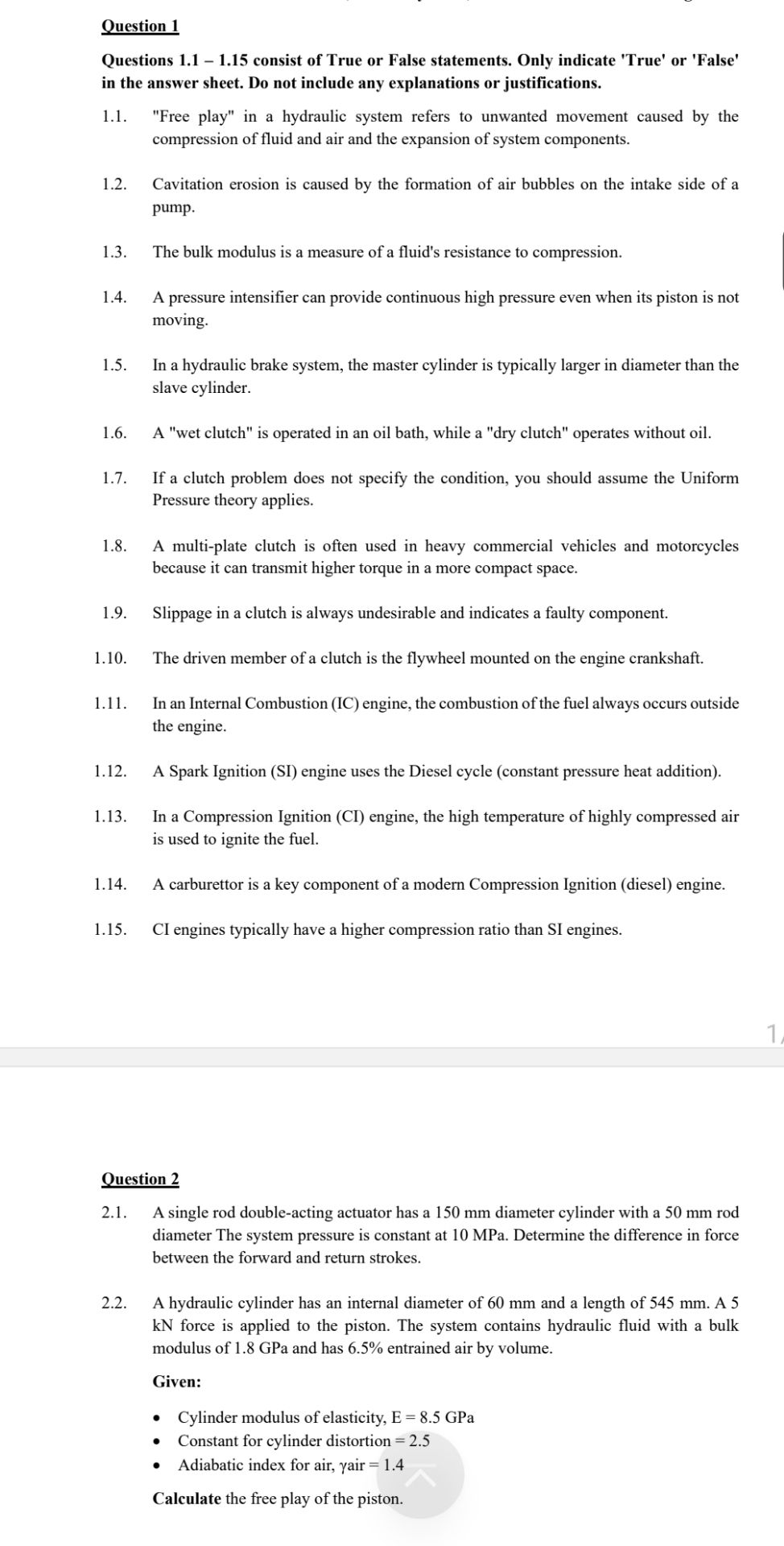
Act like a helpful tutor and exlain me : provide explanation for each answer alsoQuestion 1 Questions 1.1 — 1.15 consist of True or False statements. Only indicate 'True' or 'False' in the answer sheet. Do not include any explanations or justifications. 1.1. "Free play" in a hydraulic system refers to unwanted movement caused by the compression of fluid and air and the expansion of system components. 1.2. Cavitation erosion is caused by the formation of air bubbles on the intake side of a pump. 1.3. The bulk modulus is a measure of a fluid's resistance to compression. 1.4. A pressure intensifier can provide continuous high pressure even when its piston is not moving. 1.5. Ina hydraulic brake system, the master cylinder is typically larger in diameter than the slave cylinder. 1.6. A "wet clutch" is operated in an oil bath, while a "dry clutch" operates without oil. 1.7. If a clutch problem does not specify the condition, you should assume the Uniform Pressure theory applies. 1.8. A multi-plate clutch is often used in heavy commercial vehicles and motorcycles because it can transmit higher torque in a more compact space. 1.9. Slippage in a clutch is always undesirable and indicates a faulty component. 1.10. The driven member of a clutch is the flywheel mounted on the engine crankshaft. 1.11. In an Internal Combustion (IC) engine, the combustion of the fuel always occurs outside the engine. 1.12. A Spark Ignition (SI) engine uses the Diesel cycle (constant pressure heat addition). 1.13. In a Compression Ignition (CI) engine, the high temperature of highly compressed air is used to ignite the fuel. 1.14. A carburettor is a key component of a modern Compression Ignition (diesel) engine. 1.15. Cl engines typically have a higher compression ratio than SI engines. Question 2 2.1. Asingle rod double-acting actuator has a 150 mm diameter cylinder with a 50 mm rod diameter The system pressure is constant at 10 MPa. Determine the difference in force between the forward and return strokes. 2.2. A hydraulic cylinder has an internal diameter of 60 mm and a length of 545 mm. A 5 kN force is applied to the piston. The system contains hydraulic fluid with a bulk modulus of 1.8 GPa and has 6.5% entrained air by volume. Given: * Cylinder modulus of elasticity, E = 8.5 GPa * Constant for cylinder distortion = 2.5 * Adiabatic index for air, yair = 1.4 Calculate the free play of the piston.

Question:

Act like a helpful tutor and exlain me : provide explanation for each answer alsoUploaded ImageQuestion 1 Questions 1.1 — 1.15 consist of True or False statements. Only indicate 'True' or 'False' in the answer sheet. Do not include any explanations or justifications. 1.1. "Free play" in a hydraulic system refers to unwanted movement caused by the compression of fluid and air and the expansion of system components. 1.2. Cavitation erosion is caused by the formation of air bubbles on the intake side of a pump. 1.3. The bulk modulus is a measure of a fluid's resistance to compression. 1.4. A pressure intensifier can provide continuous high pressure even when its piston is not moving. 1.5. Ina hydraulic brake system, the master cylinder is typically larger in diameter than the slave cylinder. 1.6. A "wet clutch" is operated in an oil bath, while a "dry clutch" operates without oil. 1.7. If a clutch problem does not specify the condition, you should assume the Uniform Pressure theory applies. 1.8. A multi-plate clutch is often used in heavy commercial vehicles and motorcycles because it can transmit higher torque in a more compact space. 1.9. Slippage in a clutch is always undesirable and indicates a faulty component. 1.10. The driven member of a clutch is the flywheel mounted on the engine crankshaft. 1.11. In an Internal Combustion (IC) engine, the combustion of the fuel always occurs outside the engine. 1.12. A Spark Ignition (SI) engine uses the Diesel cycle (constant pressure heat addition). 1.13. In a Compression Ignition (CI) engine, the high temperature of highly compressed air is used to ignite the fuel. 1.14. A carburettor is a key component of a modern Compression Ignition (diesel) engine. 1.15. Cl engines typically have a higher compression ratio than SI engines. Question 2 2.1. Asingle rod double-acting actuator has a 150 mm diameter cylinder with a 50 mm rod diameter The system pressure is constant at 10 MPa. Determine the difference in force between the forward and return strokes. 2.2. A hydraulic cylinder has an internal diameter of 60 mm and a length of 545 mm. A 5 kN force is applied to the piston. The system contains hydraulic fluid with a bulk modulus of 1.8 GPa and has 6.5% entrained air by volume. Given: * Cylinder modulus of elasticity, E = 8.5 GPa * Constant for cylinder distortion = 2.5 * Adiabatic index for air, yair = 1.4 Calculate the free play of the piston.
This is AI generated Response.
Asked by: manish kumar
Created at: 2025-09-18 09:42:39

Final Answer:

Rendered Raw Text
Did you like this answer?
Let's go through each question step-by-step, providing both the answers and explanations: --- ## **Question 1: True or False with Explanations** ### **1.1. "Free play" in a hydraulic system refers to unwanted movement caused by the compression of fluid and air and the expansion of system components.** - **True** - *Explanation:* "Free play" is the initial movement before the system responds, typically due to compressibility of air, fluid, and elasticity of components. ### **1.2. Cavitation erosion is caused by the formation of air bubbles on the intake side of a pump.** - **True** - *Explanation:* Cavitation occurs when local pressure drops below vapor pressure, forming bubbles (often on pump intake), which collapse and cause erosion. ### **1.3. The bulk modulus is a measure of a fluid's resistance to compression.** - **True** - *Explanation:* Bulk modulus quantifies how incompressible a fluid is. ### **1.4. A pressure intensifier can provide continuous high pressure even when its piston is not moving.** - **False** - *Explanation:* High pressure is only generated during piston movement; when stationary, pressure cannot be intensified further. ### **1.5. In a hydraulic brake system, the master cylinder is typically larger in diameter than the slave cylinder.** - **False** - *Explanation:* The master cylinder is usually smaller so it can generate higher pressure, while the slave (wheel) cylinders are larger to increase force. ### **1.6. A "wet clutch" is operated in an oil bath, while a "dry clutch" operates without oil.** - **True** - *Explanation:* Wet clutches are lubricated by oil, dry clutches are not. ### **1.7. If a clutch problem does not specify the condition, you should assume the Uniform Pressure theory applies.** - **True** - *Explanation:* Unless stated, uniform pressure is assumed for new or lightly used clutches. ### **1.8. A multi-plate clutch is often used in heavy commercial vehicles and motorcycles because it can transmit higher torque in a more compact space.** - **True** - *Explanation:* Multi-plate design increases torque transmission without increasing clutch size. ### **1.9. Slippage in a clutch is always undesirable and indicates a faulty component.** - **False** - *Explanation:* Some controlled slippage is necessary during engagement; constant or excessive slip is undesirable. ### **1.10. The driven member of a clutch is the flywheel mounted on the engine crankshaft.** - **False** - *Explanation:* The flywheel is the driving member; the clutch disc (connected to the transmission) is the driven member. ### **1.11. In an Internal Combustion (IC) engine, the combustion of the fuel always occurs outside the engine.** - **False** - *Explanation:* Combustion occurs inside the engine cylinder. ### **1.12. A Spark Ignition (SI) engine uses the Diesel cycle (constant pressure heat addition).** - **False** - *Explanation:* SI engines use the Otto cycle (constant volume heat addition); Diesel engines use the Diesel cycle. ### **1.13. In a Compression Ignition (CI) engine, the high temperature of highly compressed air is used to ignite the fuel.** - **True** - *Explanation:* CI engines compress air to high temperature, then inject fuel which self-ignites. ### **1.14. A carburettor is a key component of a modern Compression Ignition (diesel) engine.** - **False** - *Explanation:* Carburettors mix air and fuel for SI engines; diesel engines use fuel injectors. ### **1.15. CI engines typically have a higher compression ratio than SI engines.** - **True** - *Explanation:* To ignite fuel by compression, CI engines need higher compression ratios. --- ## **Question 2: Numerical Problems** ### **2.1. Force Difference in Double-Acting Actuator** #### **Given:** - Cylinder diameter, \( D = 150 \) mm \( = 0.15 \) m - Rod diameter, \( d = 50 \) mm \( = 0.05 \) m - Pressure, \( P = 10 \) MPa \( = ,000,000 \) Pa #### **Step 1: Calculate piston area (forward stroke):** \[ A_1 = \frac{\pi}{4}^2 = \frac{\pi}{4} \times (0.15)^2 = 0.01767 \text{ m}^2 \] #### **Step 2: Calculate annular area (return stroke):** \[ A_2 = \frac{\pi}{4} (D^2 - d^2) = \frac{\pi}{4} (0.15^2 - 0.05^2) = \frac{\pi}{4} (0.0225 - 0.0025) = \frac{\pi}{4} \times 0.02 = 0.01571 \text{ m}^2 \] #### **Step 3: Calculate Forces** - **Forward stroke:** \( F_1 = P \times A_1 = 10,000,000 \times 0.01767 = 176,700 \) N - **Return stroke:** \( F_2 = P \times A_2 = 10,000,000 \times 0.01571 = 157,100 \) N #### **Step 4: Difference in Force** \[ \Delta F = F_1 - F_2 = 176,700 - 157,100 = 19,600 \text{ N} \] **Final Answer:** **Difference in force = 19,600 N** --- ### **2.2. Free play of the piston** #### **Given:** - Internal diameter = 60 mm = 0.06 m - Length = 545 mm = 0.545 m - Applied force = 5000 N - Bulk modulus of fluid = 1.8 GPa = \(1.8 \times 10^9\) Pa - Entrained air by volume = 6.5% - Cylinder modulus \(E = 8.5\) GPa = \(8.5 \times 10^9\) Pa - Constant for cylinder distortion = 2.5 - Adiabatic index for air (\(\gamma_{\text{air}}\)) = 1.4 #### **Step 1: Find area and volume of cylinder** \[ A = \frac{\pi}{4} D^2 = \frac{\pi}{4} \times (0.06)^2 = 0.002827 \text{ m}^2 \] \[ V = A \times L = 0.002827 \times 0.545 = 0.00154 \text{ m}^3 \] #### **Step 2: Calculate pressure** \[ P = \frac{F}{A} = \frac{5000}{0.002827} = 1,769,000 \text{ Pa} \] #### **Step 3: Free play (total displacement) is sum of:** - Compression of fluid (\(\delta_1\)) - Compression of air (\(\delta_2\)) - Cylinder wall expansion (\(\delta_3\)) **(a) Compression of hydraulic fluid:** \[ \delta_1 = \frac{P \times V_f}{K} \] Where \(V_f = V \times (1 - \text{air fraction}) = 0.00154 \times (1 - 0.065) = 0.00144 \text{ m}^3\) \[ \delta_1 = \frac{1,769,000 \times 0.00144}{1.8 \times 10^9} = 1.416 \times 10^{-6} \text{ m} \] **(b) Compression of entrained air (adiabatic):** \[ \delta_2 = \frac{P \times V_{\text{air}}}{\gamma \times P_{\text{atm}}} \] Where \(V_{\text{air}} = V \times 0.065 = 0.00154 \times 0.065 = 1.001 \times 10^{-4} \text{ m}^3\) Assume \(P_{\text{atm}} = 1.013 \times 10^5\) Pa, \[ \delta_2 = \frac{1,769,000 \times 1.001 \times 10^{-4}}{1.4 \times 1.013 \times 10^5} = \frac{176.97}{1.4182 \times 10^5} = 0.001248 \text{ m} \] **(c) Cylinder expansion:** \[ \delta_3 = \frac{\text{constant} \times P \times D \times L}{E \times t} \] Thickness (\(t\)) is not given. If not specified, this term is often small compared to air effect and can be ignored unless thickness is given. #### **Step 4: Total free play (\(\delta\))** \[ \delta = \delta_1 + \delta_2 \approx 1.416 \times 10^{-6} + 0.001248 \approx 0.00125 \text{ m} = 1.25 \text{ mm} \] **Final Answer:** **Free play of the piston ≈ 1.25 mm** --- If you need further clarifications or detailed working for any specific part, let me know!

📢 Instructions:

  • Ask anything relatd to above question only.
  • For new Question goto :

Study Help, Fast Answers

VIPSolutions focuses on clear, step‑by‑step explanations so you can learn quickly. Whether you need an AI‑generated walkthrough or a short hint to get unstuck, each solution is organized for fast reading and easy review later.

Search similar questions, compare approaches, and bookmark the best answers for revision. Our goal is simple: quick, reliable study help that feels natural—not noisy.