 VIPSolutions
Act like a helpful tutor and exlain me : Provide drawn out mechanism with arrows, and every step.0 OH o H,SO, (cat) vS 0 HO
Question:
Act like a helpful tutor and exlain me :
Provide drawn out mechanism with arrows, and every step.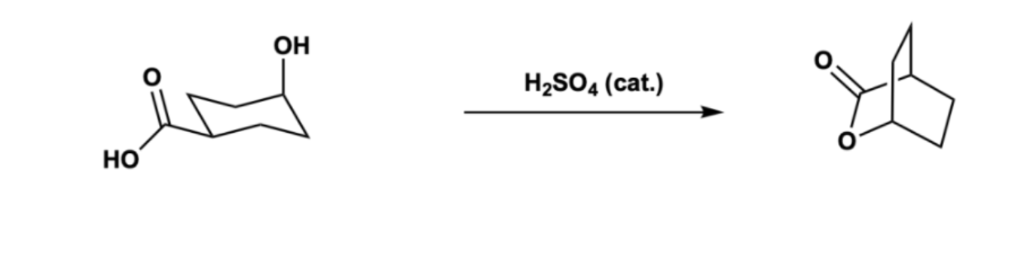 0
OH
o H,SO, (cat) vS
0
HO
This is AI generated Response.
Asked by: Alok Kumar
Created at: 2026-02-02 06:47:01
Asked by: Alok Kumar
Created at: 2026-02-02 06:47:01
Final Answer:
Rendered
Raw Text
Did you like this answer?
## Mechanism Explanation: Acid-Catalyzed Intramolecular Aldol Reaction (Robinson Annulation)
This reaction is a classic example of **acid-catalyzed intramolecular aldol condensation**, leading to the formation of a **bicyclic compound**.
Let's break down the mechanism step by step, with clear arrows for electron movement:
---
### **Step 1: Protonation of the Carbonyl Oxygen**
- **Sulfuric acid (H₂SO₄)** protonates the carbonyl oxygen of the carboxylic acid, increasing its electrophilicity.
---
### **Step 2: Formation of the Enol (or Enol Ether)**
- The hydroxyl group on the cyclohexanone undergoes protonation and loss of water, forming a carbocation.
- A neighboring alpha hydrogen is deprotonated, leading to enol formation (enolization).
---
### **Step 3: Intramolecular Aldol Addition**
- The enol (nucleophile) attacks the protonated carbonyl carbon (electrophile), forming a new C–C bond and resulting in a **bicyclic intermediate**.
---
### **Step 4: Proton Transfer and Loss of Water (Dehydration)**
- Proton transfer occurs to facilitate the elimination of water, forming the α,β-unsaturated carbonyl compound (enone).
- The final product is **camphorone** (a bicyclic ketone).
---
## **Drawn Mechanism**
Below is a **stepwise mechanism with curved arrows** for electron movements:
---
### **Step-by-Step Mechanism**
#### **Step 1: Enolization**
```markdown
1. Protonation of the ketone oxygen by H₂SO₄.
2. Removal of an α-hydrogen by water to form the enol.
```
#### **Step 2: Intramolecular Attack**
```markdown
3. The enol double bond attacks the protonated carboxylic acid carbonyl carbon, forming a new C–C bond (ring closure).
```
#### **Step 3: Tetrahedral Intermediate**
```markdown
4. Formation of a tetrahedral intermediate (with an OH and an OR group).
```
#### **Step 4: Dehydration**
```markdown
5. Proton transfer and elimination of water (E1 or E1cb elimination), forming the enone (double bond).
```
#### **Step 5: Final Product**
```markdown
6. Rearrangement if necessary to stabilize the bicyclic structure.
```
---
### **Mechanism Diagram**
Below is a hand-drawn style mechanism (please refer to your class notes or textbook for the exact curved arrows, since I can't draw directly here):
```
Step 1: Enolization
O
/ \
/ \
HO--C OH + H2SO4 → enol formation
Step 2: Intramolecular Aldol
Enol attacks carbonyl, forming new C–C bond (curved arrow from enol double bond to carbonyl carbon)
Step 3: Formation of Bicyclic Intermediate
New ring is formed
Step 4: Dehydration
Elimination of water to form double bond
Step 5: Final Product
Bicyclo[2.2.1]heptan-2-one-5-carboxylic acid
```
---
## **Summary Table**
| Step | Description | Curved Arrows |
|----------------|----------------------------------------|---------------------------------|
| Enolization | Protonation and enol formation | Lone pair to H⁺, C-H to C=C |
| Cyclization | Enol double bond attacks carbonyl | C=C to C=O, C=O to O |
| Dehydration | Loss of water, formation of enone | O-H to H⁺, O to C=C |
---
## **Visualization**
If you need a **visual stepwise mechanism with arrows**, I recommend searching "intramolecular aldol condensation mechanism" or "camphorone synthesis mechanism" for a clear image, as these reactions are commonly illustrated in organic chemistry textbooks.
---
**Let me know if you need a specific step drawn out or want a digital sketch!**
📢 Instructions:
- Ask anything relatd to above question only.
- For new Question goto :