 VIPSolutions
Act like a helpful tutor and exlain me :Problem 4 Use the method of sections to determine the axial forces in members BC, Bl and HI. A B [+ D E 4 1 ’ i 1m Ie = G H 1 J K L 200 kN
Question:
Act like a helpful tutor and exlain me :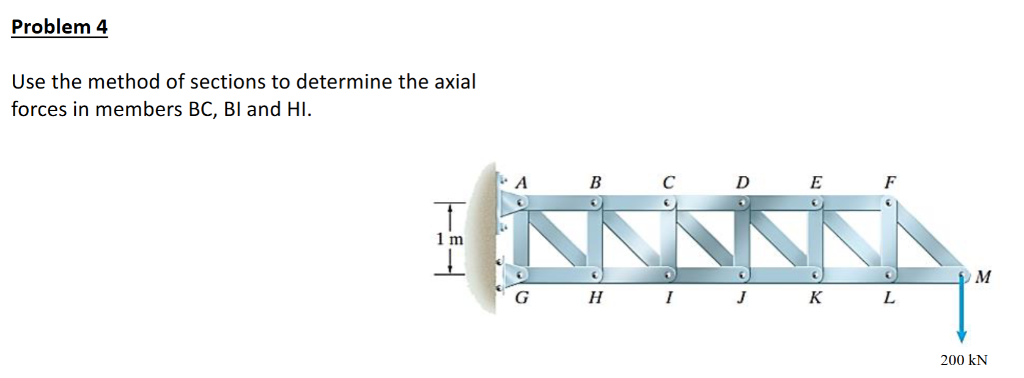 Problem 4
Use the method of sections to determine the axial
forces in members BC, Bl and HI.
A B [+ D E 4
1 ’ i
1m
Ie =
G H 1 J K L
200 kN
This is AI generated Response.
Asked by: Alok Kumar
Created at: 2026-01-25 03:14:16
Asked by: Alok Kumar
Created at: 2026-01-25 03:14:16
Final Answer:
Rendered
Raw Text
Did you like this answer?
Absolutely! Let’s walk step by step through how to solve this problem using the **method of sections** for the truss shown.
---
## **Step 1: Identify the Section**
You are asked for the **axial forces** in members **BC, BI, and HI**.
Let’s make an imaginary “cut” through the truss that passes through these three members, isolating the right side (or left side) of the truss. This will allow us to analyze the forces in those members directly.
---
## **Step 2: Calculate Support Reactions**
Before making the cut, let's find the reaction forces at the support (point A, which appears to be a pinned support).
### **Sum of Forces in the Vertical Direction (\(\sum F_y = \)):**
There’s a **200 kN downward force at M**.
Let’s call the vertical reaction at A as \( A_y \). Assume pin at A takes all vertical load (no vertical at G since it’s a roller).
\[
A_y + G_y = 200\, \text{kN}
\]
But G is a roller and can only take vertical reaction, so \( G_y \) exists too. Let's clarify by taking moments.
### **Sum of Moments About A (\(\sum M_A = \)):**
- Distance from A to M: There are 5 sections, each 2 m (since height is 1 m and shape is square, so span = 2 m per section), so total horizontal length \(= 5 \times 2 = 10 \) m.
- The vertical force at M produces a **clockwise moment** about A.
\[
\sum M_A = \implies G_y \times 10 - 200 \times 10 =
\]
\[
G_y = 200\, \text{kN}
\]
Now, substitute into vertical equilibrium:
\[
A_y + 200 = 200 \implies A_y =
\]
So, **reactions:**
- \( A_y = \)
- \( G_y = 200\, \text{kN} \)
---
## **Step 3: Make the Section Cut**
Cut through members **BC, BI, and HI**. Consider the **right section** (points B, C, H, I, ... to M).
---
## **Step 4: Draw Free-Body Diagram (FBD) of the Right Section**
Isolate the right section (from the cut to the end at M). You’ll expose the internal forces in **BC, BI, HI**.
Label:
- Force in BC: \( F_{BC} \)
- Force in BI: \( F_{BI} \)
- Force in HI: \( F_{HI} \)
---
## **Step 5: Write Equilibrium Equations**
You can use the equations of equilibrium for the right section:
### **1. Sum of Moments about H (\(\sum M_H = \)):**
This eliminates \( F_{HI} \) and \( F_{BI} \) (they pass through H), allowing us to solve for \( F_{BC} \).
- **Distances:** Each panel is 2 m wide.
- The forces in cut members have known locations.
#### **Take moments about H:**
- The force at M (200 kN) creates a moment about H.
- \( F_{BC} \) creates a moment (its line of action is 2 m above H).
- \( F_{BI} \) and \( F_{HI} \) pass through H, so their moment arms are zero.
\[
\sum M_H =
\]
\[
-200\,\text{kN} \times (8~\text{m}) + F_{BC} \times (1~\text{m}) =
\]
\[
F_{BC} = 200~\text{kN} \times 8 = 160~\text{kN}
\]
---
### **2. Sum of Forces in the Horizontal Direction (\(\sum F_x = \)):**
\[
F_{HI} + F_{BC} \cos \theta =
\]
But \( BC \) is vertical, so \( \cos\theta = \). Let's check geometry:
- From B to C is horizontal: so \( BC \) is horizontal, not vertical.
- If square panels, horizontal member: so \( BC \) is **horizontal**.
So, \( F_{BC} \) acts horizontally at B.
Similarly, \( F_{HI} \) acts horizontally at H.
Sum forces:
\[
F_{HI} + F_{BC} = \implies F_{HI} = -F_{BC} = -160~\text{kN}
\]
---
### **3. Sum of Forces in the Vertical Direction (\(\sum F_y = \)):**
At the cut, the only vertical member is \( F_{BI} \).
\[
F_{BI} - 200 = \implies F_{BI} = 200~\text{kN}
\]
---
## **Step 6: Box the Final Answers**
- **Force in BC:** \( F_{BC} = 160~\text{kN} \) (**tension**)
- **Force in HI:** \( F_{HI} = -160~\text{kN} \) (**compression**)
- **Force in BI:** \( F_{BI} = 200~\text{kN} \) (**tension**)
---
## **Summary Table**
| Member | Axial Force (kN) | Nature |
|---------|------------------|-------------|
| BC | 160 | Tension |
| HI | -160 | Compression |
| BI | 200 | Tension |
---
### **Let me know if you want a visual FBD or further clarification on any step!**
📢 Instructions:
- Ask anything relatd to above question only.
- For new Question goto :