Act like a helpful tutor and exlain me :Problem 2: As an engineer, you choose a location to install a new wind turbine where] the wind
velocity ranges from 16 ft/s to 24 ft/s. You design the turbine to have a blade length of 90 ft.
After doing some calculations, you find that the estimated mechanical efficiency of the turbine
(i.e. rotor efficiency) is 30 percent at 16 ft/s and 32 percent at 24 ft/s. Data collected from this
location shows that the wind is moving at 16 ft/s for 3000 hours each year, and at 24 ft/s for 4000
hours each year. Assume the combined efficiency of the gearbox and generator is 93 percent.
How much electricity can be created each year (in kWh) by this turbine? Assume the air density
to be 0.075 lbnv/ft3 .
Note that: 1 kW = 23730 lbm t2/s3
Question:
Act like a helpful tutor and exlain me :Problem 2: As an engineer, you choose a location to install a new wind turbine where] the wind
velocity ranges from 16 ft/s to 24 ft/s. You design the turbine to have a blade length of 90 ft.
After doing some calculations, you find that the estimated mechanical efficiency of the turbine
(i.e. rotor efficiency) is 30 percent at 16 ft/s and 32 percent at 24 ft/s. Data collected from this
location shows that the wind is moving at 16 ft/s for 3000 hours each year, and at 24 ft/s for 4000
hours each year. Assume the combined efficiency of the gearbox and generator is 93 percent.
How much electricity can be created each year (in kWh) by this turbine? Assume the air density
to be 0.075 lbnv/ft3 .
Note that: 1 kW = 23730 lbm t2/s3
This is AI generated Response.
Asked by: manish kumar
Created at: 2025-09-11 22:12:48
VIPSolutions focuses on clear, step‑by‑step explanations so you can learn quickly. Whether you need an AI‑generated walkthrough or a short hint to get unstuck, each solution is organized for fast reading and easy review later.
Search similar questions, compare approaches, and bookmark the best answers for revision. Our goal is simple: quick, reliable study help that feels natural—not noisy.
 VIPSolutions
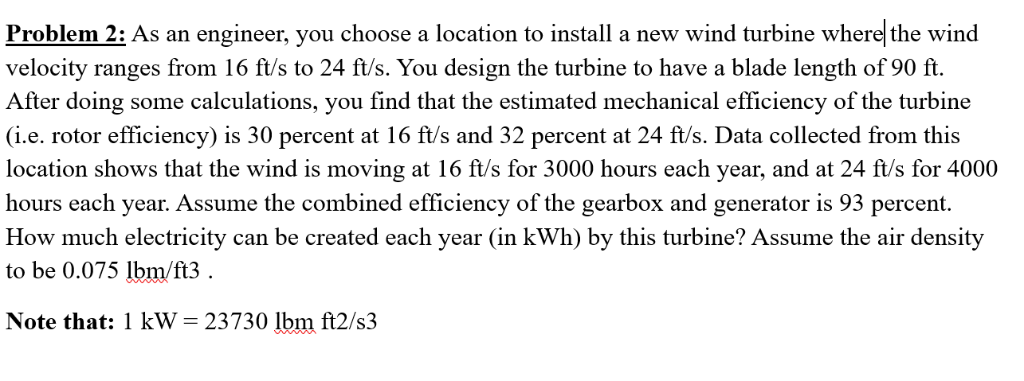 Problem 2: As an engineer, you choose a location to install a new wind turbine where] the wind
velocity ranges from 16 ft/s to 24 ft/s. You design the turbine to have a blade length of 90 ft.
After doing some calculations, you find that the estimated mechanical efficiency of the turbine
(i.e. rotor efficiency) is 30 percent at 16 ft/s and 32 percent at 24 ft/s. Data collected from this
location shows that the wind is moving at 16 ft/s for 3000 hours each year, and at 24 ft/s for 4000
hours each year. Assume the combined efficiency of the gearbox and generator is 93 percent.
How much electricity can be created each year (in kWh) by this turbine? Assume the air density
to be 0.075 lbnv/ft3 .
Note that: 1 kW = 23730 lbm t2/s3