This is AI generated Response.
Asked by: manish kumar
Created at: 2025-09-14 08:29:54
Final Answer:
RenderedRaw Text
Did you like this answer?
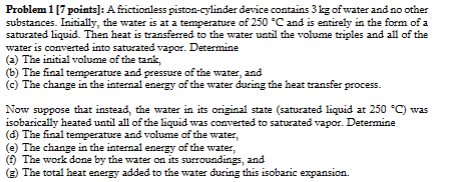
Absolutely! Let’s break down the **thermodynamics problem** step by step. You’re dealing with a piston-cylinder device containing water, and you’re asked about changes when heating it in two different ways.
---
# **Step-by-Step Explanation**
## **Given Data**
- Mass of water, \( m = 3\, \text{kg} \)
- Initial state: **Saturated liquid** at \( T_1 = 250^\circ \text{C} \)
- **Device is frictionless** (no energy loss)
- **No other substances** (pure water)
- **Piston-cylinder**: Pressure inside = Pressure outside (constant pressure for isobaric process)
---
## **Part 1: Volume Triples, Entirely Becomes Vapor**
### **(a) Initial Volume of the Tank**
- **Saturated liquid at 250°C:**
Use steam tables to find the **specific volume** of saturated liquid at \( 250^\circ \text{C} \) (\( v_f \)):
- \( v_{f,250^\circ C} \approx 0.001252\, \text{m}^3/\text{kg} \) (from steam tables)
- **Total initial volume:**
\[
V_1 = m \times v_f = 3\, \text{kg} \times 0.001252\, \text{m}^3/\text{kg} = 0.003756\, \text{m}^3
\]
---
### **(b) Final Temperature and Pressure**
- **Volume triples:** \( V_2 = 3 V_1 \)
- **All water is now saturated vapor:**
At final state: \( x_2 = 1 \) (saturated vapor quality)
- **At final state:**
\( V_2 = m \times v_g \) (where \( v_g \) is specific volume of saturated vapor at final T/P)
Set up:
\[
V_2 = 3 V_1 = m \times v_g^\prime
\]
\[
v_g^\prime = \frac{V_2}{m} = \frac{3 V_1}{m} = 3 \times v_{f,250^\circ C}
\]
\[
v_g^\prime = 3 \times 0.001252 = 0.003756\, \text{m}^3/\text{kg}
\]
- **Now, find T/P where \( v_g \approx 0.003756 \) in steam tables.**
This is typically at a much lower pressure than at 250°C, so you’d interpolate to find the exact T and P where saturated vapor has this specific volume.
---
### **(c) Change in Internal Energy (\( \Delta U \))**
- **Initial:**
Internal energy of saturated liquid at 250°C: \( u_{f,250^\circ C} \) (from steam tables)
- **Final:**
Internal energy of saturated vapor at the final state: \( u_{g,final} \)
- **Change:**
\[
\Delta U = m \left[ u_{g,final} - u_{f,250^\circ C} \right]
\]
---
## **Part 2: Isobaric Heating (Constant Pressure)**
### **Now, the process is at constant pressure, starting with saturated liquid at 250°C (find \( P_{sat,250^\circ C} \)).**
### **(d) Final Temperature and Volume**
- **Final state:** All water is saturated vapor at the same pressure as the initial state.
- **Pressure:** \( P_{sat,250^\circ C} \) (from steam tables, about 3975 kPa)
- **Temperature:** Still 250°C (because at constant pressure, phase change occurs at constant temperature)
- **Final volume:**
\[
V_2 = m \times v_{g,250^\circ C}
\]
---
### **(e) Change in Internal Energy**
\[
\Delta U = m \left[ u_{g,250^\circ C} - u_{f,250^\circ C} \right]
\]
---
### **(f) Work Done by the Water**
- **At constant pressure:**
\[
W = P \Delta V = P \left( V_2 - V_1 \right)
\]
- \( P \) in Pa, \( V \) in \( \text{m}^3 \)
---
### **(g) Total Heat Added (\( Q \))**
- **From the first law:**
\[
Q = \Delta U + W
\]
---
## **Summary Table**
| Quantity | Formula/Approach | Where to Find Data |
|---------------|------------------------------------------|----------------------------|
| Specific volume (\( v \)) | Steam Tables at given T/P | Steam Tables |
| Internal energy (\( u \)) | Steam Tables at given T/P | Steam Tables |
| Volume (\( V \)) | \( V = m \times v \) | Calculation |
| Pressure (\( P \)) | \( P_{sat,250^\circ C} \) | Steam Tables |
| Temperature (\( T \)) | Given or from Steam Tables | Steam Tables |
| Work (\( W \)) | \( P (V_2 - V_1) \) | Calculation |
| Heat (\( Q \)) | \( Q = \Delta U + W \) | Calculation |
---
## **Next Steps**
1. **Get values** from steam tables for 250°C:
- \( v_{f,250^\circ C} \), \( v_{g,250^\circ C} \)
- \( u_{f,250^\circ C} \), \( u_{g,250^\circ C} \)
- \( P_{sat,250^\circ C} \)
2. **Plug into formulas above** to calculate each answer.
---
### **Need help with the actual steam table values or with plugging numbers in?**
Let me know, and I can walk you through the calculations with the numbers!
VIPSolutions focuses on clear, step‑by‑step explanations so you can learn quickly. Whether you need an AI‑generated walkthrough or a short hint to get unstuck, each solution is organized for fast reading and easy review later.
Search similar questions, compare approaches, and bookmark the best answers for revision. Our goal is simple: quick, reliable study help that feels natural—not noisy.
 VIPSolutions
 Problem 17 poiats]: A frictionless piston-cylinder device contains 3g of water 2d 50 other.
substances. Inktaly, the wate s 2 2 temperate of 250 °C 204 i easily i the form of 2
Saturated liquid. Then heat i ransforrad to te water val the vofomne iple aad all of the
rate is convened into sacated vapor. Determine
(2) The infial voloems of te task.
(5) The final temperate 20d pressoc of the water, 208
(©) The change inthe ncereal energy of the water doing the heat caasfer process.
Now suppose that instead, the water in #5 odiginal su (sarcated figuid at 250 °C) was
isobasically heated as al of the figuid was converted to sararated vapor. Detecsine
(8) The foal temperate 20 voforme of the water,
(2) The change inthe internal energy of the wats,
(9) The work doa by the wate oa # sucrovadiass, 208
(2) The total heat energy added to the water during this iscbasic expansion.