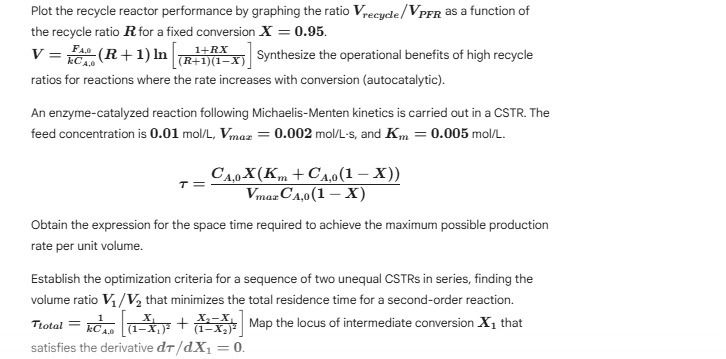
Act like a helpful tutor and exlain me :Plot the recycle reactor performance by graphing the ratio V, eeyete/ Vr as a function of
the recycle ratio Refor a fixed conversion X = 0.95.
_ Fa nx
V = 25 (R+ 1) In [23 55 | synthesize the operational benefis of high recycle
ratios for reactions where the rate increases with conversion (autocatalyti).
An enzyme-catalyzed reaction following Michaelis-Menten kinetics is carried out in a CSTR. The
feed concentration is 0.01 mol/L, Vinx = 0.002 mol/Ls, and Ky, = 0.005 mol/L.
+ CaoX (Ku + Cas =X)
VinaeCa0(1 — X)
Obtain the expression for the space time required to achieve the maximum possible production
rate per unit volume.
Establish the optimization criteria for a sequence of two unequal CSTRs in series, finding the
volume ratio V; / V4 that minimizes the total residence time for a second-order reaction.
Titer = gh [1S + 22585 | Mp the locus of inermediate conversion that
satisfies the derivative dr /dX; = 0.
Question:
Act like a helpful tutor and exlain me :Plot the recycle reactor performance by graphing the ratio V, eeyete/ Vr as a function of
the recycle ratio Refor a fixed conversion X = 0.95.
_ Fa nx
V = 25 (R+ 1) In [23 55 | synthesize the operational benefis of high recycle
ratios for reactions where the rate increases with conversion (autocatalyti).
An enzyme-catalyzed reaction following Michaelis-Menten kinetics is carried out in a CSTR. The
feed concentration is 0.01 mol/L, Vinx = 0.002 mol/Ls, and Ky, = 0.005 mol/L.
+ CaoX (Ku + Cas =X)
VinaeCa0(1 — X)
Obtain the expression for the space time required to achieve the maximum possible production
rate per unit volume.
Establish the optimization criteria for a sequence of two unequal CSTRs in series, finding the
volume ratio V; / V4 that minimizes the total residence time for a second-order reaction.
Titer = gh [1S + 22585 | Mp the locus of inermediate conversion that
satisfies the derivative dr /dX; = 0.
This is AI generated Response.
Asked by: francis
Created at: 2026-01-04 21:01:50
Final Answer:
RenderedRaw Text
Did you like this answer?
# Step-by-Step Explanation
Let's break down each part of your question and explain the concepts and calculations involved.
---
## 1. **Recycle Reactor Performance**
You are asked to **graph the ratio \( V_{\text{recycle}} / V_{\text{PFR}} \)** as a function of the recycle ratio \( R \) for a fixed conversion \( X = .95 \).
### **Key Equation:**
\[
V = \frac{F_{A}}{k C_{A}} (R+1) \ln \left[ \frac{1 + RX}{(R+1)(1-X)} \right]
\]
- \( V \): Reactor volume for recycle reactor
- \( F_{A} \): Inlet molar flow rate of A
- \( k \): Rate constant
- \( C_{A} \): Inlet concentration of A
- \( R \): Recycle ratio
- \( X \): Conversion
### **Operational Benefits of High Recycle Ratios (Autocatalytic Reactions):**
- **High recycle ratios** make the reactor behave more like a **Plug Flow Reactor (PFR)**, which is more efficient for *autocatalytic* reactions (where the rate increases with conversion).
- **Benefit:** Higher conversion per unit volume, better control of temperature and concentration profiles.
---
## 2. **Michaelis-Menten Kinetics in a CSTR**
Given:
- \( C_{A} = .01 \) mol/L (feed concentration)
- \( V_{\text{max}} = .002 \) mol/L·s (maximum rate)
- \( K_m = .005 \) mol/L (Michaelis constant)
### **Space Time (\(\tau\)) Expression:**
\[
\tau = \frac{C_{A} X \left(K_m + C_{A}(1-X)\right)}{V_{max} C_{A} (1-X)}
\]
**Interpretation:**
- \(\tau\) is the time required for the feed to achieve conversion \( X \) in a CSTR.
- Numerator: Product of feed concentration, conversion, and sum of kinetic constants.
- Denominator: Maximum rate times the concentration of unreacted A.
---
## 3. **Maximum Production Rate per Unit Volume**
To find the **maximum possible production rate per unit volume**, you maximize the rate (minimize \(\tau\)) with respect to \( X \).
- **Set** \( \frac{d\tau}{dX} = \) to find the optimal conversion \( X^* \).
---
## 4. **Optimization Criteria for Two Unequal CSTRs in Series**
For a second-order reaction, you are to find the volume ratio \( V_1/V_2 \) that **minimizes the total residence time**:
\[
\tau_{\text{total}} = \frac{1}{k C_{A}} \left[ \frac{X_1}{(1-X_1)^2} + \frac{X_2 - X_1}{(1-X_2)^2} \right]
\]
- \( X_1 \): Conversion after the first reactor
- \( X_2 \): Final conversion after the second reactor
### **Optimization Process:**
1. **Differentiate** \(\tau_{\text{total}}\) with respect to \( X_1 \).
2. **Set** \( \frac{d\tau}{dX_1} = \) and solve for \( X_1 \) to find the locus (optimal intermediate conversion).
3. This gives the best split of conversions (and volumes) between the two CSTRs to minimize total reactor volume for a given \( X_2 \).
---
## **Summary Table**
| Section | Key Equation | What to Do |
|---------|--------------|------------|
| Recycle Reactor | \( V = \ldots \) | Plot \( V_{\text{recycle}}/V_{\text{PFR}} \) vs. \( R \) |
| Michaelis-Menten CSTR | \( \tau = \ldots \) | Plug in values, analyze how \(\tau\) changes with \( X \) |
| Maximum Rate | Set \( \frac{d\tau}{dX} = \) | Solve for \( X^* \) |
| Two CSTRs in Series | \( \tau_{\text{total}} = \ldots \) | Optimize by setting \( \frac{d\tau}{dX_1} = \) |
---
## **If you need to see any of the calculations or want to plot these functions, let me know which part you'd like to work through step-by-step!**
VIPSolutions focuses on clear, step‑by‑step explanations so you can learn quickly. Whether you need an AI‑generated walkthrough or a short hint to get unstuck, each solution is organized for fast reading and easy review later.
Search similar questions, compare approaches, and bookmark the best answers for revision. Our goal is simple: quick, reliable study help that feels natural—not noisy.
 VIPSolutions
 Plot the recycle reactor performance by graphing the ratio V, eeyete/ Vr as a function of
the recycle ratio Refor a fixed conversion X = 0.95.
_ Fa nx
V = 25 (R+ 1) In [23 55 | synthesize the operational benefis of high recycle
ratios for reactions where the rate increases with conversion (autocatalyti).
An enzyme-catalyzed reaction following Michaelis-Menten kinetics is carried out in a CSTR. The
feed concentration is 0.01 mol/L, Vinx = 0.002 mol/Ls, and Ky, = 0.005 mol/L.
+ CaoX (Ku + Cas =X)
VinaeCa0(1 — X)
Obtain the expression for the space time required to achieve the maximum possible production
rate per unit volume.
Establish the optimization criteria for a sequence of two unequal CSTRs in series, finding the
volume ratio V; / V4 that minimizes the total residence time for a second-order reaction.
Titer = gh [1S + 22585 | Mp the locus of inermediate conversion that
satisfies the derivative dr /dX; = 0.