 VIPSolutions
Act like a helpful tutor and exlain me :Pb.44 At the instant shown, the frame is rotating about the y axis with an angular velocity @,=6rad/s and an angular acceleration @ =2rad/s2. At the same instant, the rotating rod FG has angular motion relative to the frame as shown. If the collar Cis moving along the rod toward F with a velocity of 0.5 m/s and an acceleration of 0.7 m/s2, both measured relative to rod FG, determine the velocity and acceleration of the collar at this instant. = SA \ “asm A Tee ES Fo obras Jeg por
Question:
Act like a helpful tutor and exlain me :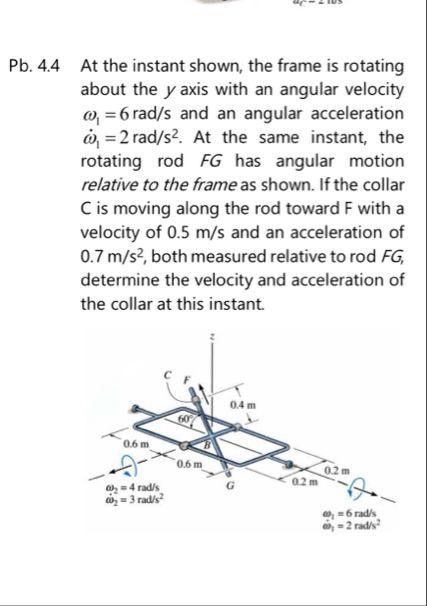 Pb.44 At the instant shown, the frame is rotating
about the y axis with an angular velocity
@,=6rad/s and an angular acceleration
@ =2rad/s2. At the same instant, the
rotating rod FG has angular motion
relative to the frame as shown. If the collar
Cis moving along the rod toward F with a
velocity of 0.5 m/s and an acceleration of
0.7 m/s2, both measured relative to rod FG,
determine the velocity and acceleration of
the collar at this instant.
=
SA
\
“asm
A Tee ES
Fo
obras
Jeg por
This is AI generated Response.
Asked by: Jack
Created at: 2025-10-17 10:06:57
Asked by: Jack
Created at: 2025-10-17 10:06:57
Final Answer:
Rendered
Raw Text
Did you like this answer?
Absolutely! Let's break down **Pb. 4.4** step by step.
---
## **Given Data**
- Frame is rotating about the **y-axis**:
- Angular velocity: \(\omega_1 = 6\, \text{rad/s}\)
- Angular acceleration: \(\dot{\omega}_1 = 2\, \text{rad/s}^2\)
- Rod **FG** is rotating (relative to the frame) about the **x-axis**:
- \(\omega_2 = 4\, \text{rad/s}\)
- \(\dot{\omega}_2 = 3\, \text{rad/s}^2\)
- Collar **C** moves along rod **FG** toward **F**:
- Relative velocity: \(v_{C/F} = .5\, \text{m/s}\)
- Relative acceleration: \(a_{C/F} = .7\, \text{m/s}^2\)
- Distance of C from O (origin): \(.4\, \text{m}\)
- Distance CF: \(.2\, \text{m}\)
---
## **Step 1: Define Reference Frames**
- **Frame **: Inertial frame (ground)
- **Frame 1**: Rotating frame (rotates about y-axis)
- **Frame 2**: Rod FG (rotates about x-axis of Frame 1)
---
## **Step 2: Express Angular Velocities**
- \(\vec{\omega}_1 = 6\, \hat{j}\) (about y-axis)
- \(\vec{\omega}_2 = 4\, \hat{i}'\) (about x'-axis, which moves with frame 1)
**Total angular velocity (of FG relative to ground):**
\[
\vec{\omega}_{FG} = \vec{\omega}_1 + \vec{\omega}_2
\]
---
## **Step 3: Collar's Position Vector**
Let’s define the position of C relative to G (center of FG):
\[
\vec{r}_{C/G} = .2\, \hat{i}'
\]
But G is .2 m from O along the x'-axis, so
\[
\vec{r}_{G/O} = .2\, \hat{i}'
\]
\[
\vec{r}_{C/O} = .4\, \hat{i}'
\]
---
## **Step 4: Velocity of Collar (Absolute)**
The general velocity formula for a point C moving along a rotating rod FG:
\[
\vec{v}_C = \vec{v}_G + \vec{\omega}_{FG} \times \vec{r}_{C/G} + \left( \frac{d\vec{r}_{C/G}}{dt} \right)_{FG}
\]
- \(\vec{v}_G\): velocity of point G
- The last term: velocity of C w.r.t. FG (given as \(.5\, \text{m/s}\) toward F, i.e., along \(\hat{i}'\))
Let’s break it down:
### **A. Velocity of G (\(\vec{v}_G\))**
Since G is on the frame rotating about the y-axis:
\[
\vec{v}_G = \vec{\omega}_1 \times \vec{r}_{G/O} = (6\,\hat{j}) \times (.2\,\hat{i}') = 6 \cdot .2 \cdot (\hat{j} \times \hat{i}') = 1.2\,(-\hat{k}')
\]
So, \(\vec{v}_G = -1.2\,\hat{k}'\,\text{m/s}\)
### **B. \(\vec{\omega}_{FG} \times \vec{r}_{C/G}\)**
\[
\vec{\omega}_{FG} = 6\,\hat{j} + 4\,\hat{i}'
\]
\[
\vec{r}_{C/G} = .2\,\hat{i}'
\]
Only the \(6\,\hat{j}\) part will contribute:
\[
(6\,\hat{j}) \times (.2\,\hat{i}') = 1.2\,(-\hat{k}')
\]
(Again, \(\hat{j} \times \hat{i}' = -\hat{k}'\))
\[
(4\,\hat{i}') \times (.2\,\hat{i}') =
\]
So, this term is \(1.2\,(-\hat{k}')\)
### **C. Relative Velocity along FG**
\[
\left( \frac{d\vec{r}_{C/G}}{dt} \right)_{FG} = v_{C/F}\,\hat{i}' = .5\,\hat{i}'
\]
---
## **Step 5: Add Up the Velocity Terms**
\[
\vec{v}_C = (-1.2\,\hat{k}') + (-1.2\,\hat{k}') + (.5\,\hat{i}')
\]
\[
\vec{v}_C = .5\,\hat{i}' - 2.4\,\hat{k}' \quad \text{(units: m/s)}
\]
---
## **Step 6: Acceleration of Collar (Absolute)**
General formula:
\[
\vec{a}_C = \vec{a}_G + \dot{\vec{\omega}}_{FG} \times \vec{r}_{C/G} + \vec{\omega}_{FG} \times \left( \vec{\omega}_{FG} \times \vec{r}_{C/G} \right) + 2\vec{\omega}_{FG} \times \left( \frac{d\vec{r}_{C/G}}{dt} \right)_{FG} + \left( \frac{d^2\vec{r}_{C/G}}{dt^2} \right)_{FG}
\]
Let’s summarize the terms (using given values):
### **A. Acceleration of G (\(\vec{a}_G\))**
\[
\vec{a}_G = \dot{\vec{\omega}}_1 \times \vec{r}_{G/O} + \vec{\omega}_1 \times (\vec{\omega}_1 \times \vec{r}_{G/O})
\]
\[
\dot{\vec{\omega}}_1 = 2\,\hat{j}
\]
\[
(2\,\hat{j}) \times (.2\,\hat{i}') = .4\,(-\hat{k}')
\]
\[
\vec{\omega}_1 \times (\vec{\omega}_1 \times \vec{r}_{G/O}) = 6\,\hat{j} \times (6\,\hat{j} \times .2\,\hat{i}') = 6\,\hat{j} \times (-1.2\,\hat{k}') = 6 \times (-1.2) (\hat{j} \times \hat{k}') = -7.2\,\hat{i}'
\]
So:
\[
\vec{a}_G = -.4\,\hat{k}' - 7.2\,\hat{i}'
\]
---
### **B. \(\dot{\vec{\omega}}_{FG} \times \vec{r}_{C/G}\)**
\[
\dot{\vec{\omega}}_{FG} = \dot{\vec{\omega}}_1 + \dot{\vec{\omega}}_2 = 2\,\hat{j} + 3\,\hat{i}'
\]
\[
\vec{r}_{C/G} = .2\,\hat{i}'
\]
\[
(2\,\hat{j}) \times (.2\,\hat{i}') = .4\,(-\hat{k}')
\]
\[
(3\,\hat{i}') \times (.2\,\hat{i}') =
\]
So, \(-.4\,\hat{k}'\)
---
### **C. Centripetal Term: \(\vec{\omega}_{FG} \times (\vec{\omega}_{FG} \times \vec{r}_{C/G})\)**
First, find \(\vec{\omega}_{FG} \times \vec{r}_{C/G}\):
Already found above: \(6\,\hat{j} \times .2\,\hat{i}' = -1.2\,\hat{k}'\)
So,
\[
\vec{\omega}_{FG} \times (-1.2\,\hat{k}')
\]
Now,
\[
(6\,\hat{j}) \times (-1.2\,\hat{k}') = 6 \cdot -1.2\, (\hat{j} \times \hat{k}') = -7.2\,\hat{i}'
\]
\[
(4\,\hat{i}') \times (-1.2\,\hat{k}') = 4 \cdot -1.2\, (\hat{i}' \times \hat{k}') = -4.8\,(-\hat{j}) = 4.8\,\hat{j}
\]
So, total: \( -7.2\,\hat{i}' + 4.8\,\hat{j} \)
---
### **D. Coriolis Term: \(2\vec{\omega}_{FG} \times \left( \frac{d\vec{r}_{C/G}}{dt} \right)_{FG}\)**
\[
2 \times (6\,\hat{j} + 4\,\hat{i}') \times (.5\,\hat{i}')
\]
\[
6\,\hat{j} \times .5\,\hat{i}' = 3\,(-\hat{k}')
\]
\[
4\,\hat{i}' \times .5\,\hat{i}' =
\]
So, total: \(2 \times -3\,\hat{k}' = -6\,\hat{k}'\)
---
### **E. Relative Acceleration along FG**
\[
\left( \frac{d^2\vec{r}_{C/G}}{dt^2} \right)_{FG} = a_{C/F}\,\hat{i}' = .7\,\hat{i}'
\]
---
## **Step 7: Add All Acceleration Terms**
Sum all terms in \(\hat{i}'\), \(\hat{j}\), and \(\hat{k}'\):
- \(\hat{i}': -7.2 + (-7.2) + .7 = -13.7\)
- \(\hat{j}: 4.8\)
- \(\hat{k}': -.4 + (-.4) + (-6) = -6.8\)
So,
\[
\vec{a}_C = -13.7\,\hat{i}' + 4.8\,\hat{j} - 6.8\,\hat{k}' \quad \text{(units: m/s}^2\text{)}
\]
---
## **Summary**
### **Velocity of Collar C**:
\[
\boxed{\vec{v}_C = .5\,\hat{i}' - 2.4\,\hat{k}' \quad [\text{m/s}]}
\]
### **Acceleration of Collar C**:
\[
\boxed{\vec{a}_C = -13.7\,\hat{i}' + 4.8\,\hat{j} - 6.8\,\hat{k}' \quad [\text{m/s}^2]}
\]
---
### **Let Me Know if You Want Step-by-Step Vector Calculations or Coordinate Conversions!**
📢 Instructions:
- Ask anything relatd to above question only.
- For new Question goto :