 VIPSolutions
Act like a helpful tutor and exlain me :Part 1: Conceptual Understanding (10 points total, 5 points each) For this portion of the homework, please identify the following for each of the circuits. * Label all the extraordinary nodes with a dot and a unique name (e.g., V1). Also label a ground node. * Label all the meshes with a clockwise arrow and give each mesh a unique name (e.g., 11) * Highlight in unique colors the paths within the circuit that have the exact same current. Example of Good Answer: Circuits for you to label (redraw as needed): sa 0 hy - Vij + - S n
Question:
Act like a helpful tutor and exlain me :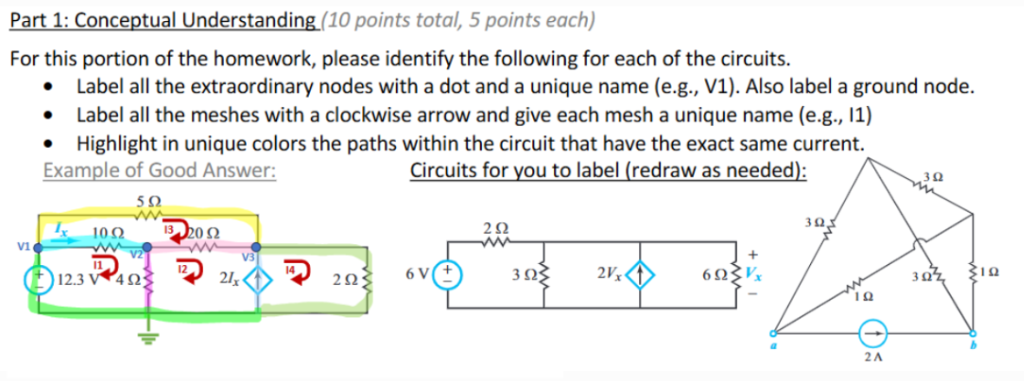 Part 1: Conceptual Understanding (10 points total, 5 points each)
For this portion of the homework, please identify the following for each of the circuits.
* Label all the extraordinary nodes with a dot and a unique name (e.g., V1). Also label a ground node.
* Label all the meshes with a clockwise arrow and give each mesh a unique name (e.g., 11)
* Highlight in unique colors the paths within the circuit that have the exact same current.
Example of Good Answer: Circuits for you to label (redraw as needed): sa
0
hy - Vij +
- S
n
This is AI generated Response.
Asked by: Alok Kumar
Created at: 2026-01-31 08:37:49
Asked by: Alok Kumar
Created at: 2026-01-31 08:37:49
Final Answer:
Rendered
Raw Text
Did you like this answer?
# How to Label Circuits for Conceptual Understanding
Let's break down the instructions and what is shown in the example:
---
## 1. **Label Extraordinary Nodes**
- **Extraordinary nodes** are points where three or more components connect.
- **How to Label:**
- Use a **dot** at these nodes.
- Assign a unique name (e.g., V1, V2, V3).
- Also, **label the ground node** (often with a ground symbol).
---
## 2. **Label Meshes with Arrows**
- **Meshes** are loops that do not contain any other loops inside them.
- **How to Label:**
- Draw a **clockwise arrow** around each mesh.
- Assign a unique name to each mesh current (e.g., I1, I2, I3).
- This helps when writing mesh (loop) equations.
---
## 3. **Highlight Common Current Paths**
- **Paths with the same current** are segments where the same current flows through several elements in sequence.
- **How to Label:**
- Use a **unique color** for each distinct current path.
- Highlight all elements that are in series and share the same current.
---
## 4. **Example Explanation**
### Example Circuit (left side)
- **Nodes:**
- Blue dots labeled V1, V2, V3.
- Ground node at the bottom.
- **Meshes:**
- Four meshes, each with a clockwise arrow and labeled I1, I2, I3, I4.
- **Current Paths:**
- Yellow, green, and pink highlight the same current paths through certain resistors.
---
## 5. **Applying to Your Circuits**
### For Each Circuit:
1. **Draw dots** at nodes where three or more elements meet. Name them (e.g., V1, V2).
2. **Label the ground node**.
3. For each **mesh**, draw a clockwise arrow and name the mesh (e.g., I1, I2…).
4. Use **different colors** to highlight segments that have the same current.
---
## 6. **Tips for Drawing and Labeling**
- Use neat, clear dots for nodes.
- Arrows should be circular and show the assumed current flow direction.
- Mesh labels should be inside the loop.
- Colors should be easy to distinguish.
---
### **Summary Table**
| Step | What to Label | How to Indicate |
|---------|-------------------------------|-------------------------------------|
| 1 | Extraordinary Nodes | Dot + Name (V1, V2...) |
| 2 | Ground Node | Ground symbol or label |
| 3 | Meshes (loops) | Clockwise arrow + mesh current name |
| 4 | Common Current Paths | Highlight with unique color |
---
## **Visual Examples (from the image)**
- **Nodes**: Blue dots labeled V1, V2, V3.
- **Ground**: Symbol at the bottom.
- **Meshes**: Arrows labeled I1, I2, I3, I4.
- **Current Paths**: Colored highlights (yellow, green, pink).
---
If you follow these steps, your circuit diagrams will be clear and ready for analysis! Let me know if you want a step-by-step walk-through for one of the circuits.
📢 Instructions:
- Ask anything relatd to above question only.
- For new Question goto :