 VIPSolutions
Act like a helpful tutor and exlain me :P— pes = A Although we usually don't show lone pairs on skeletal structures, sometimes it's necessary, for example, to show how a reaction pairs in the structure below. i Note: you may need to redraw parts of the structure to show atoms and bonds within a group before you can add any missing lone + + far | © : I | I HN == HN == - ie SS FE bs | a ba *®
Question:
Act like a helpful tutor and exlain me :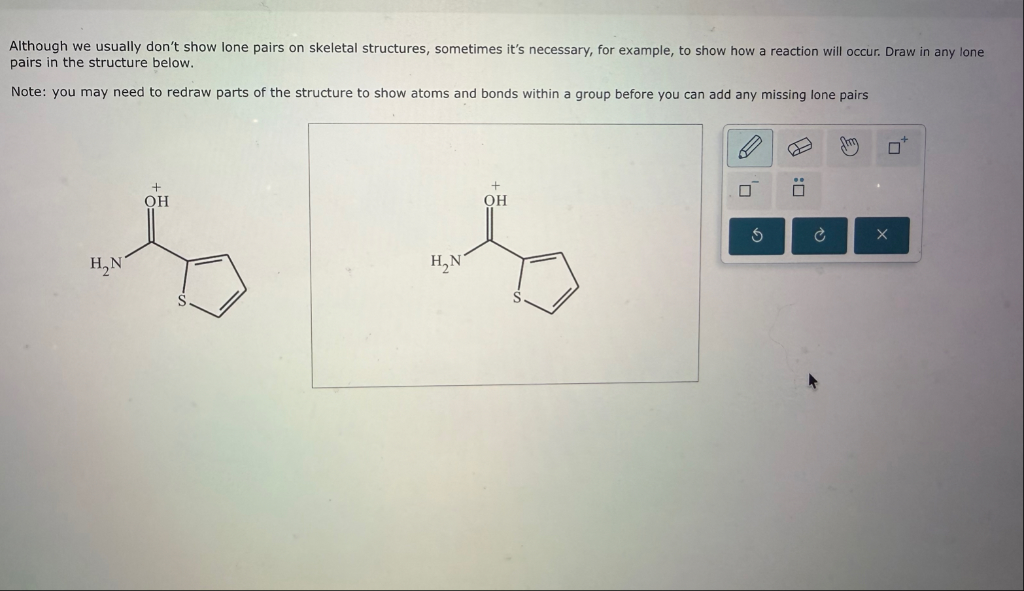 P— pes = A
Although we usually don't show lone pairs on skeletal structures, sometimes it's necessary, for example, to show how a reaction
pairs in the structure below. i
Note: you may need to redraw parts of the structure to show atoms and bonds within a group before you can add any missing lone
+ + far | © :
I | I
HN == HN == -
ie SS FE
bs | a
ba *®
This is AI generated Response.
Asked by: Alok Kumar
Created at: 2026-01-24 03:39:04
Asked by: Alok Kumar
Created at: 2026-01-24 03:39:04
Final Answer:
Rendered
Raw Text
Did you like this answer?
Absolutely! Let's break down **how to add lone pairs** to the given structure, step by step:
---
## **What You See**
- The structure is a **heterocyclic ring containing sulfur (S)** and an **NH₂ group** attached to a carbon, which is also bonded to an **OH group** (with a positive charge).
- The instruction is to **add any lone pairs** that are missing.
---
## **Step 1: Identify Atoms That Need Lone Pairs**
### **Which atoms commonly have lone pairs?**
- **Nitrogen (N)**
- **Oxygen (O)**
- **Sulfur (S)**
---
## **Step 2: Assign Lone Pairs**
### **1. Nitrogen (NH₂ group):**
- Nitrogen has **5 valence electrons**.
- In NH₂, it forms **two bonds with H** and **one bond with the carbon**.
- That means it uses 3 electrons for bonding (one for each bond), leaving **two electrons** (one lone pair) on N.
**Draw:**
- **One lone pair** on the nitrogen atom.
---
### **2. Oxygen (OH group):**
- Oxygen has **6 valence electrons**.
- In the OH group, O forms **one bond with H** and **one bond with C** (double bond, as shown).
- In the structure, O looks like it's forming **two bonds (double bond to C)** and **one bond to H**.
- Since O is shown with a positive charge, it likely has **only one lone pair** (since a neutral oxygen with two bonds has 2 lone pairs).
**Draw:**
- **One lone pair** on the oxygen.
---
### **3. Sulfur (in the ring):**
- Sulfur has **6 valence electrons**.
- In a 5-membered aromatic ring (like thiophene), S typically has **two lone pairs**.
**Draw:**
- **Two lone pairs** on the sulfur atom.
---
## **Step 3: Draw the Lone Pairs**
- **NH₂ nitrogen:** 1 lone pair
- **OH oxygen:** 1 lone pair (because it's positively charged)
- **Ring sulfur:** 2 lone pairs
---
## **Summary Table**
| Atom | Lone Pairs |
|--------|------------|
| N (NH₂) | 1 |
| O (OH⁺) | 1 |
| S (ring) | 2 |
---
## **Why Add Lone Pairs?**
- Lone pairs are important for **showing reactivity** and **understanding resonance** and **mechanisms**.
- For example, knowing where lone pairs are can help predict where a nucleophile might attack.
---
### **Visual Example** (not drawn here, but here's how you would show it):
- Draw dots (:) next to each atom to represent each lone pair as described above.
If you need a drawn example, let me know!
📢 Instructions:
- Ask anything relatd to above question only.
- For new Question goto :