 VIPSolutions
Act like a helpful tutor and exlain me :P.2.1 (100 points). ‘The rivet group shown in figure below connects two narrow lengths of plate one of which carries a 15 KN load positioned as shown. If the ultimate shear strength of a rivet is 350 N/mm? determine the ‘minimum allowable value of rivet diameter. Somm ow o é $1 4 ! 0 25mm| I hl i | 3 5 ry { s 5 é! ) | ¢ 25mm ! ] Jd ES Si ? 25mm | 25mm Note: Once the resultant shear forces in the rivets are determined, use the rivet shear failure criterion to calculate the rivet diameter.
Question:
Act like a helpful tutor and exlain me :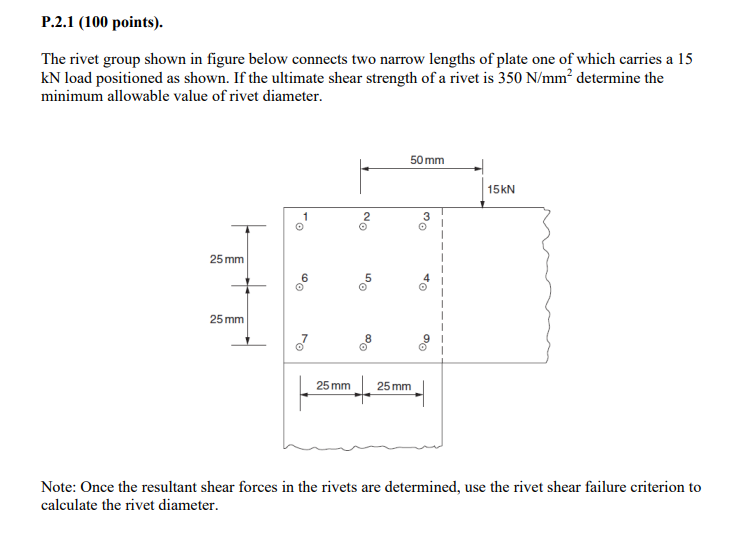 P.2.1 (100 points).
‘The rivet group shown in figure below connects two narrow lengths of plate one of which carries a 15
KN load positioned as shown. If the ultimate shear strength of a rivet is 350 N/mm? determine the
‘minimum allowable value of rivet diameter.
Somm
ow
o é $1 4
! 0
25mm| I hl
i |
3 5 ry {
s 5 é! )
| ¢
25mm ! ]
Jd ES Si ?
25mm | 25mm
Note: Once the resultant shear forces in the rivets are determined, use the rivet shear failure criterion to
calculate the rivet diameter.
This is AI generated Response.
Asked by: Alok Kumar
Created at: 2026-01-27 06:41:53
Asked by: Alok Kumar
Created at: 2026-01-27 06:41:53
Final Answer:
Rendered
Raw Text
Did you like this answer?
Absolutely, let’s break this down step by step!
---
# **Step-by-Step Solution**
## **Step 1: Understanding the Problem**
- **What’s given?**
- 9 rivets connect two plates.
- A 15 kN load is applied as shown.
- Ultimate shear strength of a rivet = **350 N/mm²**.
- Need to find the **minimum allowable rivet diameter**.
---
## **Step 2: Analyze the Rivet Group**
### **Load Distribution**
- The load is **eccentric** (not applied through the centroid of the rivet group).
- Each rivet is subjected to:
1. **Direct shear** (from the force itself).
2. **Secondary shear** (from the moment caused by the offset).
---
## **Step 3: Calculate Forces on Rivets**
### **A. Find the Centroid of the Rivet Group**
The rivets are in a \(3 \times 3\) square:
- Horizontal and vertical spacing = 25 mm.
Centroid is at the **center** of the square.
### **B. Direct Shear (Primary Shear)**
Total shear from load = 15 kN = **15,000 N**
- **Direct shear per rivet**:
\[
F_{direct} = \frac{15,000\ \text{N}}{9} = 1666.67\ \text{N}
\]
### **C. Secondary Shear Due to Moment**
The load is applied **50 mm** from the centroid:
- **Moment**: \( M = F \times d = 15,000 \times 50 = 750,000\ \text{N-mm} \)
#### **Polar Moment of Area (\( \sum r^2 \))**
Each rivet’s distance from centroid (\( r \)):
- The rivet group is symmetric, so calculate \( r \) for each rivet and sum \( r^2 \).
Let’s number the rivets as in the figure:
- The centroid is at (,). Each rivet's coordinates (relative to centroid):
- x = -25, , 25 mm
- y = -25, , 25 mm
So, for rivet at (x, y):
\[
r^2 = x^2 + y^2
\]
Sum for all 9 rivets:
| Rivet | x (mm) | y (mm) | \( r^2 \) (mm²) |
|-------|--------|--------|----------------|
| 1 | -25 | 25 | \( 125 \) |
| 2 | | 25 | \( 625 \) |
| 3 | 25 | 25 | \( 125 \) |
| 4 | 25 | | \( 625 \) |
| 5 | | | \( \) |
| 6 | -25 | | \( 625 \) |
| 7 | -25 | -25 | \( 125 \) |
| 8 | | -25 | \( 625 \) |
| 9 | 25 | -25 | \( 125 \) |
Sum: \( 4 \times 125 + 4 \times 625 + = 500 + 250 = 750\ \text{mm}^2 \)
---
#### **Shear per Rivet Due to Moment**
Shear on each rivet by moment is:
\[
F_{moment, i} = \frac{M \cdot r_i}{\sum r^2}
\]
For rivet farthest from centroid (\( r = \sqrt{125} = 35.36 \) mm):
\[
F_{moment, max} = \frac{750,000 \times 35.36}{750} = 3536\ \text{N}
\]
---
### **D. Resultant Force on Most Stressed Rivet**
The worst-case rivet will have direct + moment shear (vector sum):
\[
F_{resultant} = \sqrt{F_{direct}^2 + F_{moment, max}^2}
\]
\[
F_{resultant} = \sqrt{1666.67^2 + 3536^2} = \sqrt{2,777,778 + 12,504,896} \approx \sqrt{15,282,674} \approx 391\ \text{N}
\]
---
## **Step 4: Shear Strength of Rivet**
- **Ultimate shear strength**: \( 350\ \text{N/mm}^2 \)
- Shear area of rivet: \( A = \frac{\pi d^2}{4} \)
Set shear strength = resultant force:
\[
\text{Shear Strength} = 350 \times \frac{\pi d^2}{4}
\]
Set equal to force:
\[
350 \times \frac{\pi d^2}{4} = 391
\]
\[
\frac{\pi d^2}{4} = \frac{391}{350}
\]
\[
d^2 = \frac{391 \times 4}{350 \pi}
\]
\[
d^2 = \frac{15,640}{1099.56} = 14.22
\]
\[
d = \sqrt{14.22} \approx 3.77\ \text{mm}
\]
---
## **Step 5: Final Answer**
**Minimum allowable rivet diameter:**
\[
\boxed{3.8\ \text{mm}}
\]
(Round up to the nearest standard value, typically 4 mm.)
---
# **Summary Table**
| Quantity | Value |
|----------------------------|------------------|
| Direct shear per rivet | 1667 N |
| Moment shear (max rivet) | 3536 N |
| Resultant shear (max) | 391 N |
| Shear strength | 350 N/mm² |
| Minimum diameter | 3.8 mm |
---
## **Key Concepts Used**
- Eccentric loading on a group of fasteners
- Direct and moment-induced shear
- Resultant force calculation
- Shear area formula for a circle
Let me know if you want to see a diagram or have any step explained in more detail!
📢 Instructions:
- Ask anything relatd to above question only.
- For new Question goto :