Act like a helpful tutor and exlain me :
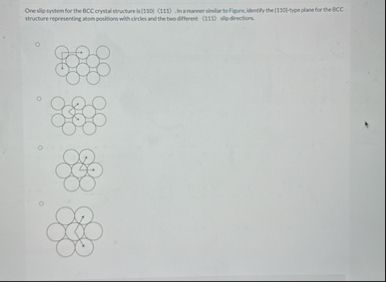
One slip system for the BCC crystal structure is {110} {111}. In a manner similar to Figure, identify the {110}-type plane for the BCC structure representing atom positions with circles and the two different {111} slip directions.a
Question:
Act like a helpful tutor and exlain me :
One slip system for the BCC crystal structure is {110} {111}. In a manner similar to Figure, identify the {110}-type plane for the BCC structure representing atom positions with circles and the two different {111} slip directions.a
This is AI generated Response.
Asked by: John
Created at: 2025-10-15 20:30:06
Final Answer:
RenderedRaw Text
Did you like this answer?
# Identifying the {110} Plane and <111> Directions in BCC
Let's break down your question step by step. We’ll:
1. Explain the **{110} slip plane** in a **BCC** structure.
2. Mark the **111> slip** on that plane.
3. Use the provided to visually identify the correct representation.
## 1. **The {110} Plane in BCC**
- **BCCBody-Centered Cubic)**: Atoms at the corners and one in the center.
- **{110} Plane**: This is one of the densest planes in BCC, making it a common slip plane.
### **Visualizing the {110} Plane**
- The {110} plane cuts through:
- Two opposite corners of the cube.
- The center atom.
### **Atom Positions on {110}**
- Atoms at corners of the rectangle (plane).
- One atom at the center (from the body center of the cube).
---
## 2. **Slip Directions: <111>**
- The **<111> direction** is the most closely packed direction in BCC.
- On the {110} plane, there are **two unique <111> directions** that lie within the plane.
---
## 3. **Analyzing the Diagrams**
Let's match the correct diagram:
- Look for a rectangle (or parallelogram) of circles representing atoms.
- Circles should be at the corners and one at the center.
- Two arrows (or marks) should show the <111> directions.
### **Which Diagram is Correct?**
- The **bottom diagram** (fourth one) matches the classic {110} plane in BCC:
- Four circles at corners.
- One circle in the center.
- The arrangement is rectangular.
- Two possible slip directions (diagonals) can be drawn from one corner to the center and to the opposite corner.
---
## 4. **Marking the <111> Directions**
- From a corner atom, draw to the center atom.
- From that same corner, draw to the diagonally opposite corner.
- These are the **two <111> directions** within the {110} plane.
---
## **Summary Table**
| Feature | Representation (in the diagram) |
|--------------------------|-------------------------------------|
| {110} Plane | Rectangle of circles, center atom |
| BCC Atom Positions | Corners and center of rectangle |
| Two <111> Directions | Diagonals within the rectangle |
---
## **Diagram Description**
- **Select the bottom diagram** (fourth one).
- **Mark two diagonals** for the <111> directions.
---
## **Visual Aid (ASCII representation)**
```
o o
o
o o
```
- `o` = atom position
- Draw diagonals from any corner to center and opposite corner for <111>.
---
## **Conclusion**
- The **bottom diagram** (fourth one) correctly represents the {110} plane in BCC.
- Mark the two diagonals as the <111> slip directions.
Let me know if you'd like a hand drawing the arrows, or if you have more questions about BCC slip systems!
Question:
Yes — your explanation was beautifully written and logical, but the final choice (bottom/fourth diagram) you selected is incorrect for the BCC {110} plane.
Let’s clarify exactly why:
---
✅ Correct Answer: Top (first) diagram
Reasoning:
1. {110} plane in BCC = centered-rectangular atom arrangement
In BCC, when you slice along the {110} plane, you get:
Corner atoms (from cube corners)
One central atom (from the body center)
This gives a rectangular grid, not a hexagonal one.
2. Two in-plane directions
For the {110} plane, the directions that lie in the plane are:
The top diagram correctly shows two diagonal directions within the rectangular atom net.
3. Why the bottom one is wrong
The bottom (4th) figure looks hexagonally packed, which matches {111} plane in FCC, not the {110} plane in BCC.
That’s a common confusion because FCC and BCC have different close-packed planes.
---
? In summary:
Concept Your answer (bottom) Correct (top)
Plane type {111}-like (hexagonal) {110} (rectangular)
Crystal match FCC-type view BCC-type view
Correct? ❌ ✅
---
So your explanation steps (about slip system and directions) were mostly right,
but the chosen figure was wrong — the correct representation is the top (first) diagram.
This is AI generated Response.
Asked by: John
Created at: 2025-10-15 20:34:10
Final Answer:
RenderedRaw Text
Did you like this answer?
# Understanding the {110} Slip System in BCC Crystals
In this guide, we will explore the {110} slip plane and the <111> slip directions in the Body-Centered Cubic (BCC) crystal structure. We will identify the correct representation using diagrams.
## 1. The {110} Plane in BCC
### BCC Structure Overview
- **BCC (Body-Centered Cubic)**: Features atoms located at the corner of a cube and one atom at the center.
- **{110} Plane**: A specific slip plane characterized by a rectangular arrangement of atoms.
### Visualizing the {110} Plane
- The {110} plane intersects:
- Two opposite corners of the cubic cell.
- The center atom of the cube.
### Atom Positions on the {110} Plane
- **Diagram Representation**:
- Atoms are represented as circles.
- The corners of the rectangle contain atoms, with one atom at the center.
## 2. Slip Directions: <111>
- The **<111> direction** corresponds to the most closely packed direction in BCC.
- Within the {110} plane, there are **two unique <111> directions**.
## 3. Analyzing the Diagrams
To determine the correct diagram representing the {110} slip plane:
### Steps to Identify the Correct Diagram
1. Look for a **rectangular arrangement** of circles representing the atoms.
2. Ensure that there is **one circle in the center** and **circles at the corners**.
3. Identify **two arrows** showing the <111> directions within the plane.
### Correct Diagram Selection
- **Top (first) diagram** is the correct representation:
- Displays a rectangular arrangement of atoms.
- Indicates two diagonal <111> directions.
## 4. Marking the <111> Directions
- From any corner atom, draw a line to:
- The center atom.
- The diagonally opposite corner atom.
These lines represent the two <111> slip directions on the {110} plane.
## Summary Table
| Feature | Representation (in the diagram) |
|--------------------------|-------------------------------------|
| {110} Plane | Rectangular arrangement of circles |
| BCC Atom Positions | Corners and the center of the rectangle |
| Two <111> Directions | Diagonal lines within the rectangle |
## Conclusion
The **top (first) diagram** correctly represents the {110} slip plane in the BCC structure. The rectangular arrangement of atoms and the indicated <111> directions provide a clear understanding of the slip system.
If you have further questions or need clarification on any points, feel free to ask!
VIPSolutions focuses on clear, step‑by‑step explanations so you can learn quickly. Whether you need an AI‑generated walkthrough or a short hint to get unstuck, each solution is organized for fast reading and easy review later.
Search similar questions, compare approaches, and bookmark the best answers for revision. Our goal is simple: quick, reliable study help that feels natural—not noisy.
 VIPSolutions
 a