 VIPSolutions
Act like a helpful tutor and exlain me :Let xg, xy, +++ , X, be n distinct points on the real line. Let yg. yy, +++, , be n associated values (measurements). Show that the problem of finding the (interpolation) polynomial of degree < n such that p,(x;) = ;, I = 0, 1, ---, n can be reduced to a linear algebra problem of the form WA = Y, where W is a (n + 1)? matrix, A is the vector of the polynomial coefficients and Y = (Jo. 1. ++» Yu)" - Wis known as the Vandemonde matrix. a) Find the matrix W. b) Without any calculation (algebra), and using only results seen in class, show that the matrix W is nonsingular.
Question:
Act like a helpful tutor and exlain me :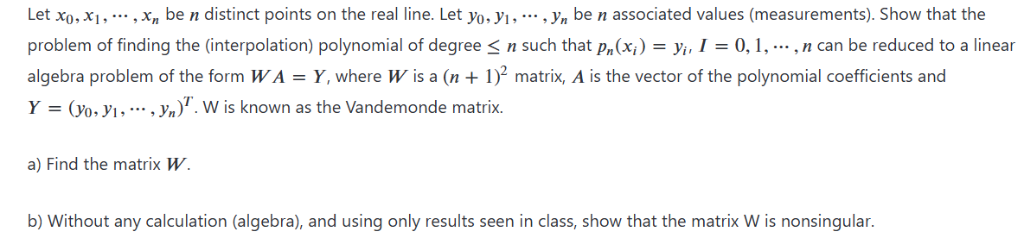 Let xg, xy, +++ , X, be n distinct points on the real line. Let yg. yy, +++, , be n associated values (measurements). Show that the
problem of finding the (interpolation) polynomial of degree < n such that p,(x;) = ;, I = 0, 1, ---, n can be reduced to a linear
algebra problem of the form WA = Y, where W is a (n + 1)? matrix, A is the vector of the polynomial coefficients and
Y = (Jo. 1. ++» Yu)" - Wis known as the Vandemonde matrix.
a) Find the matrix W.
b) Without any calculation (algebra), and using only results seen in class, show that the matrix W is nonsingular.
This is AI generated Response.
Asked by: Alok Kumar
Created at: 2026-01-26 03:28:45
Asked by: Alok Kumar
Created at: 2026-01-26 03:28:45
Final Answer:
Rendered
Raw Text
Did you like this answer?
Let's break down problem step by step:
---
## Restatement
Given distinct points \( x_, x_1, \ldots, x_n \) and corresponding values \( y_, y_1, \ldots, y_n \), we want to find the unique polynomial \( p_n(x) \) of degree \( \leq n \) such that \( p_n(x_i) = y_i \) for all \( i = , 1, \ldots, n \).
We are told this can be written as the matrix equation \( W A = Y \), where \( W \) is the Vandermonde matrix.
---
## a) **Find the Matrix \( W \)**
The polynomial of degree \( \leq n \) can be written as:
\[
p_n(x) = a_ + a_1 x + a_2 x^2 + \ldots + a_n x^n
\]
where \( a_, a_1, \ldots, a_n \) are the coefficients.
For each \( x_i \), we have:
\[
p_n(x_i) = a_ + a_1 x_i + a_2 x_i^2 + \ldots + a_n x_i^n = y_i
\]
Writing this for all \( i = , 1, \ldots, n \) yields the system:
\[
\begin{bmatrix}
1 & x_ & x_^2 & \cdots & x_^n \\
1 & x_1 & x_1^2 & \cdots & x_1^n \\
\vdots & \vdots & \vdots & & \vdots \\
1 & x_n & x_n^2 & \cdots & x_n^n \\
\end{bmatrix}
\begin{bmatrix}
a_ \\
a_1 \\
\vdots \\
a_n
\end{bmatrix}
=
\begin{bmatrix}
y_ \\
y_1 \\
\vdots \\
y_n
\end{bmatrix}
\]
The matrix on the left is the **Vandermonde matrix \( W \)**.
### **Explicitly:**
\[
\boxed{
W = \begin{bmatrix}
1 & x_ & x_^2 & \cdots & x_^n \\
1 & x_1 & x_1^2 & \cdots & x_1^n \\
\vdots & \vdots & \vdots & & \vdots \\
1 & x_n & x_n^2 & \cdots & x_n^n \\
\end{bmatrix}
}
\]
---
## b) **Why is the Vandermonde matrix \( W \) nonsingular?**
**Key Fact:**
A square Vandermonde matrix \( W \) is nonsingular (invertible) **if and only if all the \( x_i \) are distinct**.
**Reason:**
- The determinant of a Vandermonde matrix is:
\[
\det(W) = \prod_{ \leq i < j \leq n} (x_j - x_i)
\]
- If all \( x_i \) are distinct, every term \( (x_j - x_i) \neq \), so the product is nonzero.
- Thus, **\( W \) is invertible** (nonsingular).
**No algebra needed**—just knowing the determinant formula and the distinctness of the \( x_i \)'s!
---
### **Summary**
- **a)** The Vandermonde matrix \( W \) is as described above.
- **b)** \( W \) is nonsingular because the \( x_i \) are distinct, and thus the determinant is nonzero.
Let me know if you want to see a worked example!
📢 Instructions:
- Ask anything relatd to above question only.
- For new Question goto :