 VIPSolutions
Act like a helpful tutor and exlain me :JFor each of the molecules below, highlight each of the positions on the benzene ring that you expect will be most reactive towards electrophilic aromatic ubstitution. | | or NH, | : 0
Question:
Act like a helpful tutor and exlain me :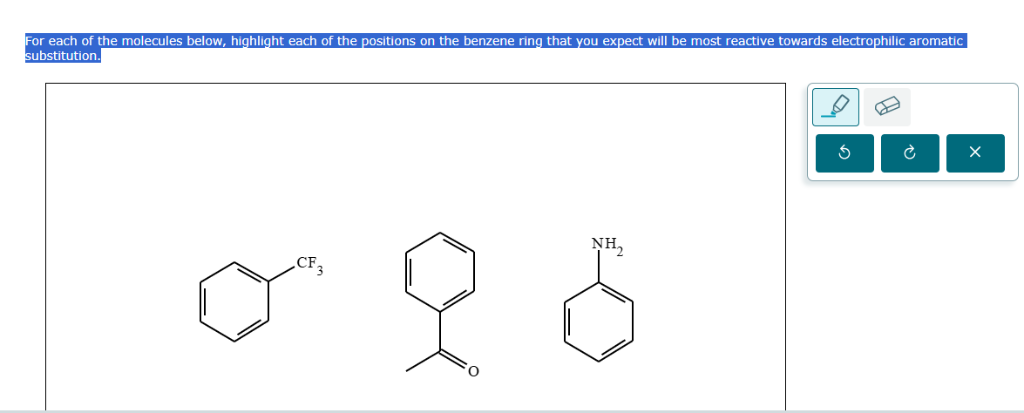 JFor each of the molecules below, highlight each of the positions on the benzene ring that you expect will be most reactive towards electrophilic aromatic
ubstitution.
| |
or NH,
| :
0
This is AI generated Response.
Asked by: Alok Kumar
Created at: 2026-02-02 05:43:57
Asked by: Alok Kumar
Created at: 2026-02-02 05:43:57
Final Answer:
Rendered
Raw Text
Did you like this answer?
Sure! Let's break down which positions on each benzene ring will be the most reactive toward **electrophilic aromatic substitution (EAS)**. The reactivity and preferred positions depend on the substituent already attached to the ring.
---
## 1. Benzene ring with **CF₃** group (trifluoromethylbenzene)
- **CF₃** is a **strong electron-withdrawing group** (due to the electronegative fluorines).
- It **deactivates** the ring and **directs new substituents to the meta position**.
- **Most reactive positions:** **meta** to CF₃.
---
## 2. Benzene ring with **COCH₃** group (acetophenone)
- **COCH₃** (acetyl group) is also an **electron-withdrawing group**.
- It **deactivates** the ring and **directs to the meta position** (like CF₃).
- **Most reactive positions:** **meta** to COCH₃.
---
## 3. Benzene ring with **NH₂** group (aniline)
- **NH₂** is a **strong electron-donating group**.
- It **activates** the ring and **directs to the ortho and para positions**.
- **Most reactive positions:** **ortho** and **para** to NH₂.
---
### **Summary Table**
| Molecule | Substituent | Activating/Deactivating | Directs to: | Most Reactive Positions |
|---------------------|-------------|------------------------|---------------------|-------------------------------|
| Benzene-CF₃ | CF₃ | Deactivating | Meta | 3, 5 (meta to CF₃) |
| Benzene-COCH₃ | COCH₃ | Deactivating | Meta | 3, 5 (meta to COCH₃) |
| Benzene-NH₂ | NH₂ | Activating | Ortho, Para | 2, 4, 6 (ortho, para to NH₂) |
---
## **Visual Explanation**
- For **CF₃** and **COCH₃**: Highlight the positions **meta** to the substituent.
- For **NH₂**: Highlight the **ortho** and **para** positions relative to NH₂.
---
### **How to Identify the Positions:**
- **Ortho** = positions **adjacent** to the substituent (1 away).
- **Meta** = positions **one carbon further** than ortho (2 away).
- **Para** = position **opposite** the substituent (3 away).
---
Let me know if you'd like a diagram with the specific positions marked!
📢 Instructions:
- Ask anything relatd to above question only.
- For new Question goto :