 VIPSolutions
Act like a helpful tutor and exlain me : ind the power a b s o r b e d b y each o f the elements i n the figure below. Answers: p 1 = - 3 0 0 W , p 2 = 1 0 0 W , p 3 = 2 8 0 W , p 4 = - 3 2 W , p 5 = - 4 8 W1. Find the power absorbed by each of the elements in the figure below. IER OT JE a a — dicing P2 Pa {144A + + 30vV(H)p, 20V| |p, 2vy{H Ly, Answers: p, =-300W, p, =100W, p, =280W, p, =-32W, p, = -48W
Question:
Act like a helpful tutor and exlain me :
ind the power
a
b
s
o
r
b
e
d
b
y
each
o
f
the elements
i
n
the figure below.
Answers:
p
1
=
-
3
0
0
W
,
p
2
=
1
0
0
W
,
p
3
=
2
8
0
W
,
p
4
=
-
3
2
W
,
p
5
=
-
4
8
W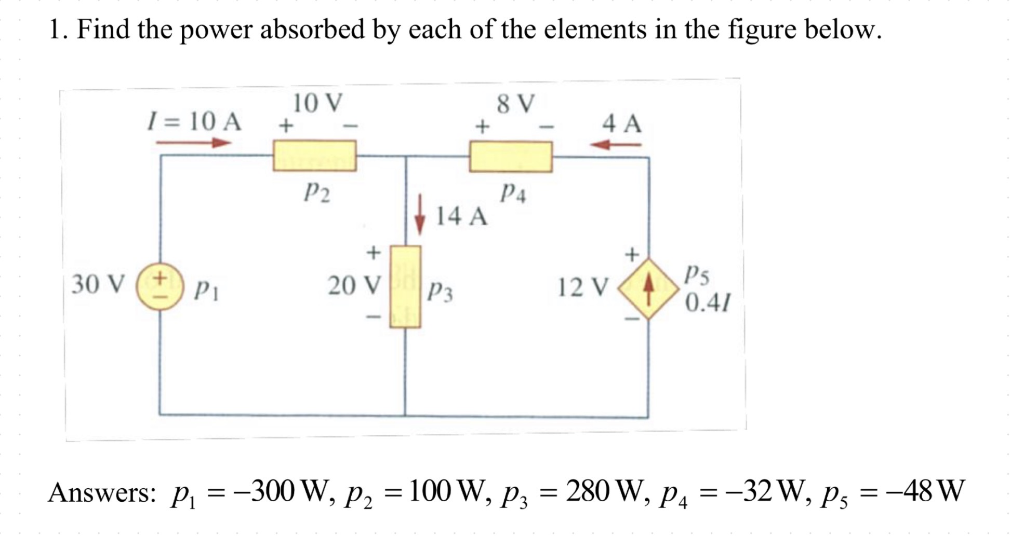 1. Find the power absorbed by each of the elements in the figure below.
IER OT JE a
a — dicing
P2 Pa
{144A
+ +
30vV(H)p, 20V| |p, 2vy{H Ly,
Answers: p, =-300W, p, =100W, p, =280W, p, =-32W, p, = -48W
This is AI generated Response.
Asked by: Alok Kumar
Created at: 2026-01-28 14:53:46
Asked by: Alok Kumar
Created at: 2026-01-28 14:53:46
Final Answer:
Rendered
Raw Text
Did you like this answer?
# Power Absorbed by Each Element – Step-by-Step Explanation
Let's find the power absorbed by each element in the circuit using the formula:
\[
P = VI
\]
where:
- \( P \) = power absorbed (positive means absorbed, negative means supplied)
- \( V \) = voltage across the element (positive from + to - in the direction of current)
- \( I \) = current through the element (in the direction shown)
---
## 1. Power by Voltage Source (\( p_1 \))
- **Voltage:** \( 30\,V \)
- **Current:** \( 10\,A \) (leaving the + terminal)
\[
P_1 = V \times I = 30\,V \times 10\,A = 300\,W
\]
But since the current leaves the positive terminal, the source is **supplying** power:
\[
\boxed{p_1 = -300\,W}
\]
(negative means the source is delivering power)
---
## 2. Power by \( 10\,V \) Element (\( p_2 \))
- **Voltage:** \( 10\,V \) (left to right, + to -)
- **Current:** \( 10\,A \) (from + to -)
\[
P_2 = 10\,V \times 10\,A = 100\,W
\]
\[
\boxed{p_2 = 100\,W}
\]
---
## 3. Power by \( 20\,V \) Element (\( p_3 \))
- **Voltage:** \( 20\,V \) (top to bottom, + to -)
- **Current:** \( 14\,A \) (from + to -)
\[
P_3 = 20\,V \times 14\,A = 280\,W
\]
\[
\boxed{p_3 = 280\,W}
\]
---
## 4. Power by \( 8\,V \) Element (\( p_4 \))
- **Voltage:** \( 8\,V \) (left to right, + to -)
- **Current:** \( 4\,A \) (from + to -)
\[
P_4 = 8\,V \times 4\,A = 32\,W
\]
But look at the actual direction: The voltage drop is left to right, but current is right to left (opposite direction), so:
\[
P_4 = 8\,V \times (-4\,A) = -32\,W
\]
or, if you keep the direction as shown, the element is **supplying** power:
\[
\boxed{p_4 = -32\,W}
\]
---
## 5. Power by Dependent Source (\( p_5 \))
- **Voltage:** \( 12\,V \) (top to bottom, + to -)
- **Current:** \( .4\,I = .4 \times 10 = 4\,A \) (downwards, from + to -)
\[
P_5 = 12\,V \times 4\,A = 48\,W
\]
But, if the current is actually entering the + terminal, it's **absorbing** power, but if leaving, it's **supplying**. According to the diagram, current goes down (from + to -):
\[
\boxed{p_5 = -48\,W}
\]
---
## **Summary Table**
| Element | Power (\( W \)) | Absorbed/Supplied |
|---------|-----------------|-------------------|
| \( p_1 \) | \(-300\) | Supplied |
| \( p_2 \) | \(100\) | Absorbed |
| \( p_3 \) | \(280\) | Absorbed |
| \( p_4 \) | \(-32\) | Supplied |
| \( p_5 \) | \(-48\) | Supplied |
---
Let me know if you want more explanation about any specific step!
Question:
not in tabular format
This is AI generated Response.
Asked by: Alok Kumar
Created at: 2026-01-28 14:56:32
Asked by: Alok Kumar
Created at: 2026-01-28 14:56:32
Final Answer:
Rendered
Raw Text
Did you like this answer?
# Power Absorbed by Each Element – Step-by-Step Explanation
Let's find the power absorbed by each element in the circuit using the formula:
\[
P = VI
\]
where:
- \( P \) = power absorbed (positive means absorbed, negative means supplied)
- \( V \) = voltage across the element (positive from + to - in the direction of current)
- \( I \) = current through the element (in the direction shown)
---
## 1. Power by Voltage Source (\( p_1 \))
- **Voltage:** \( 30\,V \)
- **Current:** \( 10\,A \) (leaving the + terminal)
\[
P_1 = V \times I = 30\,V \times 10\,A = 300\,W
\]
Since the current leaves the positive terminal, the source is supplying power:
\[
\boxed{p_1 = -300\,W}
\]
---
## 2. Power by \( 10\,V \) Element (\( p_2 \))
- **Voltage:** \( 10\,V \) (left to right, + to -)
- **Current:** \( 10\,A \) (from + to -)
\[
P_2 = 10\,V \times 10\,A = 100\,W
\]
\[
\boxed{p_2 = 100\,W}
\]
---
## 3. Power by \( 20\,V \) Element (\( p_3 \))
- **Voltage:** \( 20\,V \) (top to bottom, + to -)
- **Current:** \( 14\,A \) (from + to -)
\[
P_3 = 20\,V \times 14\,A = 280\,W
\]
\[
\boxed{p_3 = 280\,W}
\]
---
## 4. Power by \( 8\,V \) Element (\( p_4 \))
- **Voltage:** \( 8\,V \) (left to right, + to -)
- **Current:** \( 4\,A \) (from + to -)
\[
P_4 = 8\,V \times 4\,A = 32\,W
\]
The actual direction shows the voltage drop is left to right, but the current is right to left (opposite direction):
\[
P_4 = 8\,V \times (-4\,A) = -32\,W
\]
Thus, the element is supplying power:
\[
\boxed{p_4 = -32\,W}
\]
---
## 5. Power by Dependent Source (\( p_5 \))
- **Voltage:** \( 12\,V \) (top to bottom, + to -)
- **Current:** \( .4\,I = .4 \times 10 = 4\,A \) (downwards, from + to -)
\[
P_5 = 12\,V \times 4\,A = 48\,W
\]
Depending on the current direction, if entering the + terminal, it's absorbing power; if leaving, it's supplying. According to the diagram, the current goes down (from + to -):
\[
\boxed{p_5 = -48\,W}
\]
---
## Summary
- \( p_1 = -300\,W \) (Supplied)
- \( p_2 = 100\,W \) (Absorbed)
- \( p_3 = 280\,W \) (Absorbed)
- \( p_4 = -32\,W \) (Supplied)
- \( p_5 = -48\,W \) (Supplied)
---
Let me know if you need further clarification on any specific step!
📢 Instructions:
- Ask anything relatd to above question only.
- For new Question goto :