 VIPSolutions
Act like a helpful tutor and exlain me :In the Spring-Mass-Damper system, determine the free-response . (when f(t) = 0) with the initial conditions (0) = 0,x(0) =x, a Mr —x(1) HE 10) FEE
Question:
Act like a helpful tutor and exlain me :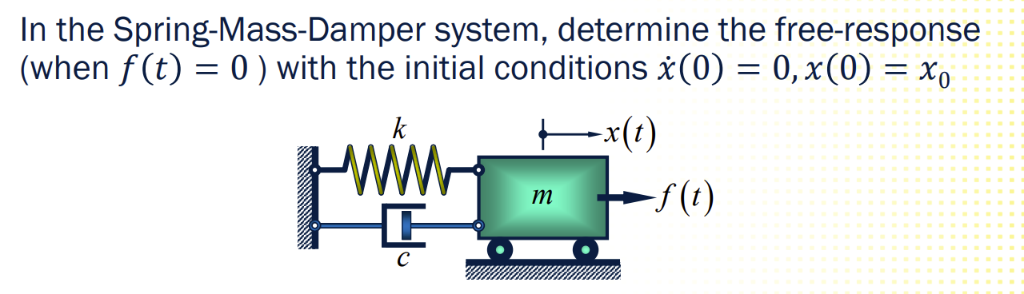 In the Spring-Mass-Damper system, determine the free-response .
(when f(t) = 0) with the initial conditions (0) = 0,x(0) =x,
a Mr —x(1) HE
10) FEE
This is AI generated Response.
Asked by: manish kumar
Created at: 2025-09-12 19:32:11
Asked by: manish kumar
Created at: 2025-09-12 19:32:11
Final Answer:
Rendered
Raw Text
Did you like this answer?
# **Spring-Mass-Damper System: Free Response Solution**
Let's break down the problem step-by-step!
---
## **1. System Equation**
The equation of motion for the spring-mass-damper system is:
\[
m\ddot{x}(t) + c\dot{x}(t) + kx(t) = f(t)
\]
For the free response (no external force), \( f(t) = 0 \):
\[
m\ddot{x}(t) + c\dot{x}(t) + kx(t) = 0
\]
---
## **2. Initial Conditions**
- Initial position: \( x(0) = x_0 \)
- Initial velocity: \( \dot{x}(0) = 0 \)
---
## **3. Characteristic Equation**
Rewrite the equation as:
\[
\ddot{x}(t) + 2\zeta \omega_n \dot{x}(t) + \omega_n^2 x(t) = 0
\]
Where:
- **Natural frequency:** \( \omega_n = \sqrt{\frac{k}{m}} \)
- **Damping ratio:** \( \zeta = \frac{c}{2\sqrt{km}} \)
The characteristic equation is:
\[
r^2 + 2\zeta \omega_n r + \omega_n^2 = 0
\]
---
## **4. Solution Form**
### **Case 1: Underdamped (\( \zeta < 1 \))**
Most common case, so let's focus on this:
\[
x(t) = e^{-\zeta \omega_n t} [A \cos(\omega_d t) + B \sin(\omega_d t)]
\]
where:
- \( \omega_d = \omega_n \sqrt{1 - \zeta^2} \) (damped natural frequency)
---
## **5. Apply Initial Conditions**
At \( t = 0 \):
- \( x(0) = x_0 \)
- \( \dot{x}(0) = 0 \)
Plug into general solution:
### \( x(0) = x_0 \):
\[
x(0) = e^{0} [A \cdot 1 + B \cdot 0] = A = x_0
\]
### \( \dot{x}(0) = 0 \):
Differentiate \( x(t) \):
\[
\dot{x}(t) = e^{-\zeta \omega_n t} [-\zeta\omega_n A \cos(\omega_d t) - \zeta\omega_n B \sin(\omega_d t) - A \omega_d \sin(\omega_d t) + B \omega_d \cos(\omega_d t)]
\]
At \( t = 0 \):
\[
\dot{x}(0) = [-\zeta\omega_n A] + [B \omega_d] = 0
\]
Plug \( A = x_0 \):
\[
-\zeta\omega_n x_0 + B \omega_d = 0 \implies B = \frac{\zeta\omega_n x_0}{\omega_d}
\]
---
## **6. Final Free Response Solution**
\[
\boxed{
x(t) = e^{-\zeta \omega_n t} \left[ x_0 \cos(\omega_d t) + \frac{\zeta\omega_n x_0}{\omega_d}\sin(\omega_d t) \right]
}
\]
- \( \omega_n = \sqrt{\frac{k}{m}} \)
- \( \zeta = \frac{c}{2\sqrt{km}} \)
- \( \omega_d = \omega_n \sqrt{1-\zeta^2} \)
---
## **Summary Table**
| Quantity | Formula |
|--------------------|------------------------------------------|
| Natural frequency | \( \omega_n = \sqrt{\frac{k}{m}} \) |
| Damping ratio | \( \zeta = \frac{c}{2\sqrt{km}} \) |
| Damped frequency | \( \omega_d = \omega_n\sqrt{1-\zeta^2} \)|
| Free response | See boxed formula above |
---
**Let me know if you want the solution for the overdamped (\( \zeta > 1 \)) or critically damped (\( \zeta = 1 \)) cases!**
📢 Instructions:
- Ask anything relatd to above question only.
- For new Question goto :