 VIPSolutions
Act like a helpful tutor and exlain me : I need whole answer clearlymill @ Uh RA i HTT 31 Hii mE Gf i= atuepsnr ip [I 7 HR HHH LE | ULHRA | Sh Sak ih i : ii aia: Bl. at 4 1 = i 3 © | i 3 FH ss | H i t i AGS 2% - I]
Question:
Act like a helpful tutor and exlain me :
I need whole answer clearly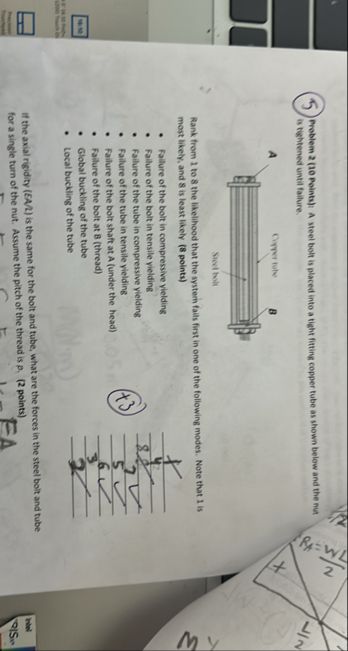 mill
@
Uh RA i
HTT
31 Hii mE Gf
i= atuepsnr ip [I 7
HR HHH LE |
ULHRA | Sh
Sak ih i :
ii aia: Bl.
at 4 1 = i
3 © | i
3 FH
ss |
H
i t i
AGS
2%
- I]
This is AI generated Response.
Asked by: Jack
Created at: 2025-10-16 19:55:54
Asked by: Jack
Created at: 2025-10-16 19:55:54
Final Answer:
Rendered
Raw Text
Did you like this answer?
Sure! Let’s break down the question and answer it step by step.
---
## **Question 5 Analysis**
**Given:**
- A steel bar is placed into a vise (fixed at both ends).
- A force \( F \) is applied at the center, pulling downwards.
- The figure shows points A (at the left end) and B (at the right end).
**Task:**
Rank terms 1 to 6 from the list (below) based on which failure mode is most likely to occur first to least likely.
**List of Failure Modes:**
1. Yielding at the center of the bar (in tension)
2. Yielding at the center of the bar (in compression)
3. Failure of the bolts (in tension from shearing)
4. Failure of the bolts (in compression from shearing)
5. Pullout of the bolts at Point A (tension)
6. Global buckling of the bar
---
## **Step-by-Step Explanation**
### **Step 1: Understanding the Setup**
- The bar is fixed at both ends.
- Force \( F \) pulls down at the center.
- The bar will experience **bending**, with the top fibers in **compression** and the bottom fibers in **tension**.
- Bolts at the ends resist the bar's movement.
---
### **Step 2: Analyzing Each Failure Mode**
1. **Yielding at the center of the bar (Tension)**
- The bottom of the bar at the center will experience maximum tension due to bending.
2. **Yielding at the center of the bar (Compression)**
- The top of the bar at the center will experience maximum compression due to bending.
3. **Failure of the bolts (Tension from Shearing)**
- The bolts could fail due to the shear force from the bar trying to move downward.
4. **Failure of the bolts (Compression from Shearing)**
- Bolts usually fail in tension/shear before compression. Compression is less likely unless the bolts are extremely weak.
5. **Pullout of the bolts at Point A (Tension)**
- The force could pull the bolts out from their anchors.
6. **Global Buckling of the Bar**
- Buckling would require very high compressive forces and is less likely unless the bar is slender/long.
---
### **Step 3: Ranking the Failure Modes**
We need to rank from **most likely to fail first (lowest strength required)** to **least likely (highest strength required)**.
#### **Typical Order:**
1. **Yielding at the center of the bar (Tension)** (bottom fibers)
2. **Yielding at the center of the bar (Compression)** (top fibers)
3. **Failure of the bolts (Tension from Shearing)**
4. **Failure of the bolts (Compression from Shearing)**
5. **Pullout of the bolts at Point A (Tension)**
6. **Global Buckling of the Bar**
**Reasoning**:
- Metal bars usually yield in tension at lower forces than they buckle.
- Bolts in shear (tension) are usually designed to be strong, but can still fail after the bar yields.
- Compression failure of bolts is rare.
- Pullout depends on the anchor strength, usually designed to be strong.
- Buckling needs very high compressive forces, so it’s last.
---
### **Step 4: Final Ranked List**
1. Yielding at the center of the bar (Tension)
2. Yielding at the center of the bar (Compression)
3. Failure of the bolts (Tension from Shearing)
4. Failure of the bolts (Compression from Shearing)
5. Pullout of the bolts at Point A (Tension)
6. Global Buckling of the Bar
---
## **Summary Table**
| Rank | Failure Mode Description |
|------|----------------------------------------------------|
| 1 | Yielding at the center of the bar (Tension) |
| 2 | Yielding at the center of the bar (Compression) |
| 3 | Failure of the bolts (Tension from Shearing) |
| 4 | Failure of the bolts (Compression from Shearing) |
| 5 | Pullout of the bolts at Point A (Tension) |
| 6 | Global Buckling of the Bar |
---
## **Why this order?**
- Yielding (tension/compression) happens at the lowest force.
- Bolts may shear after the bar yields.
- Compression/shear or pullout needs even more force.
- Buckling is the least likely unless the bar is very long and slender.
---
**If you need further clarification on any part, let me know!**
📢 Instructions:
- Ask anything relatd to above question only.
- For new Question goto :