Act like a helpful tutor and exlain me :
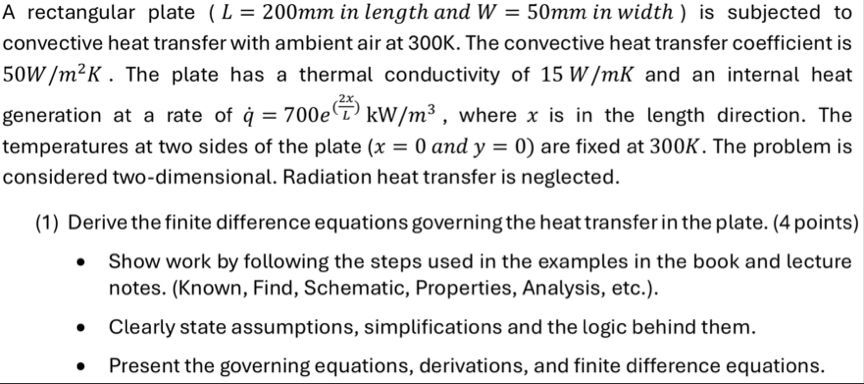
I need exact and accurate answers clearly for chegg without aiA rectangular plate (L = 200mm in length and W = 50mm in width) is subjected to
convective heat transfer with ambient air at 300K. The convective heat transfer coefficients
S50W/m?K . The plate has a thermal conductivity of 15 W/mK and an internal heat
2x,
generation at a rate of ¢ = 700e‘z) kW/m? , where x is in the length direction. The
temperatures at two sides of the plate (x = 0 and y = 0) are fixed at 300K. The problem is
considered two-dimensional. Radiation heat transfer is neglected.
(1) Derive the finite difference equations governing the heat transfer in the plate. (4 points)
* Show work by following the steps used in the examples in the book and lecture
notes. (Known, Find, Schematic, Properties, Analysis, etc.).
* Clearly state assumptions, simplifications and the logic behind them.
* Present the governing equations, derivations, and finite difference equations.
Question:
Act like a helpful tutor and exlain me :
I need exact and accurate answers clearly for chegg without aiA rectangular plate (L = 200mm in length and W = 50mm in width) is subjected to
convective heat transfer with ambient air at 300K. The convective heat transfer coefficients
S50W/m?K . The plate has a thermal conductivity of 15 W/mK and an internal heat
2x,
generation at a rate of ¢ = 700e‘z) kW/m? , where x is in the length direction. The
temperatures at two sides of the plate (x = 0 and y = 0) are fixed at 300K. The problem is
considered two-dimensional. Radiation heat transfer is neglected.
(1) Derive the finite difference equations governing the heat transfer in the plate. (4 points)
* Show work by following the steps used in the examples in the book and lecture
notes. (Known, Find, Schematic, Properties, Analysis, etc.).
* Clearly state assumptions, simplifications and the logic behind them.
* Present the governing equations, derivations, and finite difference equations.
This is AI generated Response.
Asked by: John
Created at: 2025-10-15 21:46:54
Final Answer:
RenderedRaw Text
Did you like this answer?
# Finite Difference Equations for Heat Transfer in a Plate
Let's break down the problem step by step as asked:
---
## **1. Known (Given Data)**
- **Plate dimensions:**
\( L = 200\, \text{mm} = .2\, \text{m} \) (length, x-direction)
\( W = 50\, \text{mm} = .05\, \text{m} \) (width, y-direction)
- **Convective boundary:**
Ambient temperature: \( T_\infty = 300\, \text{K} \)
Heat transfer coefficient: \( h = 50\, \text{W/m}^2\text{K} \)
- **Thermal conductivity:**
\( k = 15\, \text{W/mK} \)
- **Internal heat generation:**
\( \dot{q} = 700e^{\frac{2x}{L}} \) kW/m³ (convert to W/m³: \( 700,000e^{\frac{2x}{L}} \) W/m³)
- **Boundary temperatures:**
At \( x= \) and \( y= \): \( T = 300\, \text{K} \) (Dirichlet BC)
- **Radiation is neglected.**
- **2D steady-state conduction with generation.**
---
## **2. Find**
**Derive the finite difference equations governing the steady-state temperature distribution in the plate.**
---
## **3. Schematic**
```
y ^
|
|------------------- (x=L, y=) (T=?)
| |
| | Plate
| |
|-------------------|-----> x
(x=, y=) (T=300K)
```
- Bottom edge (\( y= \)) and left edge (\( x= \)) at fixed \( T=300K \).
- Top edge (\( y=W \)) and right edge (\( x=L \)): Convective boundary.
---
## **4. Properties**
- **Thermal conductivity:** \( k = 15\, \text{W/mK} \) (constant)
- **Internal heat generation:** \( \dot{q} = 700,000e^{\frac{2x}{L}} \) W/m³
---
## **5. Assumptions and Simplifications**
- Steady-state, 2D conduction (\( \frac{\partial T}{\partial t} = \))
- Constant thermal conductivity.
- No radiation.
- Internal heat generation is a function of \( x \) only.
---
## **6. Governing Equation**
For 2D steady-state conduction with generation:
\[
\frac{\partial^2 T}{\partial x^2}
+ \frac{\partial^2 T}{\partial y^2}
+ \frac{\dot{q}(x)}{k} =
\]
\[
\frac{\partial^2 T}{\partial x^2}
+ \frac{\partial^2 T}{\partial y^2}
= -\frac{700,000\, e^{\frac{2x}{L}}}{15}
\]
---
## **7. Finite Difference Formulation**
Let \( \Delta x \) and \( \Delta y \) be the grid spacings. Let \( T_{i,j} \) be the temperature at grid point \( (i,j) \):
\[
\frac{T_{i+1, j} - 2T_{i,j} + T_{i-1, j}}{(\Delta x)^2}
+ \frac{T_{i, j+1} - 2T_{i,j} + T_{i, j-1}}{(\Delta y)^2}
= -\frac{700,000\, e^{\frac{2x_i}{L}}}{15}
\]
If \( \Delta x = \Delta y = h \):
\[
T_{i+1,j} + T_{i-1,j} + T_{i,j+1} + T_{i,j-1} - 4T_{i,j} = -h^2 \frac{700,000\, e^{\frac{2x_i}{L}}}{15}
\]
Or,
\[
T_{i,j} = \frac{1}{4} \left[ T_{i+1,j} + T_{i-1,j} + T_{i,j+1} + T_{i,j-1} + h^2 \frac{700,000\, e^{\frac{2x_i}{L}}}{15} \right]
\]
---
## **8. Boundary Conditions**
- \( x= \) and \( y= \): \( T = 300\, \text{K} \) (Dirichlet)
- \( x=L \) and \( y=W \): Convective boundary (Newton’s law of cooling)
For convective boundary (e.g., at \( x=L \)):
\[
-k \left. \frac{\partial T}{\partial x} \right|_{x=L} = h(T_{L,j} - T_\infty)
\]
Using finite difference (forward/backward difference as needed):
\[
\frac{T_{N,j} - T_{N-1,j}}{\Delta x} = -\frac{h}{k}(T_{N,j}-T_\infty)
\]
---
## **Summary Table**
| Node Type | Finite Difference Equation |
|-------------------|-------------------------------------------------------------------------------------------|
| **Interior** | \( T_{i,j} = \frac{1}{4} [ T_{i+1,j} + T_{i-1,j} + T_{i,j+1} + T_{i,j-1} + h^2 S_{i,j} ] \) |
| **Dirichlet** | \( T_{i,j} = 300 \) |
| **Convective BC** | \( T_{N,j} = \frac{ k T_{N-1,j} + h \Delta x T_\infty }{ k + h \Delta x } \) |
where \( S_{i,j} = \frac{700,000\, e^{\frac{2x_i}{L}}}{15} \)
---
### **In summary:**
- Write out the node equations for interior and boundary points.
- Apply Dirichlet condition at fixed-T boundaries.
- Use the convective boundary equation for boundaries with convection.
---
**If you need the step-by-step derivation for each type of node (corner, edge, interior), let me know!**
VIPSolutions focuses on clear, step‑by‑step explanations so you can learn quickly. Whether you need an AI‑generated walkthrough or a short hint to get unstuck, each solution is organized for fast reading and easy review later.
Search similar questions, compare approaches, and bookmark the best answers for revision. Our goal is simple: quick, reliable study help that feels natural—not noisy.
 VIPSolutions
 A rectangular plate (L = 200mm in length and W = 50mm in width) is subjected to
convective heat transfer with ambient air at 300K. The convective heat transfer coefficients
S50W/m?K . The plate has a thermal conductivity of 15 W/mK and an internal heat
2x,
generation at a rate of ¢ = 700e‘z) kW/m? , where x is in the length direction. The
temperatures at two sides of the plate (x = 0 and y = 0) are fixed at 300K. The problem is
considered two-dimensional. Radiation heat transfer is neglected.
(1) Derive the finite difference equations governing the heat transfer in the plate. (4 points)
* Show work by following the steps used in the examples in the book and lecture
notes. (Known, Find, Schematic, Properties, Analysis, etc.).
* Clearly state assumptions, simplifications and the logic behind them.
* Present the governing equations, derivations, and finite difference equations.