Act like a helpful tutor and exlain me :
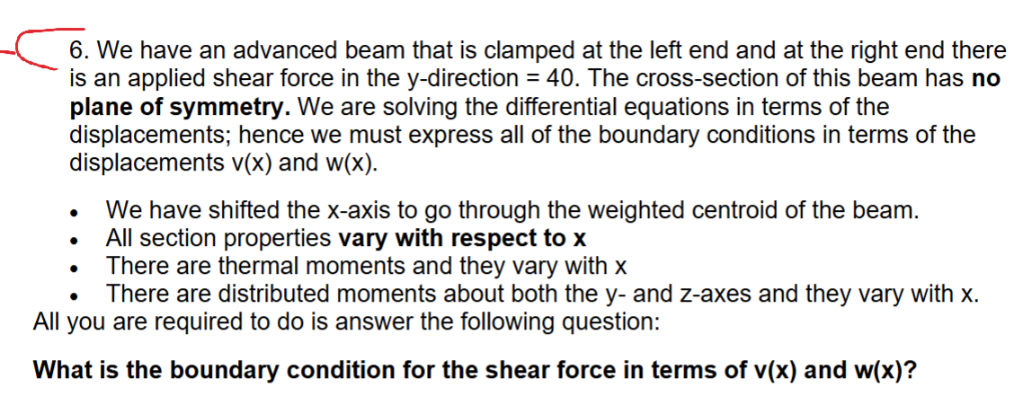
I need accurate answer clearly( 6. We have an advanced beam that is clamped at the left end and at the right end there
is an applied shear force in the y-direction = 40. The cross-section of this beam has no
plane of symmetry. We are solving the differential equations in terms of the
displacements; hence we must express all of the boundary conditions in terms of the
displacements v(x) and w(x).
+ We have shifted the x-axis to go through the weighted centroid of the beam.
« All section properties vary with respect to x
+ There are thermal moments and they vary with x
« There are distributed moments about both the y- and z-axes and they vary with x.
All you are required to do is answer the following question:
What is the boundary condition for the shear force in terms of v(x) and w(x)?
Question:
Act like a helpful tutor and exlain me :
I need accurate answer clearly( 6. We have an advanced beam that is clamped at the left end and at the right end there
is an applied shear force in the y-direction = 40. The cross-section of this beam has no
plane of symmetry. We are solving the differential equations in terms of the
displacements; hence we must express all of the boundary conditions in terms of the
displacements v(x) and w(x).
+ We have shifted the x-axis to go through the weighted centroid of the beam.
« All section properties vary with respect to x
+ There are thermal moments and they vary with x
« There are distributed moments about both the y- and z-axes and they vary with x.
All you are required to do is answer the following question:
What is the boundary condition for the shear force in terms of v(x) and w(x)?
This is AI generated Response.
Asked by: Jack
Created at: 2025-10-16 10:23:36
Final Answer:
RenderedRaw Text
Did you like this answer?
## Explanation of the Problem
You have a beam:
- **Clamped at the left end (x = )**
- **Shear force applied at the right end (x = L), value = 40, in the y-direction**
- **No plane of symmetry**
- Displacements are \( v(x) \) (in the y-direction) and \( w(x) \) (in the z-direction)
- Section properties and moments vary with \( x \)
- **You are asked:**
_What is the boundary condition for the shear force in terms of \( v(x) \) and \( w(x) \) at the right end (x = L)?_
---
## Step-by-Step Solution
### 1. **Shear Force and Displacement Relationship**
For an advanced (unsymmetric) beam, the shear force vector at any section relates to the second derivatives of the displacements:
- Shear force in y: \( V_y \)
- Shear force in z: \( V_z \)
The general relationship (from beam theory):
\[
\begin{bmatrix}
V_y \\
V_z
\end{bmatrix}
=
\begin{bmatrix}
A_{11}(x) & A_{12}(x) \\
A_{21}(x) & A_{22}(x)
\end{bmatrix}
\begin{bmatrix}
v''(x) \\
w''(x)
\end{bmatrix}
\]
Where \( A_{ij}(x) \) are section properties that may vary with \( x \).
**For your problem:**
- At \( x = L \): \( V_y = 40 \) (applied shear), \( V_z = \) (no z-direction shear specified).
---
### 2. **Boundary Condition at x = L**
Express the boundary condition at \( x = L \):
\[
\boxed{
A_{11}(L) v''(L) + A_{12}(L) w''(L) = 40
}
\]
\[
\boxed{
A_{21}(L) v''(L) + A_{22}(L) w''(L) =
}
\]
- The **first equation** comes from the applied shear in the y-direction.
- The **second equation** is typically set to zero if no shear is applied in the z-direction.
---
### 3. **Summary Table**
| Shear Force Direction | Boundary Condition (at \( x = L \)) |
|----------------------|-------------------------------------------------------------------|
| \( V_y \) | \( A_{11}(L) v''(L) + A_{12}(L) w''(L) = 40 \) |
| \( V_z \) | \( A_{21}(L) v''(L) + A_{22}(L) w''(L) = \) |
---
## **Final Answer**
> **Boundary condition for the shear force at the right end (x = L) in terms of \( v(x) \) and \( w(x) \):**
>
> \[
> \boxed{
> A_{11}(L)\, v''(L) + A_{12}(L)\, w''(L) = 40
> }
> \]
>
> \[
> \boxed{
> A_{21}(L)\, v''(L) + A_{22}(L)\, w''(L) =
> }
> \]
>
> where \( A_{ij}(L) \) are the section property coefficients at \( x = L \).
If you need the full physical meaning or how to derive these, just ask!
Question:
I need full answer clearly
This is AI generated Response.
Asked by: Jack
Created at: 2025-10-16 10:24:31
Final Answer:
RenderedRaw Text
Did you like this answer?
# Understanding the Boundary Condition for Shear Force in a Beam
## Problem Overview
You are working with a beam that has the following characteristics:
- **Clamped at the left end** (at \( x = 0 \))
- **Applied shear force** at the right end (at \( x = L \)), with a value of **40 N** in the y-direction
- **Asymmetric cross-section** with varying properties along the beam
- **Displacements** represented as \( v(x) \) (deflection in y-direction) and \( w(x) \) (deflection in z-direction)
### Objective
Determine the boundary condition for the shear force in terms of the displacements \( v(x) \) and \( w(x) \) at the right end of the beam.
---
## Key Concepts
### 1. Shear Force and Displacement Relationship
The shear force components at any section of the beam can be expressed in relation to the second derivatives of the displacement functions:
- **Shear force in y-direction**: \( V_y \)
- **Shear force in z-direction**: \( V_z \)
The relationship can be modeled as:
\[
\begin{bmatrix}
V_y \\
V_z
\end{bmatrix}
=
\begin{bmatrix}
A_{11}(x) & A_{12}(x) \\
A_{21}(x) & A_{22}(x)
\end{bmatrix}
\begin{bmatrix}
v''(x) \\
w''(x)
\end{bmatrix}
\]
Where:
- \( A_{ij}(x) \) are the coefficients that depend on the beam's section properties.
### 2. Boundary Condition at \( x = L \)
At the right end (\( x = L \)), the applied shear force gives us the following condition:
- Given \( V_y = 40 \) N (in the y-direction)
- Assume \( V_z = 0 \) N (if no shear is applied in the z-direction)
Thus, the boundary conditions can be expressed as:
\[
\boxed{
A_{11}(L) v''(L) + A_{12}(L) w''(L) = 40
}
\]
\[
\boxed{
A_{21}(L) v''(L) + A_{22}(L) w''(L) = 0
}
\]
---
## Summary of Boundary Conditions
| Shear Force Direction | Boundary Condition (at \( x = L \)) |
|-----------------------|-----------------------------------------------------------------|
| \( V_y \) | \( A_{11}(L) v''(L) + A_{12}(L) w''(L) = 40 \) |
| \( V_z \) | \( A_{21}(L) v''(L) + A_{22}(L) w''(L) = 0 \) |
---
## Conclusion
The boundary conditions for the shear force at the right end of the beam in terms of the displacements \( v(x) \) and \( w(x) \) are as follows:
1. For the y-direction shear:
\[
\boxed{
A_{11}(L) v''(L) + A_{12}(L) w''(L) = 40
}
\]
2. For the z-direction shear (assuming no force is applied):
\[
\boxed{
A_{21}(L) v''(L) + A_{22}(L) w''(L) = 0
}
\]
If you need further clarification on how to derive \( A_{ij}(L) \) or the implications of these conditions, feel free to ask!
Question:
I need all derivations also
This is AI generated Response.
Asked by: Jack
Created at: 2025-10-16 10:25:40
Final Answer:
RenderedRaw Text
Did you like this answer?
# Deriving the Boundary Condition for Shear Force in a Beam
## Problem Overview
You are analyzing a beam under specific loading conditions:
- **Clamped at the left end** (at \( x = 0 \))
- **Applied shear force** at the right end (at \( x = L \)): \( V_y = 40 \, \text{N} \)
- **Asymmetric cross-section**, causing variations in section properties
### Objective
To derive the boundary condition for shear force in terms of displacements \( v(x) \) (vertical deflection) and \( w(x) \) (lateral deflection) at \( x = L \).
---
## Key Concepts
### Shear Force and Displacement Relationship
The shear force in a beam can be related to its displacement functions through the following equations derived from beam theory. Given that the shear force components \( V_y \) and \( V_z \) depend on the second derivatives of the displacements \( v(x) \) and \( w(x) \):
\[
\begin{bmatrix}
V_y \\
V_z
\end{bmatrix}
=
\begin{bmatrix}
A_{11}(x) & A_{12}(x) \\
A_{21}(x) & A_{22}(x)
\end{bmatrix}
\begin{bmatrix}
v''(x) \\
w''(x)
\end{bmatrix}
\]
Where:
- \( A_{ij}(x) \): section property coefficients that may vary with \( x \)
### 1. Expressing Shear Forces
At any section along the beam, the shear forces can be expressed as:
- **In the y-direction**:
\[
V_y = A_{11}(x) v''(x) + A_{12}(x) w''(x)
\]
- **In the z-direction**:
\[
V_z = A_{21}(x) v''(x) + A_{22}(x) w''(x)
\]
### 2. Boundary Condition at \( x = L \)
At the right end of the beam (\( x = L \)), we have:
- **Given**: \( V_y = 40 \, \text{N} \)
- **Assumed**: No shear in the z-direction, \( V_z = 0 \)
#### Setting Up the Equations
1. For the y-direction shear force:
\[
A_{11}(L) v''(L) + A_{12}(L) w''(L) = 40
\]
2. For the z-direction shear force (assuming no shear):
\[
A_{21}(L) v''(L) + A_{22}(L) w''(L) = 0
\]
---
## Summary of Derived Boundary Conditions
| Shear Force Direction | Boundary Condition (at \( x = L \)) |
|-----------------------|-----------------------------------------------------------------|
| \( V_y \) | \( A_{11}(L) v''(L) + A_{12}(L) w''(L) = 40 \) |
| \( V_z \) | \( A_{21}(L) v''(L) + A_{22}(L) w''(L) = 0 \) |
---
## Final Expression of Boundary Conditions
The final expressions for the boundary conditions at the right end of the beam are:
1. **For shear force in the y-direction**:
\[
\boxed{
A_{11}(L) v''(L) + A_{12}(L) w''(L) = 40
}
\]
2. **For shear force in the z-direction**:
\[
\boxed{
A_{21}(L) v''(L) + A_{22}(L) w''(L) = 0
}
\]
---
## Conclusion
These equations provide the necessary boundary conditions to analyze the beam's behavior under the applied shear force. If you have further questions about how to calculate the coefficients \( A_{ij}(L) \) or the implications of these boundary conditions, feel free to ask!
VIPSolutions focuses on clear, step‑by‑step explanations so you can learn quickly. Whether you need an AI‑generated walkthrough or a short hint to get unstuck, each solution is organized for fast reading and easy review later.
Search similar questions, compare approaches, and bookmark the best answers for revision. Our goal is simple: quick, reliable study help that feels natural—not noisy.
 VIPSolutions
 ( 6. We have an advanced beam that is clamped at the left end and at the right end there
is an applied shear force in the y-direction = 40. The cross-section of this beam has no
plane of symmetry. We are solving the differential equations in terms of the
displacements; hence we must express all of the boundary conditions in terms of the
displacements v(x) and w(x).
+ We have shifted the x-axis to go through the weighted centroid of the beam.
« All section properties vary with respect to x
+ There are thermal moments and they vary with x
« There are distributed moments about both the y- and z-axes and they vary with x.
All you are required to do is answer the following question:
What is the boundary condition for the shear force in terms of v(x) and w(x)?