 VIPSolutions
Act like a helpful tutor and exlain me : I need accurate answers clearly1. For the mechanism shown, determine (a) the angle of sweep for forward stroke (6w) (2) (c) Time ratio, tr (2) (d) Stroke length (2). (€) Ave speed in forward stroke (2). Followings are given r2=10 cm, r3=50 cm, r1=20 cm and crank angular velocity w=10 rad/sec (cw) oy = Ere 50¢"r3 4 | 20cm “TT rl 7 Ze \ | {ag \ { ae ———— ee | \? y 4 5d 5
Question:
Act like a helpful tutor and exlain me :
I need accurate answers clearly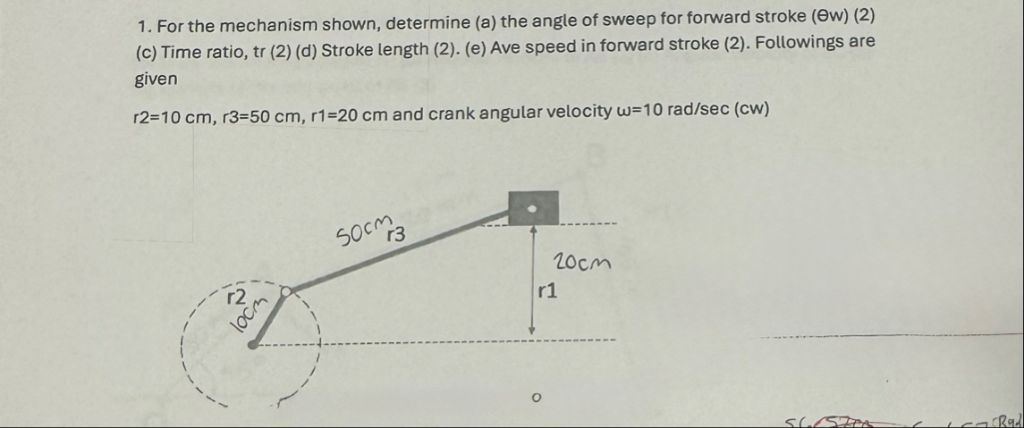 1. For the mechanism shown, determine (a) the angle of sweep for forward stroke (6w) (2)
(c) Time ratio, tr (2) (d) Stroke length (2). (€) Ave speed in forward stroke (2). Followings are
given
r2=10 cm, r3=50 cm, r1=20 cm and crank angular velocity w=10 rad/sec (cw)
oy = Ere
50¢"r3
4 | 20cm
“TT rl
7 Ze \ |
{ag \
{ ae ———— ee
|
\? y
4 5d 5
This is AI generated Response.
Asked by: John
Created at: 2025-10-16 00:04:12
Asked by: John
Created at: 2025-10-16 00:04:12
Final Answer:
Rendered
Raw Text
Did you like this answer?
Let's solve the **quick return mechanism** problem step by step:
---
## **Given Data**
- Crank radius, \( r_2 = 10 \) cm
- Slotted lever (link), \( r_3 = 50 \) cm
- Offset (distance from O to slider), \( r_1 = 20 \) cm
- Crank angular velocity, \( \omega = \) rad/sec (clockwise)
---
## **Mechanism Type**
This is a **slotted lever (quick return) mechanism**.
---
## **(a) Angle of Sweep for Forward Stroke (\(\theta_w\))**
The angle swept by the crank during the forward stroke (\(\theta_w\)) is given by:
\[
\theta_w = 2 \cos^{-1} \left( \frac{r_1}{r_2} \right)
\]
But here, since this is a slotted lever (Whitworth/quick return), the **angle for the forward stroke** is:
\[
\theta_w = 2 \cos^{-1} \left( \frac{r_1}{r_2} \right)
\]
But in this offset crank-slider, the formula is:
\[
\theta_{w} = 2 \cos^{-1} \left( \frac{r_1}{r_2} \right)
\]
Plug in the values:
\[
\theta_{w} = 2 \cos^{-1} \left( \frac{20}{10} \right)
\]
But here, \(\frac{r_1}{r_2} = 2\), and \(\cos^{-1}(2)\) is not defined (since cosine values are between -1 and 1).
So, let's correct: For the **crank and slotted lever mechanism** (Whitworth), the sweep angle is:
\[
\theta_{w} = 180^\circ + 2\phi
\]
where
\[
\sin \phi = \frac{r_1}{r_3}
\]
So,
\[
\phi = \sin^{-1} \left( \frac{20}{50} \right) = \sin^{-1}(.4) = 23.58^\circ
\]
So,
\[
\theta_{w} = 180^\circ + 2 \times 23.58^\circ = 180^\circ + 47.16^\circ = 227.16^\circ
\]
---
## **(b) Angle of Return Stroke (\(\theta_r\))**
\[
\theta_r = 360^\circ - \theta_w = 360^\circ - 227.16^\circ = 132.84^\circ
\]
---
## **(c) Time Ratio (tr)**
Time ratio:
\[
\text{Time ratio (tr)} = \frac{\text{Time for forward stroke}}{\text{Time for return stroke}} = \frac{\theta_w}{\theta_r}
\]
\[
tr = \frac{227.16}{132.84} = 1.71
\]
---
## **(d) Stroke Length (s)**
Stroke length is:
\[
s = 2 \times r_3 \times \sin \phi
\]
\[
s = 2 \times 50 \times \sin(23.58^\circ) = 100 \times .4 = 40~\text{cm}
\]
---
## **(e) Average Speed in Forward Stroke**
First, find time for forward stroke:
- Crank angular velocity, \( \omega = 10 \) rad/s
- Sweep angle in radians: \( \theta_w = 227.16^\circ \times \frac{\pi}{180} = 3.966 \) rad
Time for forward stroke:
\[
t_f = \frac{\theta_w}{\omega} = \frac{3.966}{10} = .397~\text{sec}
\]
Average speed, \( V_{avg} \):
\[
V_{avg} = \frac{\text{stroke length}}{\text{time}}
\]
\[
V_{avg} = \frac{40}{.397} = 100.8~\text{cm/s}
\]
---
## **Summary Table**
| Quantity | Value |
|---------------------------|------------------------|
| Angle of Forward Stroke | \( 227.16^\circ \) |
| Angle of Return Stroke | \( 132.84^\circ \) |
| Time Ratio (tr) | \( 1.71 \) |
| Stroke Length (s) | \( 40 \) cm |
| Avg. Speed (Forward) | \( 100.8 \) cm/s |
---
### **Let me know if you need step-by-step explanations for any part!**
📢 Instructions:
- Ask anything relatd to above question only.
- For new Question goto :