 VIPSolutions
Act like a helpful tutor and exlain me :i Le 1 NE Bafzza: (BFif 0c: a sgEifE CE Feiprre S5ifi: 7) p. ifeeiis Eigiis £5 = Sri EERE as | Hath f3gdqg £1 HET PEI RH - | i: ip sigEen fi; =f BEL ¥Esd § =F Eigy fikp io: Pil Rie Eg g gig 8d 37 & Tg 1%: © LTE ER 4 FR 5. 15: i oo pss apis E og il GRE - Tl ECT] y
Question:
Act like a helpful tutor and exlain me :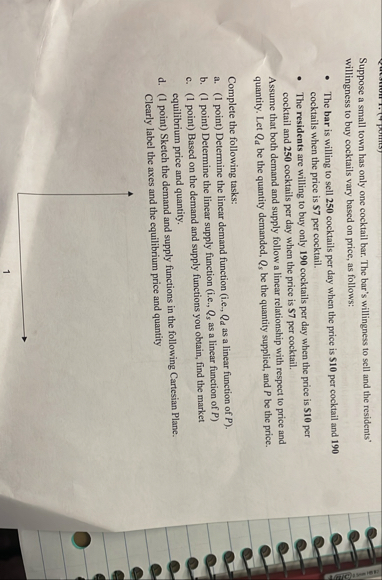 i Le 1
NE
Bafzza: (BFif 0c:
a sgEifE CE
Feiprre S5ifi: 7)
p. ifeeiis Eigiis £5
= Sri EERE as
| Hath f3gdqg £1
HET PEI RH
- | i: ip sigEen fi;
=f BEL ¥Esd § =F
Eigy fikp io:
Pil Rie Eg
g gig 8d 37 &
Tg 1%: ©
LTE ER 4 FR
5. 15: i oo
pss apis E og
il
GRE
- Tl ECT] y
This is AI generated Response.
Asked by: Alok Kumar
Created at: 2026-02-03 08:10:25
Asked by: Alok Kumar
Created at: 2026-02-03 08:10:25
Final Answer:
Rendered
Raw Text
Did you like this answer?
Of course! Let’s break down the problem step by step.
---
## **Restating the Problem**
- There is a bar with only **one cocktail bar**.
- The bar has a **willingness to sell** (minimum price) and each student has a **willingness to buy** (maximum price).
- **Willingness to buy** (students):
- $25 at $20 per cocktail
- $10 at $10 per cocktail
- **Willingness to sell** (the bar):
- 100 cocktails/day at $10 per cocktail
- 250 cocktails/day at $15 per cocktail
- **Q** is the quantity (number of cocktails sold per day).
- **P** is the price per cocktail.
---
## **Question a: Demand Function (Qd as a function of P)**
### **Using the given data:**
- At $20, 25 cocktails are demanded.
- At $10, 100 cocktails are demanded.
### **Find the linear demand function:**
The general form:
\( Q_d = a - bP \)
We have two points:
- When \( P = 20, Q_d = 25 \)
- When \( P = 10, Q_d = 100 \)
Set up the equations:
1. \( 25 = a - b(20) \)
2. \( 100 = a - b(10) \)
Subtract equation 1 from 2:
\[
100 - 25 = (a - b \cdot 10) - (a - b \cdot 20)
\]
\[
75 = b(20 - 10) = 10b
\]
\[
b = 7.5
\]
Plug \( b \) back into one equation:
\[
25 = a - 7.5 \times 20
\]
\[
25 = a - 150
\]
\[
a = 175
\]
**So, the demand function is:**
\[
\boxed{Q_d = 175 - 7.5P}
\]
---
## **Question b: Supply Function (Qs as a function of P)**
### **Given:**
- At $10, 100 cocktails supplied.
- At $15, 250 cocktails supplied.
General form:
\( Q_s = c + dP \)
Two points:
- \( P = 10, Q_s = 100 \)
- \( P = 15, Q_s = 250 \)
Set equations:
1. \( 100 = c + d(10) \)
2. \( 250 = c + d(15) \)
Subtract equation 1 from 2:
\[
250 - 100 = (c + 15d) - (c + 10d)
\]
\[
150 = 5d
\]
\[
d = 30
\]
Plug \( d \) back in:
\[
100 = c + 30 \times 10
\]
\[
100 = c + 300
\]
\[
c = -200
\]
**So, the supply function is:**
\[
\boxed{Q_s = -200 + 30P}
\]
---
## **Question c: Find the Equilibrium Price and Quantity**
Set \( Q_d = Q_s \):
\[
175 - 7.5P = -200 + 30P
\]
\[
175 + 200 = 30P + 7.5P
\]
\[
375 = 37.5P
\]
\[
P^* = 10
\]
Now plug \( P^* \) into either equation to get \( Q^* \):
\[
Q^* = 175 - 7.5 \times 10 = 175 - 75 = 100
\]
(or \( Q^* = -200 + 30 \times 10 = -200 + 300 = 100 \))
**Equilibrium:**
- **Price:** \(\boxed{10}\)
- **Quantity:** \(\boxed{100}\)
---
## **Question d: Clearly label axes and plot supply and demand curves**
**You would draw:**
- X-axis: **Quantity of Cocktails (Q)**
- Y-axis: **Price per Cocktail (P)**
- **Demand curve:** downward sloping from (Q = 25, P = 20) to (Q = 100, P = 10)
- **Supply curve:** upward sloping from (Q = 100, P = 10) to (Q = 250, P = 15)
- **Equilibrium point:** where they cross, at (Q = 100, P = 10)
---
### **Summary Table**
| Function | Equation | Intercepts (Q) | Slope |
|---------------------|---------------------|------------------------|--------------|
| Demand | Qd = 175 - 7.5P | Q = 175 (P = ) | -7.5 |
| Supply | Qs = -200 + 30P | Q = -200 (P = ) | +30 |
| **Equilibrium** | Q = 100, P = 10 | | |
---
If you need help drawing the graph or further clarification, let me know!
📢 Instructions:
- Ask anything relatd to above question only.
- For new Question goto :