 VIPSolutions
Act like a helpful tutor and exlain me : Give step-by-step solution with explanation and final answer:A neat pump i sed to warm a building in the winter. Tis system implements an ideal vapor-Compression cycle with R-134a as the working fluid. The cycle operates between 140 kPa and 900 KPa, with a mass flow rate of 0.06 ky/s. Determine: (2) the heating load that can be met ow (6) the power Input required fo his system w (c) the coefficient of performance (0) the warmest outsice temperature at which this particular cycle | unable fo operate: © (Same as the coldest outside temperature at which its able 10 operate)
Question:
Act like a helpful tutor and exlain me :
Give step-by-step solution with explanation and final answer: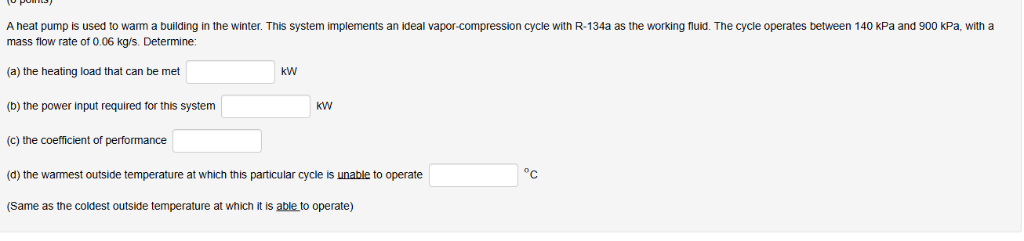 A neat pump i sed to warm a building in the winter. Tis system implements an ideal vapor-Compression cycle with R-134a as the working fluid. The cycle operates between 140 kPa and 900 KPa, with a
mass flow rate of 0.06 ky/s. Determine:
(2) the heating load that can be met ow
(6) the power Input required fo his system w
(c) the coefficient of performance
(0) the warmest outsice temperature at which this particular cycle | unable fo operate: ©
(Same as the coldest outside temperature at which its able 10 operate)
This is AI generated Response.
Asked by: manish kumar
Created at: 2025-10-29 10:40:02
Asked by: manish kumar
Created at: 2025-10-29 10:40:02
Final Answer:
Rendered
Raw Text
Did you like this answer?
Let's solve the heat pump problem **step by step**.
---
## **Given Data**
- **Working fluid:** R-134a
- **Low pressure, \( P_L \):** 140 kPa
- **High pressure, \( P_H \):** 900 kPa
- **Mass flow rate, \( \dot{m} \):** .06 kg/s
- **Cycle:** Ideal vapor-compression
---
## **Step 1: Draw a Simple Schematic**
1. **Compressor:** (1 → 2: Compression, isentropic)
2. **Condenser:** (2 → 3: Heat rejection at constant \( P_H \))
3. **Expansion Valve:** (3 → 4: Expansion at constant enthalpy)
4. **Evaporator:** (4 → 1: Heat absorption at constant \( P_L \))
---
## **Step 2: Find State Points (using R-134a tables)**
We'll need **enthalpies** at each state:
### **State 1: Inlet to Compressor (Evaporator exit)**
- \( P_1 = 140\, \text{kPa} \)
- Saturated vapor: \( x_1 = 1 \)
**From R-134a tables:**
- At 140 kPa, \( h_1 \approx 239.15\, \text{kJ/kg} \)
- \( s_1 \approx .9172\, \text{kJ/kg}\cdot K \)
### **State 2: Exit Compressor (Condenser inlet)**
- \( P_2 = 900\, \text{kPa} \)
- Find \( h_2 \): Isentropic compression (\( s_2 = s_1 \))
From R-134a superheated tables at \( P_2 = 900\, \text{kPa} \):
Look up \( s_1 = .9172 \) at 900 kPa:
- At 900 kPa:
- \( T = 40^\circ C \): \( s = .8997, h = 263.86 \)
- \( T = 50^\circ C \): \( s = .9305, h = 271.11 \)
Interpolate for \( s_2 = s_1 = .9172 \):
\[
h_2 = h_{40^\circ C} + \frac{(s_1 - s_{40^\circ C})}{(s_{50^\circ C} - s_{40^\circ C})} \times (h_{50^\circ C} - h_{40^\circ C})
\]
\[
h_2 = 263.86 + \frac{(.9172 - .8997)}{(.9305 - .8997)} \times (271.11 - 263.86)
\]
\[
= 263.86 + \frac{.0175}{.0308} \times 7.25
\]
\[
= 263.86 + .568 \times 7.25 = 263.86 + 4.12 = 267.98 \, \text{kJ/kg}
\]
### **State 3: Exit Condenser (Expansion valve inlet)**
- \( P_3 = 900\, \text{kPa} \)
- Saturated liquid: \( x_3 = \)
- \( h_3 \) at 900 kPa, sat liq: \( h_3 \approx 95.50\, \text{kJ/kg} \)
### **State 4: Exit Expansion Valve (Evaporator inlet)**
- \( P_4 = 140\, \text{kPa} \)
- \( h_4 = h_3 \) (isenthalpic expansion)
- \( h_4 = 95.50\, \text{kJ/kg} \)
---
## **Step 3: Calculate Required Quantities**
### **(a) Heating load (condenser heat output):**
\[
\dot{Q}_{out} = \dot{m} (h_2 - h_3)
\]
\[
\dot{Q}_{out} = .06 \times (267.98 - 95.50) = .06 \times 172.48 = \boxed{10.35\, \text{kW}}
\]
### **(b) Power input (compressor work):**
\[
\dot{W}_{in} = \dot{m} (h_2 - h_1)
\]
\[
\dot{W}_{in} = .06 \times (267.98 - 239.15) = .06 \times 28.83 = \boxed{1.73\, \text{kW}}
\]
### **(c) Coefficient of performance (COP):**
\[
COP_{HP} = \frac{\dot{Q}_{out}}{\dot{W}_{in}} = \frac{10.35}{1.73} = \boxed{5.98}
\]
### **(d) Warmest outside temperature at which cycle is unable to operate**
This is when the evaporator is at the **saturated temperature** corresponding to \( P_{low} = 140\, \text{kPa} \):
- From R-134a tables, at 140 kPa:
- \( T_{sat} \approx -18.8^\circ C \)
So, **outside temperature cannot be higher than \( -18.8^\circ C \)** for heat absorption.
\[
\boxed{-18.8^\circ C}
\]
---
## **Summary Table**
| Part | Answer | Units |
|------|---------------|----------|
| (a) | 10.35 | kW |
| (b) | 1.73 | kW |
| (c) | 5.98 | |
| (d) | -18.8 | °C |
---
### **Let me know if you want details for each calculation or help with R-134a tables!**
📢 Instructions:
- Ask anything relatd to above question only.
- For new Question goto :