 VIPSolutions
Act like a helpful tutor and exlain me : Give step-by-step solution with explanation and final answer: do not include tables in your answer, detailed explanation ,explain in very detail ,a) The velocity for the flow of a gas along the center streamline of the pipe is defined by u = (102° +2001 + 6) mvs, where x is in meters and is in seconds. Determine the local, convective and total acceleration of a particle when 1 = 0.01 s and itis at A, just before leaving the nozzle. a MY on] Figure Q2a: A pipe attached with a nozzle. (5 marks) (CO2PO2ACH)
Question:
Act like a helpful tutor and exlain me :
Give step-by-step solution with explanation and final answer:
do not include tables in your answer, detailed explanation ,explain in very detail ,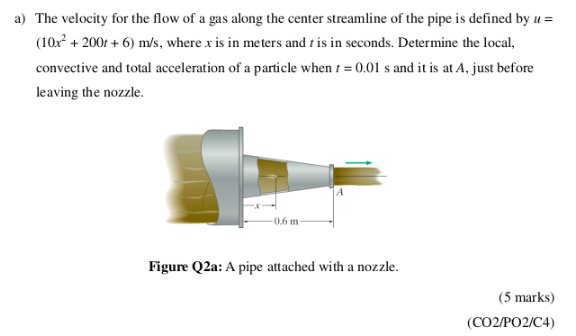 a) The velocity for the flow of a gas along the center streamline of the pipe is defined by u =
(102° +2001 + 6) mvs, where x is in meters and is in seconds. Determine the local,
convective and total acceleration of a particle when 1 = 0.01 s and itis at A, just before
leaving the nozzle.
a
MY on]
Figure Q2a: A pipe attached with a nozzle.
(5 marks)
(CO2PO2ACH)
This is AI generated Response.
Asked by: manish kumar
Created at: 2025-10-28 08:54:54
Asked by: manish kumar
Created at: 2025-10-28 08:54:54
Final Answer:
Rendered
Raw Text
Did you like this answer?
Let's carefully analyze and solve this problem step-by-step.
---
## Given Data and what is asked:
### Data:
- Velocity of gas along center streamline:
\[
u = 10x^2 + 200t + 6 \quad \text{(m/s)}
\]
where:
- \( x \) is in meters
- \( t \) is in seconds
- Time just before leaving nozzle:
\[
t = .01 \, \text{sec}
\]
- Position of interest:
\[
x = A
\]
(where \( A \) is the nozzle exit point)
- Distance from the pipe wall to the centerline:
\[
.6 \, \text{m}
\]
### To find:
- The **local acceleration** \( a_{local} \) at the exit point just before the particle leaves (at \( t=.01\, \text{s} \) and \( x=A \))
- The **convective acceleration** \( a_{conv} \) at the same point
- The **total acceleration** \( a_{total} \)
---
## Step 1: Find the velocity \( u \) at \( t=.01\,\text{s} \) and \( x=A \)
Since the velocity is given as a function of \( x \) and \( t \), at the point of interest:
\[
u = 10A^2 + 200(.01) + 6
\]
Calculate:
\[
u = 10A^2 + 2 + 6 = 10A^2 + 8
\]
---
## Step 2: Find the **local acceleration** \( a_{local} \)
**Local acceleration** is the partial derivative of the velocity with respect to time at a fixed position:
\[
a_{local} = \frac{\partial u}{\partial t}
\]
Given:
\[
u = 10x^2 + 200t + 6
\]
The partial derivative with respect to \( t \):
\[
a_{local} = \frac{\partial}{\partial t} (10x^2 + 200t + 6)
\]
Since \( 10x^2 \) and 6 are independent of \( t \):
\[
a_{local} = 200
\]
**Answer for local acceleration:**
\[
a_{local} = 200\, \text{m/s}^2
\]
---
## Step 3: Find the **convective acceleration** \( a_{conv} \)
**Convective acceleration** reflects the change in velocity as the particle moves along the streamline, given by:
\[
a_{conv} = u \frac{\partial u}{\partial x}
\]
First, compute \( \frac{\partial u}{\partial x} \):
\[
u = 10x^2 + 200t + 6
\]
Derivative with respect to \( x \):
\[
\frac{\partial u}{\partial x} = 20x
\]
At \( x = A \):
\[
\frac{\partial u}{\partial x} = 20A
\]
Now, the convective acceleration:
\[
a_{conv} = u \times 20A
\]
Recall that:
\[
u = 10A^2 + 8
\]
So:
\[
a_{conv} = (10A^2 + 8) \times 20A
\]
Simplify:
\[
a_{conv} = 20A \times 10A^2 + 20A \times 8
\]
\[
a_{conv} = 200A^3 + 160A
\]
---
## Step 4: Find the **total acceleration** \( a_{total} \)
The total acceleration combines local and convective accelerations:
\[
a_{total} = a_{local} + a_{conv}
\]
Substitute the values:
\[
a_{total} = 200 + (200A^3 + 160A)
\]
\[
a_{total} = 200A^3 + 160A + 200
\]
---
## **Final Answer:**
\[
\boxed{
\text{Local acceleration} = 200\, \text{m/s}^2
}
\]
\[
\boxed{
\text{Convective acceleration} = 200A^3 + 160A\, \text{m/s}^2
}
\]
\[
\boxed{
\text{Total acceleration} = 200A^3 + 160A + 200\, \text{m/s}^2
}
\]
---
**Note:** To get a numerical value for total acceleration, you need the specific value of \( A \).
📢 Instructions:
- Ask anything relatd to above question only.
- For new Question goto :