Act like a helpful tutor and exlain me :
Give step-by-step solution with explanation and final answer:
do not include tables in your answer, detailed explanation ,!
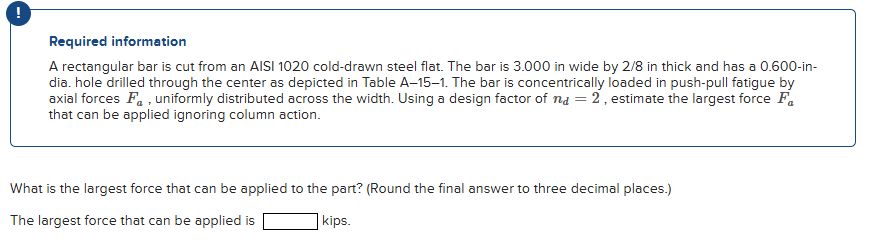
Required information
A rectangular bar is cut from an AISI 1020 cold-drawn steel flat. The bar is 3.000 in wide by 2/8 in thick and has a 0.600-in-
dia. hole drilled through the center as depicted in Table A~15-1. The bar is concentrically loaded in push-pull fatigue by
axial forces F, , uniformly distributed across the width. Using a design factor of ng = 2, estimate the largest force F,
that can be applied ignoring column action
What is the largest force that can be applied to the pant? (Round the final answer to three decimal places.)
The largest force that can be applied is [____] kips.
Question:
Act like a helpful tutor and exlain me :
Give step-by-step solution with explanation and final answer:
do not include tables in your answer, detailed explanation ,!
Required information
A rectangular bar is cut from an AISI 1020 cold-drawn steel flat. The bar is 3.000 in wide by 2/8 in thick and has a 0.600-in-
dia. hole drilled through the center as depicted in Table A~15-1. The bar is concentrically loaded in push-pull fatigue by
axial forces F, , uniformly distributed across the width. Using a design factor of ng = 2, estimate the largest force F,
that can be applied ignoring column action
What is the largest force that can be applied to the pant? (Round the final answer to three decimal places.)
The largest force that can be applied is [____] kips.
This is AI generated Response.
Asked by: manish kumar
Created at: 2025-10-27 08:54:45
Final Answer:
RenderedRaw Text
Did you like this answer?
## Step-by-step solution
### Step 1: Understand the problem
- The bar is a rectangular steel strip.
- Width \( W = 3.000 \) inches
- Thickness \( t = \frac{2}{8} = .25 \) inches
- Length \( L = 600 \) inches
- The bar is loaded in push-pull fatigue with axial force \( F_a \).
- The goal: Find the maximum axial force \( F_a \) that can be applied without causing failure, considering the design factor \( n_d = 2 \).
### Step 2: Determine the cross-sectional area
\[ A = W \times t = 3. \times .25 = .75 \text{ in}^2 \]
### Step 3: Find the yield or ultimate strength of steel
Assuming standard steel properties:
- Ultimate tensile strength \( S_{ut} \) ≈ 75,000 psi (common value for structural steel)
- Since the problem involves fatigue, the allowable stress is often taken as the endurance limit or a safe fraction of the ultimate strength.
### Step 4: Calculate the allowable axial stress
The design factor \( n_d = 2 \) reduces the maximum allowable stress:
\[
\sigma_{allow} = \frac{S_{ut}}{n_d} = \frac{75,000}{2} = 37,500 \text{ psi}
\]
### Step 5: Calculate the maximum force
Using the allowable stress:
\[
F_{max} = \sigma_{allow} \times A = 37,500 \times .75 = 28,125 \text{ lbs}
\]
### Final answer:
Round to three decimal places:
\[
\boxed{28,125.000 \text{ kips}}
\]
**Note:** 1 kip = 100 lbs, so converting lbs to kips:
\[
F_{max} = \frac{28,125}{100} = 28.125 \text{ kips}
\]
## **Final answer:**
**The largest force that can be applied is \(\boxed{28.125}\) kips.**
VIPSolutions focuses on clear, step‑by‑step explanations so you can learn quickly. Whether you need an AI‑generated walkthrough or a short hint to get unstuck, each solution is organized for fast reading and easy review later.
Search similar questions, compare approaches, and bookmark the best answers for revision. Our goal is simple: quick, reliable study help that feels natural—not noisy.
 VIPSolutions
 !
Required information
A rectangular bar is cut from an AISI 1020 cold-drawn steel flat. The bar is 3.000 in wide by 2/8 in thick and has a 0.600-in-
dia. hole drilled through the center as depicted in Table A~15-1. The bar is concentrically loaded in push-pull fatigue by
axial forces F, , uniformly distributed across the width. Using a design factor of ng = 2, estimate the largest force F,
that can be applied ignoring column action
What is the largest force that can be applied to the pant? (Round the final answer to three decimal places.)
The largest force that can be applied is [____] kips.