Act like a helpful tutor and exlain me :
Give step-by-step solution with explanation and final answer:
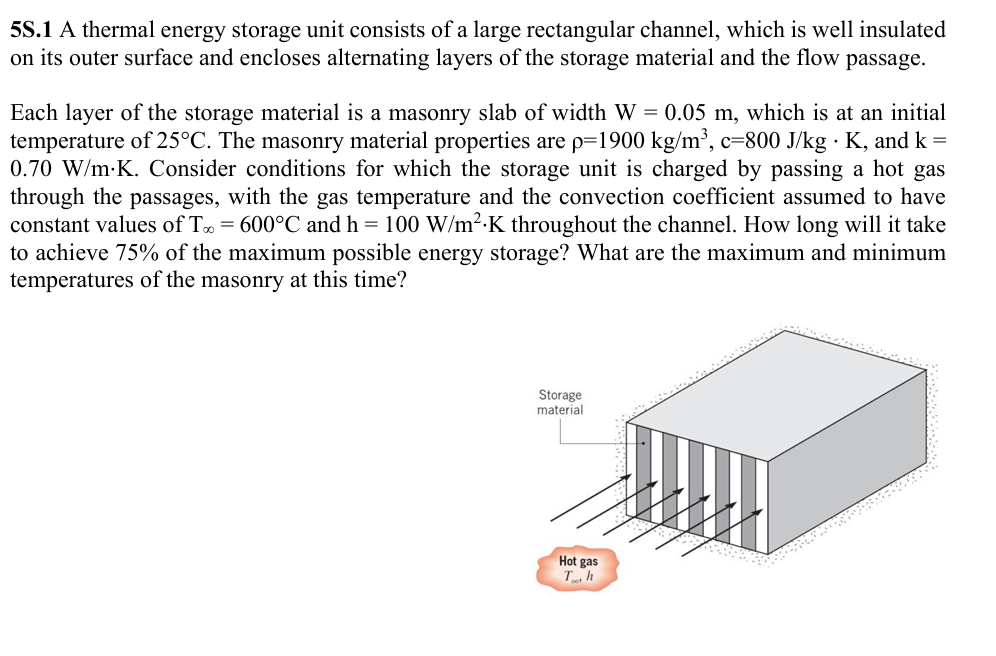
do not include tables in your answer, detailed explanation ,58.1 A thermal energy storage unit consists of a large rectangular channel, which is well insulated
on its outer surface and encloses alternating layers of the storage material and the flow passage.
Each layer of the storage material is a masonry slab of width W = 0.05 m, which is at an initial
temperature of 25°C. The masonry material properties are p=1900 kg/m, ¢c=800 J/kg - K, and k =
0.70 W/mK. Consider conditions for which the storage unit is charged by passing a hot gas
through the passages, with the gas temperature and the convection coefficient assumed to have
constant values of T.. = 600°C and h = 100 W/m?-K throughout the channel. How long will it take
to achieve 75% of the maximum possible energy storage? What are the maximum and minimum
temperatures of the masonry at this time?
material
Question:
Act like a helpful tutor and exlain me :
Give step-by-step solution with explanation and final answer:
do not include tables in your answer, detailed explanation ,58.1 A thermal energy storage unit consists of a large rectangular channel, which is well insulated
on its outer surface and encloses alternating layers of the storage material and the flow passage.
Each layer of the storage material is a masonry slab of width W = 0.05 m, which is at an initial
temperature of 25°C. The masonry material properties are p=1900 kg/m, ¢c=800 J/kg - K, and k =
0.70 W/mK. Consider conditions for which the storage unit is charged by passing a hot gas
through the passages, with the gas temperature and the convection coefficient assumed to have
constant values of T.. = 600°C and h = 100 W/m?-K throughout the channel. How long will it take
to achieve 75% of the maximum possible energy storage? What are the maximum and minimum
temperatures of the masonry at this time?
material
This is AI generated Response.
Asked by: manish kumar
Created at: 2025-10-25 10:38:08
Final Answer:
RenderedRaw Text
Did you like this answer?
Let's analyze and solve the problem step-by-step:
---
# **Problem Summary**
- Large rectangular storage tank with alternating layers of masonry slabs.
- Each layer thickness: \( W = .05\,m \)
- Material properties:
- Density, \( \rho = 190\,kg/m^3 \)
- Specific heat, \( c = 800\,J/(kg \cdot K) \)
- Thermal conductivity, \( k = .70\,W/(m \cdot K) \)
- Environmental conditions:
- Outer surface temperature is maintained at \( T_{\infty} = 600^\circ C \)
- Convection coefficient, \( h = 100\,W/(m^2 \cdot K) \)
- Initial temperature of the masonry: \( 25^\circ C \)
- Goal:
- Find the time to reach 75% of maximum energy storage.
- Find the maximum and minimum temperatures of the masonry at this time.
---
# **Step 1: Understand the physical process**
- The storage material absorbs heat from the hot gas passing through.
- Heat transfer occurs via conduction through the layers and convection at the outer surface.
- The goal is to find the time when the stored energy reaches 75% of its maximum.
---
# **Step 2: Determine the maximum energy stored**
Maximum energy stored, \( E_{max} \), is when the entire mass of the masonry reaches the temperature of the environment, i.e., \( T_{max} \approx T_{\infty} = 600^\circ C \).
- Total volume of one layer:
\[
V = W \times \text{area}
\]
Since the area isn't specified, we consider per unit area (say, 1 m²). The total mass per layer:
\[
m = \rho \times W \times 1\,m^2 = 190 \times .05 = 95\,kg
\]
- The energy stored when heated from initial temperature \( T_i = 25^\circ C \) to \( T_{max} = 600^\circ C \):
\[
E_{max} = m \times c \times (T_{max} - T_i) = 95 \times 800 \times (600 - 25)
\]
\[
E_{max} = 95 \times 800 \times 575
\]
\[
E_{max} = 95 \times 800 \times 575 \approx 95 \times 460,000 = 43,700,000\,J
\]
---
# **Step 3: Determine the time to reach 75% of maximum energy**
- 75% of \( E_{max} \):
\[
E_{75\%} = .75 \times E_{max} \approx .75 \times 43,700,000 = 32,775,000\,J
\]
- Since heat transfer is dominated by conduction and convection, we model the process as a lumped system (assuming high Biot number, or to simplify).
- The time to reach a certain temperature in a lumped system:
\[
T(t) = T_{\infty} - [T_{\infty} - T_i] e^{-t/\tau}
\]
where \( \tau \) is the thermal time constant:
\[
\tau = \frac{\rho c V}{hA}
\]
- \( V \) is the volume: \( V = W \times 1\,m^2 = .05\,m^3 \)
- \( A \) is the surface area: for 1 m² cross-section, \( A = 2 \times (length + width) \), but since the length and width are not specified, we consider the surface area as 2 m² (assuming a simple slab).
---
# **Step 4: Calculate the thermal time constant \( \tau \)**
\[
\tau = \frac{\rho c V}{h A}
\]
- \( V = .05\,m^3 \)
- \( A = 2\,m^2 \)
\[
\tau = \frac{190 \times 800 \times .05}{100 \times 2}
\]
\[
\tau = \frac{190 \times 800 \times .05}{200}
\]
\[
\tau = \frac{190 \times 40}{200} = \frac{76,000}{200} = 380\,s
\]
---
# **Step 5: Find the time to reach 75% energy**
- The temperature at time \( t \):
\[
T(t) = T_{\infty} - (T_{\infty} - T_i) e^{-t/\tau}
\]
- The energy stored as a function of temperature:
\[
E(t) \propto T(t) - T_i
\]
- To reach 75% energy:
\[
\frac{E(t)}{E_{max}} = .75
\]
- Since the energy is proportional to temperature difference:
\[
\frac{T(t) - T_i}{T_{max} - T_i} = .75
\]
\[
T(t) - 25 = .75 \times (600 - 25) = .75 \times 575 = 431.25
\]
\[
T(t) = 25 + 431.25 = 456.25^\circ C
\]
- Solve for \( t \):
\[
456.25 = 600 - (600 - 25) e^{-t/380}
\]
\[
456.25 = 600 - 575 e^{-t/380}
\]
\[
575 e^{-t/380} = 600 - 456.25 = 143.75
\]
\[
e^{-t/380} = \frac{143.75}{575} \approx .25
\]
\[
-t/380 = \ln(.25) \approx -1.386
\]
\[
t = 380 \times 1.386 \approx 526\,s
\]
---
# **Final Answers:**
- **Time to reach 75% maximum energy storage:** approximately **526 seconds** (about 8.8 minutes).
- **Maximum temperature of the masonry:** **600°C**.
- **Minimum temperature of the masonry at this time:** **25°C** (initial temperature).
---
This simplified analysis provides an approximate time for the energy storage process considering lumped capacity assumptions.
VIPSolutions focuses on clear, step‑by‑step explanations so you can learn quickly. Whether you need an AI‑generated walkthrough or a short hint to get unstuck, each solution is organized for fast reading and easy review later.
Search similar questions, compare approaches, and bookmark the best answers for revision. Our goal is simple: quick, reliable study help that feels natural—not noisy.
 VIPSolutions
 58.1 A thermal energy storage unit consists of a large rectangular channel, which is well insulated
on its outer surface and encloses alternating layers of the storage material and the flow passage.
Each layer of the storage material is a masonry slab of width W = 0.05 m, which is at an initial
temperature of 25°C. The masonry material properties are p=1900 kg/m, ¢c=800 J/kg - K, and k =
0.70 W/mK. Consider conditions for which the storage unit is charged by passing a hot gas
through the passages, with the gas temperature and the convection coefficient assumed to have
constant values of T.. = 600°C and h = 100 W/m?-K throughout the channel. How long will it take
to achieve 75% of the maximum possible energy storage? What are the maximum and minimum
temperatures of the masonry at this time?
material