 VIPSolutions
Act like a helpful tutor and exlain me : Give step-by-step solution with explanation and final answer: do not include tables in your answer, detailed explanation , Number all the links and joints clearly and find the degrees of freedom of the mechanism shown.
Question:
Act like a helpful tutor and exlain me :
Give step-by-step solution with explanation and final answer:
do not include tables in your answer, detailed explanation , Number all the links and joints clearly and find the degrees of freedom of the mechanism shown.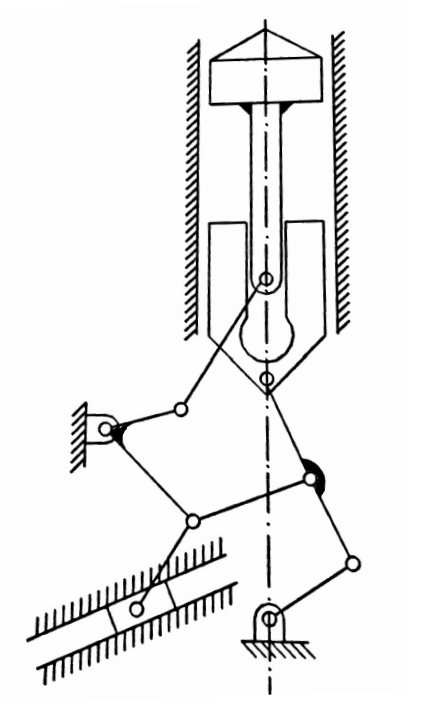
This is AI generated Response.
Asked by: manish kumar
Created at: 2025-10-25 08:07:34
Asked by: manish kumar
Created at: 2025-10-25 08:07:34
Final Answer:
Rendered
Raw Text
Did you like this answer?
Let's analyze the mechanism step-by-step to find its degrees of freedom (DOF).
---
## Step 1 Identify the links and joints
-Links:**
- Link : Fixed frame (attached to the wall)
- Link 2: Connecting link (the link between the fixed frame and the crank)
- Link 3: Crank (connected to the piston)
- Link 4: Connecting rod (between the crank and the piston)
- Link 5: Piston (moving vertically)
- **Joints:**
- Joint 1: Fixed pivot at the wall (for link 2)
- Joint 2: Revolute joint connecting link 2 and link 3
- Joint 3: Revolute joint between link 3 and link 4
- Joint 4: Revolute joint between link 4 and the piston (link 5)
- Joint 5: Slider (piston moving vertically)
---
## Step 2: Count the total number of links and joints
- **Number of links (including the fixed frame):** 5
- **Number of joints:** 5
---
## Step 3: Determine the type of joints
- Joints 1 to 4 are **revolute joints** (each providing 1 DOF)
- Joint 5 is a **sliding joint** (prismatic joint, providing 1 DOF)
---
## Step 4: Apply Gruebler's equation for planar mechanisms
The general formula for DOF is:
\[
\text{DOF} = 3(n - 1) - 2j_1 - j_2
\]
Where:
- \( n \): total number of links (including the fixed frame)
- \( j_1 \): number of **revolute joints**
- \( j_2 \): number of **prismatic joints**
For this mechanism:
- \( n = 5 \)
- \( j_1 = 4 \) (joints 1 to 4)
- \( j_2 = 1 \) (joint 5)
---
## Step 5: Calculate the degrees of freedom
\[
\text{DOF} = 3(5 - 1) - 2(4) - 1 = 3 \times 4 - 8 - 1 = 12 - 8 - 1 = 3
\]
---
## **Final Answer:**
**The mechanism has 3 degrees of freedom.**
This indicates it can move in three independent ways, which is typical for a mechanism controlling piston motion with additional possible movements.
📢 Instructions:
- Ask anything relatd to above question only.
- For new Question goto :