 VIPSolutions
Act like a helpful tutor and exlain me : Give step-by-step solution with explanation and final answer: do not include tables in your answer04. A Newtonian liquid of viscosity pu = 0.020 Pa - s fills a gap h = 6 mm between two large plates. The bottom plate y = 0 is fixed. The top surface at y = h is exposed to air exerting a uniform tangential shear To = 0.12 Pa in x direction. No imposed pressure gradient. a) u(y) 10 pts. b) Umax 5 pts. ou 5 pts. d) q (per unit width) 5 pts.
Question:
Act like a helpful tutor and exlain me :
Give step-by-step solution with explanation and final answer:
do not include tables in your answer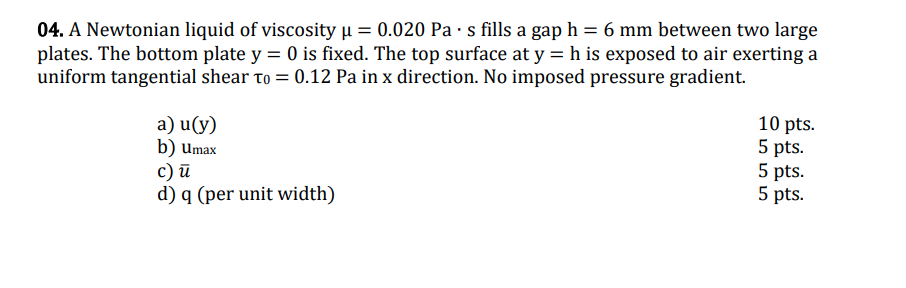 04. A Newtonian liquid of viscosity pu = 0.020 Pa - s fills a gap h = 6 mm between two large
plates. The bottom plate y = 0 is fixed. The top surface at y = h is exposed to air exerting a
uniform tangential shear To = 0.12 Pa in x direction. No imposed pressure gradient.
a) u(y) 10 pts.
b) Umax 5 pts.
ou 5 pts.
d) q (per unit width) 5 pts.
This is AI generated Response.
Asked by: manish kumar
Created at: 2025-10-24 19:13:34
Asked by: manish kumar
Created at: 2025-10-24 19:13:34
Final Answer:
Rendered
Raw Text
Did you like this answer?
Let's analyze the problem step-by-step.
---
## Given Data:
- Viscosity, \( \mu = .020\, \text{Pa·s} \)
- Gap between plates, \( h = 6\, \text{mm} = 6 \times 10^{-3}\, \text{m} \)
- Bottom plate is fixed at \( y = \)
- Top plate at \( y = h \), exposed to air
- Shear stress, \( \tau_ = .12\, \text{Pa} \)
- No pressure gradient in the x-direction
---
## Step 1: Understand the problem
The fluid is between two large plates:
- The bottom plate is stationary.
- The top plate moves or exerts a shear stress due to air exposure.
Since the top surface is exposed to air, the shear stress at the top surface is \( \tau_ \).
---
## Step 2: Find the velocity profile \( u(y) \)
In a steady, laminar flow with no pressure gradient, the Navier-Stokes equations reduce to a simple form:
\[
\frac{d^2 u}{dy^2} =
\]
which implies a linear velocity profile:
\[
u(y) = A y + B
\]
### Boundary conditions:
- At \( y= \), bottom plate is fixed: \( u() = \)
- At \( y=h \), shear stress \( \tau \) is related to velocity gradient:
\[
\tau = \mu \frac{du}{dy}
\]
Given the shear stress at \( y=h \):
\[
\left.\tau\right|_{y=h} = \tau_ = .12\, \text{Pa}
\]
---
## Step 3: Find the velocity gradient
Since \( \frac{du}{dy} \) is constant in a linear profile:
\[
\frac{du}{dy} = \frac{\tau}{\mu}
\]
At \( y=h \):
\[
\frac{du}{dy} = \frac{.12}{.020} = 6\, \text{m/s}
\]
This is the shear rate at the top surface.
---
## Step 4: Determine \( u(y) \)
Because the flow is linear:
\[
u(y) = \left( \frac{\tau}{\mu} \right) y + C
\]
Using boundary condition \( u() = \):
\[
= + C \Rightarrow C=
\]
Therefore:
\[
u(y) = 6 y
\]
At \( y=h=6\, \text{mm} = .006\, \text{m} \):
\[
u(h) = 6 \times .006 = .036\, \text{m/s}
\]
---
## **Final Results:**
### a) Velocity profile \( u(y) \):
\[
u(y) = 6 y \quad \text{(m/s)}
\]
### b) Maximum velocity \( u_{max} \):
\[
u_{max} = u(h) = .036\, \text{m/s}
\]
### c) Mean velocity \( \bar{u} \):
\[
\bar{u} = \frac{1}{h} \int_^{h} u(y) dy = \frac{1}{h} \times \frac{1}{2} u(h) h = \frac{u(h)}{2} = .018\, \text{m/s}
\]
### d) Shear stress per unit width \( q \):
Since shear stress is uniform:
\[
q = \tau_ \times h = .12\, \text{Pa} \times .006\, \text{m} = 7.2 \times 10^{-4}\, \text{N/m}
\]
---
## **Summary:**
- **Velocity profile:** \( u(y) = 6 y \, \text{m/s} \)
- **Maximum velocity:** \( .036\, \text{m/s} \)
- **Mean velocity:** \( .018\, \text{m/s} \)
- **Shear stress per unit width:** \( 7.2 \times 10^{-4} \, \text{N/m} \)
---
Let me know if you'd like further clarification!
📢 Instructions:
- Ask anything relatd to above question only.
- For new Question goto :