 VIPSolutions
Act like a helpful tutor and exlain me : Give step-by-step solution with explanation and final answer: Do not include any type of table in answer2) For uniform flow V=10 m/s over a circulation '=200 ms with a sink m=-500 ms , both Tf i located at the origin, determine the velocity 1 ‘magnitude at pt P located at (x,y) = (3.2). Use Oo LN PZ ad your preference to solve this ( 3 A rie at ! E Tr Ve
Question:
Act like a helpful tutor and exlain me :
Give step-by-step solution with explanation and final answer:
Do not include any type of table in answer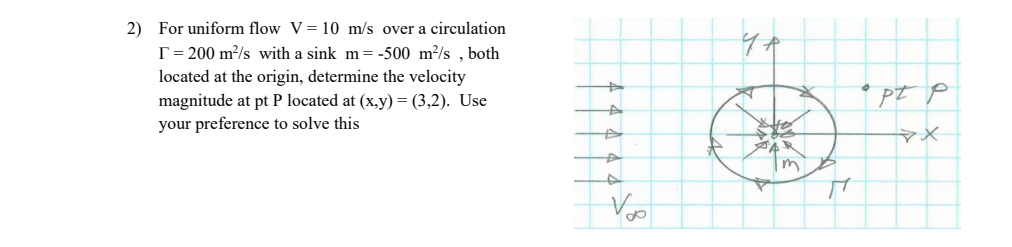 2) For uniform flow V=10 m/s over a circulation
'=200 ms with a sink m=-500 ms , both Tf i
located at the origin, determine the velocity 1
‘magnitude at pt P located at (x,y) = (3.2). Use Oo LN PZ ad
your preference to solve this ( 3 A rie
at !
E Tr
Ve
This is AI generated Response.
Asked by: manish kumar
Created at: 2025-10-24 09:36:06
Asked by: manish kumar
Created at: 2025-10-24 09:36:06
Final Answer:
Rendered
Raw Text
Did you like this answer?
Certainly! Let’s carefully analyze and solve the problem step-by-step.
---
# Problem Breakdown:
- **Flow velocity, \( V 10 \, \text{/s} \)** (constant)
- **Circulation, \( \Gamma = \, \text{}^2text{s} \)**
- **Sink strength, \( m = -500 \, \text{m}2/\text{s} \)** (negative because it's a sink)
- Both are located at the origin.
- **Point \( P \) at \((x, y) = (3, 2) \)**
- **Find the velocity magnitude at point \( P \).**
---
# Step 1: Understanding the flow components
The total flow at point \( P \) is composed of three parts:
1. **Uniform flow** \( \vec{V}_\infty \) in the x-direction with magnitude \( V = 10\, \text{m/s} \).
2. **Vortex flow** due to circulation \( \Gamma \).
3. **Sink flow** due to sink strength \( m \).
---
# Step 2: Velocity due to uniform flow
The uniform flow velocity vector:
\[
\vec{V}_\infty = V \hat{i} = 10 \hat{i} \, \text{m/s}
\]
This contributes a constant velocity component in the x-direction.
---
# Step 3: Velocity due to vortex (circulation \( \Gamma \))
For a vortex at the origin, the velocity at point \( (x, y) \) is:
\[
\vec{V}_\text{vortex} = \frac{\Gamma}{2\pi r^2} \begin{bmatrix} -y \\ x \end{bmatrix}
\]
Where:
- \( r = \sqrt{x^2 + y^2} \)
Plugging in \( (x, y) = (3, 2) \):
\[
r = \sqrt{3^2 + 2^2} = \sqrt{9 + 4} = \sqrt{13} \approx 3.606
\]
Now, the vortex velocity components:
\[
V_{x,\text{vortex}} = - \frac{\Gamma}{2\pi r^2} y
\]
\[
V_{y,\text{vortex}} = \frac{\Gamma}{2\pi r^2} x
\]
Calculate denominator:
\[
2\pi r^2 = 2 \times 3.1416 \times (13) \approx 81.68
\]
Calculate numerator:
\[
\frac{\Gamma}{2\pi r^2} \approx \frac{200}{81.68} \approx 2.447\, \text{m/s}
\]
Now, the components:
\[
V_{x,\text{vortex}} = - 2.447 \times 2 = -4.894\, \text{m/s}
\]
\[
V_{y,\text{vortex}} = 2.447 \times 3 = 7.341\, \text{m/s}
\]
---
# Step 4: Velocity due to sink \( m \)
For a sink at the origin, the velocity at \( (x, y) \) is:
\[
\vec{V}_\text{sink} = - \frac{m}{2\pi r} \hat{r}
\]
The radial unit vector:
\[
\hat{r} = \frac{1}{r} (x, y)
\]
Since \( m = -500 \):
\[
V_{x,\text{sink}} = - \frac{-500}{2\pi r} \times \frac{x}{r} = \frac{500}{2\pi r^2} x
\]
\[
V_{y,\text{sink}} = \frac{500}{2\pi r^2} y
\]
Calculate:
\[
2\pi r^2 = 81.68 \text{ (from previous step)}
\]
\[
V_{x,\text{sink}} = \frac{500}{81.68} \times 3 \approx 6.11 \times 3 = 18.33\, \text{m/s}
\]
\[
V_{y,\text{sink}} = 6.11 \times 2 = 12.22\, \text{m/s}
\]
---
# Step 5: Sum all velocity components
Total velocities:
\[
V_{x,\text{total}} = V + V_{x,\text{vortex}} + V_{x,\text{sink}} = 10 - 4.894 + 18.33 \approx 23.44\, \text{m/s}
\]
\[
V_{y,\text{total}} = + 7.341 + 12.22 \approx 19.56\, \text{m/s}
\]
---
# Step 6: Calculate the magnitude of the velocity at \( P \)
\[
V_{total} = \sqrt{V_{x,\text{total}}^2 + V_{y,\text{total}}^2}
\]
\[
V_{total} = \sqrt{(23.44)^2 + (19.56)^2} \approx \sqrt{549.8 + 382.4} = \sqrt{932.2} \approx 30.54\, \text{m/s}
\]
---
# **Final Answer:**
\[
\boxed{
\text{Velocity magnitude at point } (3, 2) \text{ is approximately } \mathbf{30.54\, \text{m/s}}
}
\]
📢 Instructions:
- Ask anything relatd to above question only.
- For new Question goto :