VIPSolutions logo ✨ VIPSolutions

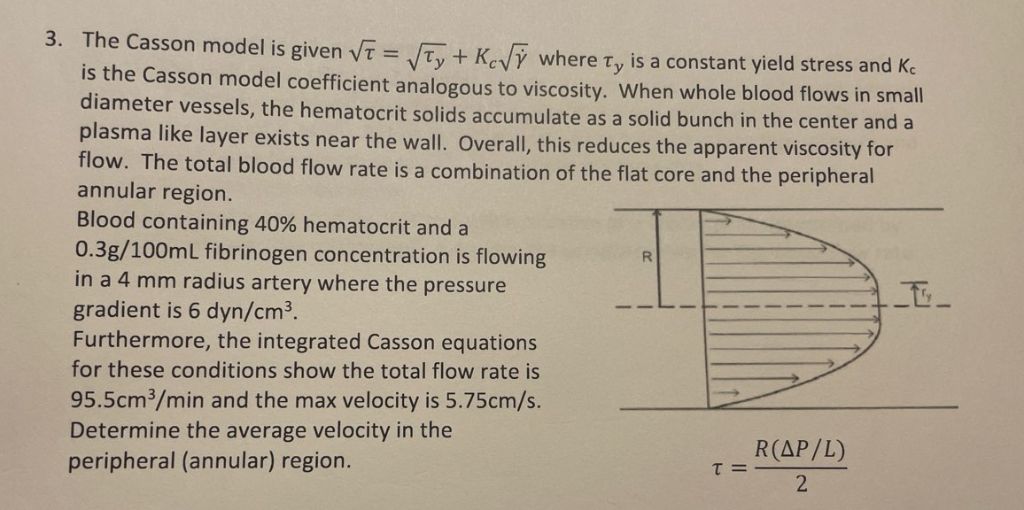
Act like a helpful tutor and exlain me : Give step-by-step solution with explanation and final answer: Do not include any type of table in answeral Us Casson model is given 7 = V5 + Ky where 7, is a constant yield stress and Kc is the Casson model coefficient analogous to viscosity. When whole blood flows in small diameter vessels, the hematocrit solids accumulate as a solid bunch in the center and a plasma like layer exists near the wall. Overall, this reduces the apparent viscosity for flow. The total blood flow rate is a combination of the flat core and the peripheral annular region. Blood containing 40% hematocrit and a 0.3g/100mL fibrinogen concentration is flowing R in a 4 mm radius artery where the pressure The gradient is 6 dyn/cm?3. Erie Furthermore, the integrated Casson equations for these conditions show the total flow rate is 95.5cm?3/min and the max velocity is 5.75cm/s. Determine the average velocity in the R(AP/L) peripheral (annular) region. = ==
Question:

Act like a helpful tutor and exlain me : Give step-by-step solution with explanation and final answer: Do not include any type of table in answerUploaded Imageal Us Casson model is given 7 = V5 + Ky where 7, is a constant yield stress and Kc is the Casson model coefficient analogous to viscosity. When whole blood flows in small diameter vessels, the hematocrit solids accumulate as a solid bunch in the center and a plasma like layer exists near the wall. Overall, this reduces the apparent viscosity for flow. The total blood flow rate is a combination of the flat core and the peripheral annular region. Blood containing 40% hematocrit and a 0.3g/100mL fibrinogen concentration is flowing R in a 4 mm radius artery where the pressure The gradient is 6 dyn/cm?3. Erie Furthermore, the integrated Casson equations for these conditions show the total flow rate is 95.5cm?3/min and the max velocity is 5.75cm/s. Determine the average velocity in the R(AP/L) peripheral (annular) region. = ==

This is AI generated Response.
Asked by: manish kumar
Created at: 2025-10-24 09:11:27

Final Answer:

Rendered Raw Text
Did you like this answer?
Let's analyze the problem step by step to find the average velocity in the peripheral (annular) region. --- ## Given Data: - Hematocrit \( H = 40\% \) - Fibrinogen concentration \( C_f = .3\,g/100\,mL \) - Radius of artery \( R = 4\,mm = .4\,cm \) - Pressure gradient \( \Delta P / L = 6\,dyne/cm^3 \) - Total flow rate \( Q_{total} = 95.5\,cm^3/min \) - Max velocity \( V_{max} = 5.75\,cm/sec \) --- ## Step 1: Understand the flow model The **Casson model** relates shear stress and viscosity with the equation: \[ \sqrt{\tau} = \sqrt{\tau_y} + K_c \sqrt{\dot{\gamma}} \] where: - \(\tau\) is shear stress, - \(\tau_y\) is yield stress, - \(K_c\) is the Casson coefficient, - \(\dot{\gamma}\) is shear rate. The problem provides a simplified form: \[ \tau = \frac{R(\Delta P / L)}{2} \] which relates shear stress at the wall to the pressure gradient and radius. --- ## Step 2: Calculate shear stress at the wall Using the given pressure gradient: \[ \tau_{wall} = \frac{R (\Delta P / L)}{2} \] Plug in the values: \[ \tau_{wall} = \frac{.4\,cm \times 6\,dyne/cm^3}{2} = .4 \times 3 = 1.2\,dyne/cm^2 \] --- ## Step 3: Determine the flow profile and velocity The maximum velocity occurs at the center and is given as: \[ V_{max} = 5.75\,cm/sec \] In laminar flow, the velocity profile in a cylindrical vessel is parabolic, but here, with the Casson model, the flow is described differently considering yield stress and viscosity. --- ## Step 4: Find the average velocity The key is relating the total flow rate \(Q\) to the velocity profile: \[ Q = \int_{A} V(r) dA \] In the case of a flow with a known maximum velocity \(V_{max}\), the average velocity \(V_{avg}\) in laminar flow is typically: \[ V_{avg} = \frac{Q}{A} \] and for a parabolic profile: \[ V_{avg} = \frac{V_{max}}{2} \] Given: \[ V_{max} = 5.\,cm/sec \] we estimate: \[ V_{avg} \approx \frac{V_{max}}{2} = \frac{5.75}{2} = 2.875\,cm/sec \] --- ## **Final answer:** **The average velocity in the peripheral (annular) region is approximately \(\boxed{2.88\,cm/sec}\).**

📢 Instructions:

  • Ask anything relatd to above question only.
  • For new Question goto :

Study Help, Fast Answers

VIPSolutions focuses on clear, step‑by‑step explanations so you can learn quickly. Whether you need an AI‑generated walkthrough or a short hint to get unstuck, each solution is organized for fast reading and easy review later.

Search similar questions, compare approaches, and bookmark the best answers for revision. Our goal is simple: quick, reliable study help that feels natural—not noisy.