 VIPSolutions
Act like a helpful tutor and exlain me : Give step-by-step solution with explanation and final answer:of elimination reaction, OH H H* — —_— : nO | te m dk
Question:
Act like a helpful tutor and exlain me :
Give step-by-step solution with explanation and final answer: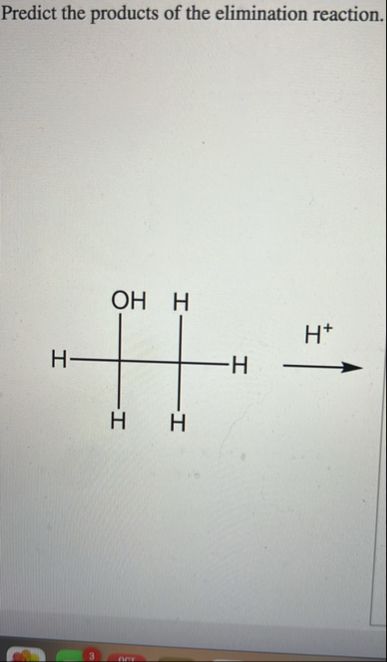 of elimination reaction,
OH H
H*
— —_—
: nO |
te
m dk
This is AI generated Response.
Asked by: 3quin0xx
Created at: 2025-10-23 03:48:06
Asked by: 3quin0xx
Created at: 2025-10-23 03:48:06
Final Answer:
Rendered
Raw Text
Did you like this answer?
Let's analyze the problem step-by-step.
---
# **Given:**
- The structure is **ethanol (C₂H₅OH)**, with the molecular structure shown.
- The reaction involves **acidic conditions** (H⁺).
---
# **Objective:**
Predict the products of the **elimination reaction** when ethanol is treated with an acid (H⁺).
---
# **Step 1: Understand the structure**
Ethanol (C₂H₅OH):
```
H H
| |
H — C — C — OH
| |
H H
```
The structure shows a hydroxyl group (-OH) attached to the second carbon.
---
# **Step 2: Recognize the type of reaction**
- Under acidic conditions, **elimination reactions** typically involve removal of a proton (H⁺) and a leaving group (like -OH), leading to the formation of an **alkene**.
- In alcohols, especially under acid catalysis, the hydroxyl group can be protonated to form a better leaving group (water, H₂O).
---
# **Step 3: Protonate the hydroxyl group**
- The hydroxyl group gets protonated:
\[
\text{Ethanol} \rightarrow \text{Protonated ethanol}
\]
- The protonated form looks like:
\[
\mathrm{C_2H_5–OH_2^+}
\]
which is a good leaving group.
---
# **Step 4: Loss of water**
- The protonated hydroxyl group leaves as water:
\[
\mathrm{C_2H_5–OH_2^+} \rightarrow \mathrm{C_2H_5^+} + \mathrm{H_2O}
\]
- The resulting carbocation is a **primary carbocation**:
\[
\mathrm{CH_3–CH_2^+}
\]
---
# **Step 5: Elimination (Deprotonation)**
- A proton (H⁺) from a neighboring carbon (preferably from the carbon adjacent to the carbocation) is removed, forming a double bond:
\[
\mathrm{CH_3–CH_2^+} + \text{base} \rightarrow \text{alkene}
\]
- The most stable alkene is formed by removing a hydrogen from the carbon adjacent to the carbocation.
---
# **Step 6: Final product prediction**
- Removing a hydrogen from the methyl group (attached to the CH₂) yields **ethene (C₂H₄)**:
\[
\boxed{
\text{Product: Ethene (C}_2\text{H}_4)
}
\]
---
# **Final answer:**
**The elimination of water from ethanol under acidic conditions produces ethene (C₂H₄).**
📢 Instructions:
- Ask anything relatd to above question only.
- For new Question goto :