 VIPSolutions
Act like a helpful tutor and exlain me : Give step-by-step solution with explanation and final answer: solve all parts completely, do not include tables in your answerThe two Pelton turbines at the Moccasin Powerhouse have 97% efficiency. Each of the two turbines produces up to 55 MW. Multiple water jets drive each turbine. The water jets driving the turbine produce a total flow rate of 4 m%s with a velocity of 83 m/s (185 miles per hour). (a) Determine the maximum head provided by one of the turbines (h,). (b) Estimate the force (kN) exerted by the water on one of the turbines if the water is deflected by 150 degrees. Sone ’ (%) ARH ASX
Question:
Act like a helpful tutor and exlain me :
Give step-by-step solution with explanation and final answer:
solve all parts completely, do not include tables in your answer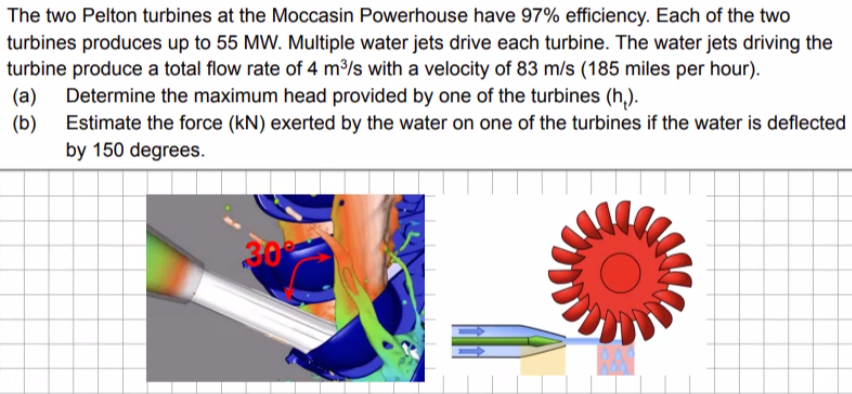 The two Pelton turbines at the Moccasin Powerhouse have 97% efficiency. Each of the two
turbines produces up to 55 MW. Multiple water jets drive each turbine. The water jets driving the
turbine produce a total flow rate of 4 m%s with a velocity of 83 m/s (185 miles per hour).
(a) Determine the maximum head provided by one of the turbines (h,).
(b) Estimate the force (kN) exerted by the water on one of the turbines if the water is deflected
by 150 degrees.
Sone
’
(%) ARH
ASX
This is AI generated Response.
Asked by: manish kumar
Created at: 2025-10-22 21:47:51
Asked by: manish kumar
Created at: 2025-10-22 21:47:51
Final Answer:
Rendered
Raw Text
Did you like this answer?
Let's analyze and solve the problem step by step.
---
# Given:
- Efficiency of each Pelton turbine:97%**
Power output per turbine: ** MW**
- Total flow rate: **4 m³/s**
- of water: **83 m/s**
- Water jets drive the turbines with multiple jets (number of jets per turbine not specified directly, but implied to be consistent- Water deflects by: **150 degrees** (for force estimation)
- Temperature or other parameters are not given, so focus on fluid dynamics and energy principles.
---
# Part (a): Determine the maximum head (h<sub>t</sub>) provided by one turbine
### Step 1: Convert power to useful hydraulic power
Since efficiency (η) = 97%, the hydraulic power (P<sub>hydraulic</sub>) supplied to the turbine is:
\[
P_{hydraulic} = \frac{P_{output}}{\eta}
\]
\[
P_{hydraulic} = \frac{55 \text{ MW}}{.97} \approx 56.7 \text{ MW}
\]
### Step 2: Calculate the hydraulic power using flow rate and head
Hydraulic power can be expressed as:
\[
P_{hydraulic} = \rho \cdot g \cdot Q \cdot h_t
\]
Where:
- \(\rho\) = density of water = **100 kg/m³**
- \(g\) = acceleration due to gravity = **9.81 m/s²**
- \(Q\) = flow rate = **4 m³/s**
- \(h_t\) = head in meters (unknown, to find)
### Step 3: Solve for \(h_t\)
\[
h_t = \frac{P_{hydraulic}}{\rho \cdot g \cdot Q}
\]
\[
h_t = \frac{56.7 \times 10^6}{100 \times 9.81 \times 4}
\]
\[
h_t \approx \frac{56.7 \times 10^6}{39,240}
\]
\[
h_t \approx 1444.8 \text{ meters}
\]
---
# **Answer for Part (a):**
**Maximum head \(h_t\) provided by one turbine is approximately \(\boxed{1445 \text{ meters}}\).**
---
# Part (b): Estimate the force (kN) exerted by water on the turbine blade when the water is deflected by 150 degrees
### Step 1: Understand the problem
The force exerted by the water depends on the change in momentum of water as it strikes and deflects off the turbine blades.
### Step 2: Calculate the initial momentum flux
The velocity of water jets:
\[
V = 83 \text{ m/s}
\]
Flow rate:
\[
Q = 4 \text{ m}^3/\text{s}
\]
Number of jets isn't specified explicitly, but since the problem asks for the force exerted by water on one turbine, assume the total flow rate applies to all jets combined.
The mass flow rate:
\[
\dot{m} = \rho \times Q = 100 \times 4 = 400 \text{ kg/s}
\]
### Step 3: Determine change in velocity components
Water strikes the blades with velocity \(V\). After deflection by \(\theta = 150^\circ\), the change in velocity component in the direction of the jet is:
\[
\Delta V = V (\cos 150^\circ - \cos ^\circ)
\]
But more straightforwardly, the force relates to the change in momentum flux:
\[
F = \dot{m} \times \Delta V
\]
Since the water is deflected by 150 degrees, the change in velocity component along the original direction:
\[
\Delta V = V (1 - \cos 150^\circ)
\]
\[
\cos 150^\circ = -\cos 30^\circ = -.866
\]
\[
\Delta V = 83 \times (1 - (-.866)) = 83 \times 1.866 \approx 154.9 \text{ m/s}
\]
### Step 4: Calculate the force
\[
F = \dot{m} \times \Delta V = 400 \times 154.9 \approx 619,600 \text{ N}
\]
Convert to kN:
\[
F \approx 620 \text{ kN}
\]
---
# **Final answer for Part (b):**
**The force exerted by the water on one turbine blade when deflected by 150 degrees is approximately \(\boxed{620 \text{ kN}}\).**
---
**Summary:**
- Part (a): Maximum head \(h_t \approx 1445 \text{ meters}\)
- Part (b): Force exerted \( \approx 620 \text{ kN} \)
Let me know if you'd like further clarification!
📢 Instructions:
- Ask anything relatd to above question only.
- For new Question goto :