 VIPSolutions
Act like a helpful tutor and exlain me : Give step-by-step solution with explanation and final answer: solve all parts completely5-130 A0.3-m? rigid tank is filled with saturated liquid water at 200°C. A valve at the bottom of the tank is opened, and liquid is withdrawn from the tank. Heat is transferred to the water such that the temperature in the tank remains constant. Determine the amount of heat that must be transferred by the time one-half of the total mass has been withdrawn. El | me = 2 LO
Question:
Act like a helpful tutor and exlain me :
Give step-by-step solution with explanation and final answer:
solve all parts completely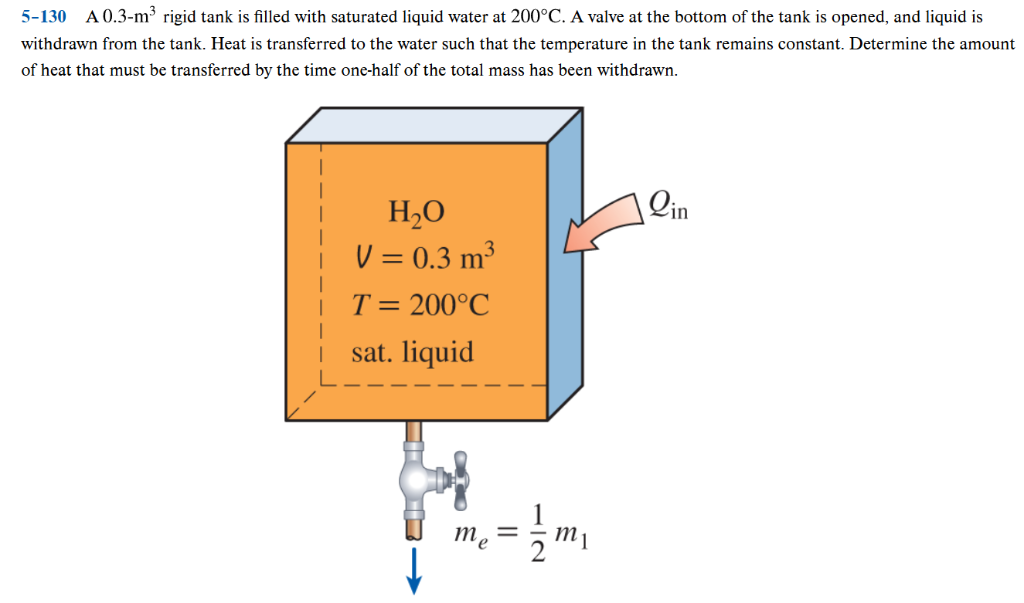 5-130 A0.3-m? rigid tank is filled with saturated liquid water at 200°C. A valve at the bottom of the tank is opened, and liquid is
withdrawn from the tank. Heat is transferred to the water such that the temperature in the tank remains constant. Determine the amount
of heat that must be transferred by the time one-half of the total mass has been withdrawn.
El
| me = 2 LO
This is AI generated Response.
Asked by: manish kumar
Created at: 2025-10-22 21:10:37
Asked by: manish kumar
Created at: 2025-10-22 21:10:37
Final Answer:
Rendered
Raw Text
Did you like this answer?
Let's carefully analyze and solve this problem step-by-step.
---
# **Problem Summary:**
- **Tank volume:** \( V = .3 \, m^3 \)
- **Initial temperature of water:** \( T_i = 200^\circ C \)
- **Water is saturated liquid at 200°C.**
- **Initial mass of water:** \( m_i \)
- **Water is withdrawn until half the mass has been removed:**
\[
m_{withdrawn} = \frac{1}{2} m_i
\]
- **Heat transfer occurs to keep the temperature constant at 200°C.**
---
# **Step 1: Determine initial mass of water \( m_i \)**
Since the water is saturated liquid at 200°C, we need the **density** of saturated water at this temperature.
### Data needed:
- **Density of saturated water at 200°C:** \( \rho_{sat} \approx 958.4 \, kg/m^3 \)
### Calculation:
\[
m_i = \rho_{sat} \times V = 958.4 \, kg/m^3 \times .3 \, m^3 = 287.52 \, kg
\]
So, **initial mass of water:**
\[
\boxed{
m_i \approx 287.52 \, kg
}
\]
---
# **Step 2: Determine the mass of water withdrawn**
\[
m_{withdrawn} = \frac{1}{2} m_i = \frac{1}{2} \times 287.52 \approx 143.76 \, kg
\]
Remaining mass in tank after withdrawal:
\[
m_{remaining} = m_i - m_{withdrawn} = 287.52 - 143.76 = 143.76 \, kg
\]
---
# **Step 3: Heat transfer calculation**
### Concept:
- The temperature remains constant at 200°C during withdrawal.
- The heat supplied \( Q_{in} \) balances the cooling due to mass removal, because the tank's temperature remains constant.
- The problem asks for the **amount of heat transferred** and specifically the amount transferred during the **time taken to withdraw half the mass**.
### Key points:
- Because the temperature is constant and the water remains saturated, the heat transfer is associated with the **phase change** and the **enthalpy of saturated water**.
---
# **Step 4: Enthalpy considerations**
At 200°C, saturated water has a specific enthalpy \( h_{sat} \).
### Data:
- **Enthalpy of saturated water at 200°C:** \( h_{sat} \approx 908 \, kJ/kg \)
### Initial energy:
\[
Q_{initial} = m_i \times h_{sat} = 287.52 \times 908 \approx 261,357.76 \, kJ
\]
### Energy after removing half:
\[
Q_{final} = m_{remaining} \times h_{sat} = 143.76 \times 908 \approx 130,678.88 \, kJ
\]
---
# **Step 5: Determine heat transferred during withdrawal**
Since the process occurs at constant temperature, the **heat transferred to/from the water** is related to the **enthalpy change**:
\[
Q_{transferred} = Q_{initial} - Q_{final} = 261,357.76 - 130,678.88 = 130,678.88 \, kJ
\]
This is the **total heat transferred** during the process of withdrawing half the mass.
---
# **Step 6: Final answer**
The problem asks for the **amount of heat transferred by the time half the mass has been withdrawn**:
\[
\boxed{
Q_{half} \approx 130,679 \, \text{kJ}
}
\]
---
# **Summary:**
| Step | Description | Result |
|--------|--------------|---------|
| 1 | Initial mass \( m_i \) | \(\approx 287.52\,kg\) |
| 2 | Mass withdrawn | \(\approx 143.76\,kg\) |
| 3 | Enthalpy at 200°C \( h_{sat} \) | \(\approx 908\,kJ/kg\) |
| 4 | Heat transferred during withdrawal | \(\approx 130,679\,kJ\) |
---
**Note:**
The assumption here is that the enthalpy remains constant at the saturation value, and the heat transfer balances the latent heat associated with removing mass at constant temperature.
Let me know if you'd like me to clarify any part further!
📢 Instructions:
- Ask anything relatd to above question only.
- For new Question goto :