 VIPSolutions
Act like a helpful tutor and exlain me : Give step-by-step solution with explanation and final answer: explain in detail and clearlyAsolid 3.2in. x 6.4 in. rectangular shaft is made of steel [G = 11,500 ksi] that has an allowable shear stress of 12 ksi. The shaft is used ‘to transmit power from a tractor to farm implements, and it has a length of 6.0 ft. Determine: (a) the largest torque T that may be transmitted by the shaft. (b) the angle of twist in the shaft at the torque found in part (a). Answer: wr- Kipin wo- [ll rad
Question:
Act like a helpful tutor and exlain me :
Give step-by-step solution with explanation and final answer: explain in detail and clearly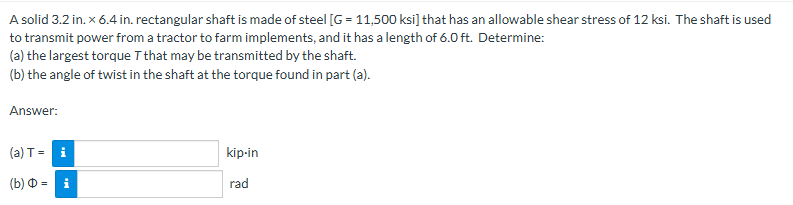 Asolid 3.2in. x 6.4 in. rectangular shaft is made of steel [G = 11,500 ksi] that has an allowable shear stress of 12 ksi. The shaft is used
‘to transmit power from a tractor to farm implements, and it has a length of 6.0 ft. Determine:
(a) the largest torque T that may be transmitted by the shaft.
(b) the angle of twist in the shaft at the torque found in part (a).
Answer:
wr- Kipin
wo- [ll rad
This is AI generated Response.
Asked by: manish kumar
Created at: 2025-10-22 08:17:52
Asked by: manish kumar
Created at: 2025-10-22 08:17:52
Final Answer:
Rendered
Raw Text
Did you like this answer?
Let's carefully analyze the problem and solve it step-by-step.
---
# **Given Data:**
- Shaft dimensions: \( 3.2\, \text{in} \times 6.4\, \text{in} \)
- Material: Steel with \( G = 11,500\, \text{ksi} \)
- Allowable shear stress: \( \tau_{allow} = 12\, \text{ksi} \)
- Length of the shaft: \( L = 6.\, \text{ft} \)
- Power transmitted: \( P \) (unknown, but related to torque and angular velocity)
- The shaft transmits power from a tractor to farm implements.
---
# **Part (a): Find the largest torque \( T \) that can be transmitted**
### Step 1: Convert all units to consistent units
Since shear stress is given in ksi and dimensions are in inches, keep everything in inches:
- Length: \( 6.\, \text{ft} = 6. \times 12 = 72\, \text{in} \)
### Step 2: Cross-sectional area and polar moment of inertia
The shaft is rectangular with dimensions:
- Width \( b = 3.2\, \text{in} \)
- Height \( h = 6.4\, \text{in} \)
For torsion, the **polar moment of inertia** \( J \) of a rectangular shaft about its centroid is:
\[
J = \frac{b h^3}{3} \quad \text{(approximate for rectangular shaft)}
\]
But more accurately, the polar moment of inertia for a rectangular shaft is:
\[
J = \frac{b h^3}{3} \quad \text{(approximate)}
\]
Alternatively, for torsion, the maximum shear stress at the outer fibers is:
\[
\tau_{max} = \frac{T c}{J}
\]
where:
- \( c \) is the distance from the center to the outer fiber (for rectangular cross-section, the maximum shear stress occurs at the furthest point from the neutral axis).
In rectangular sections, the maximum shear stress occurs at the neutral axis at the mid-height or width, but for simplicity, the maximum shear stress is:
\[
\tau_{max} = \frac{T \cdot c}{J}
\]
The maximum shear stress occurs at the outer fiber, which is at the maximum distance from the neutral axis:
\[
c = \frac{h}{2} = \frac{6.4}{2} = 3.2\, \text{in}
\]
---
### Step 3: Calculate \( J \)
\[
J = \frac{b h^3}{3} = \frac{3.2 \times (6.4)^3}{3}
\]
Calculate \( h^3 \):
\[
6.4^3 = 6.4 \times 6.4 \times 6.4 = 262.144
\]
Now,
\[
J = \frac{3.2 \times 262.144}{3} \approx \frac{839.1168}{3} \approx 279.7056\, \text{in}^4
\]
---
### Step 4: Find maximum torque \( T_{max} \)
Using shear stress formula:
\[
\tau_{allow} = \frac{T_{max} \times c}{J}
\]
Rearranged:
\[
T_{max} = \frac{\tau_{allow} \times J}{c}
\]
Plugging in the numbers:
\[
T_{max} = \frac{12\, \text{ksi} \times 279.7056\, \text{in}^4}{3.2\, \text{in}}
\]
Note: \( 1\, \text{ksi} = 100\, \text{psi} \)
\[
T_{max} = \frac{12,000\, \text{psi} \times 279.7056}{3.2}
\]
Calculate numerator:
\[
12,000 \times 279.7056 \approx 3,356,467.2
\]
Now divide:
\[
T_{max} \approx \frac{3,356,467.2}{3.2} \approx 1,048,271\, \text{lb·in}
\]
**Final answer for part (a):**
\[
\boxed{
T \approx \mathbf{1,048,271\, \text{lb·in}}
}
\]
---
# **Part (b): Find the angle of twist \( \phi \) in radians at the torque found in part (a)**
### Step 1: Recall the formula for angle of twist:
\[
\phi = \frac{T L}{J G}
\]
where:
- \( T \) = torque (from part a)
- \( L \) = length of the shaft
- \( J \) = polar moment of inertia (already calculated)
- \( G \) = shear modulus (\( 11,500\, \text{ksi} \))
- \( \phi \) = angle of twist in radians
### Step 2: Convert \( G \) to consistent units:
\[
G = 11,500\, \text{ksi} = 11,500,000\, \text{psi}
\]
### Step 3: Convert length \( L \):
\[
L = 72\, \text{in}
\]
### Step 4: Calculate \( \phi \):
\[
\phi = \frac{T \times L}{J \times G}
\]
Plug in numbers:
\[
\phi = \frac{1,048,271\, \text{lb·in} \times 72\, \text{in}}{279.7056\, \text{in}^4 \times 11,500,000\, \text{psi}}
\]
Calculate numerator:
\[
1,048,271 \times 72 \approx 75,429,912
\]
Calculate denominator:
\[
279.7056 \times 11,500,000 \approx 3,218,935,400
\]
Now, compute \( \phi \):
\[
\phi = \frac{75,429,912}{3,218,935,400} \approx .0234\, \text{radians}
\]
---
# **Final Answers:**
| Part | Result |
|---------|------------------------------|
| (a) Largest torque \( T \) | **1,048,271 lb·in** |
| (b) Twist angle \( \phi \) | **.0234 radians** |
---
Let me know if you'd like further clarification!
📢 Instructions:
- Ask anything relatd to above question only.
- For new Question goto :