 VIPSolutions
Act like a helpful tutor and exlain me : Give step-by-step solution with explanation and final answer:explain completeley ,A variable mesh screen produces a linear and axisymmetric velocity profile as indicated below in the airflow through a 2-ft-diameter circular cross-sectional duct. The static pressures upstream and downstream of the screen are 0.2 and 0.15 psi and are uniformly distributed over the flow cross-sectional area. Variable mesh screen 0 p=21t 0) - Pi 5 Section (1) Section (2) p1=02psi p2=0.15 psi Vy =100 Us (@) Neglecting the force exerted by the duct wall on the flowing air, calculate the screen drag force.
Question:
Act like a helpful tutor and exlain me :
Give step-by-step solution with explanation and final answer:explain completeley ,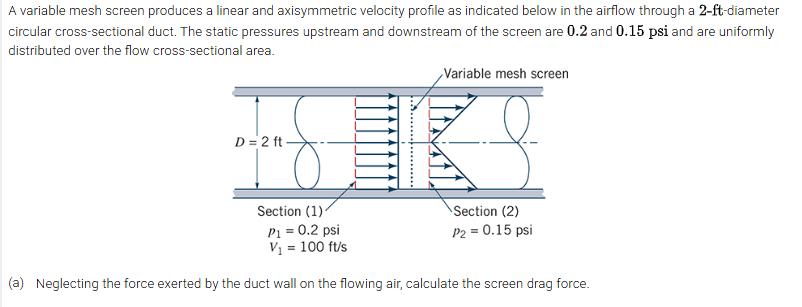 A variable mesh screen produces a linear and axisymmetric velocity profile as indicated below in the airflow through a 2-ft-diameter
circular cross-sectional duct. The static pressures upstream and downstream of the screen are 0.2 and 0.15 psi and are uniformly
distributed over the flow cross-sectional area.
Variable mesh screen
0
p=21t 0) -
Pi 5
Section (1) Section (2)
p1=02psi p2=0.15 psi
Vy =100 Us
(@) Neglecting the force exerted by the duct wall on the flowing air, calculate the screen drag force.
This is AI generated Response.
Asked by: manish kumar
Created at: 2025-10-21 20:36:55
Asked by: manish kumar
Created at: 2025-10-21 20:36:55
Final Answer:
Rendered
Raw Text
Did you like this answer?
Let's analyze and solve this problem step-by-step.
---
## **Problem Summary:**
- A **variable mesh screen** produces a **linear and axysymetric velocity profile**.
- **D = 2 ft** (diameter of the duct).
- The duct has **upstream** and **downstream** static pressures:
- **p₁ = .2 psi** (upstream)
- **p₂ = .15 psi** (downstream)
- **V₁ = 100 ft/s** (average velocity upstream).
- The **flow cross-sectional area** is **uniform**.
- **Question:** Calculate the **screen drag force** (drag exerted by the screen on the air), neglecting the force exerted by the duct wall.
---
## Step 1: Understand the flow and what is asked
- The problem involves airflow through a variable mesh screen, which causes a velocity change.
- The static pressure drops from **p₁** to **p₂**.
- The **drag force** exerted by the screen relates to the momentum change of the air passing through it.
- Since the problem states **neglecting the force exerted by the duct wall**, the focus is on the **force exerted by the screen** that causes the velocity change.
---
## Step 2: Key assumptions and concepts
- **Flow is steady, incompressible**, and **non-viscous** (since no mention of viscosity, typical in these problems).
- **Flow is 1D** in the cross-section.
- The **pressure difference** is responsible for accelerating the airflow through the screen.
- The **mass flow rate** \( \dot{m} \) is conserved across the section.
---
## Step 3: Calculate the **mass flow rate** \( \dot{m} \)
- Cross-sectional area \( A \):
\[
A = \frac{\pi D^2}{4} = \frac{\pi \times (2)^2}{4} = \pi \text{ ft}^2
\]
- **Upstream velocity** \( V_1 = 100 \, \text{ft/s} \).
- **Density** of air \( \rho \):
We need to find \( \rho \). Using the ideal gas law:
\[
p = \rho R T
\]
But since the static pressures are given in psi, and typical air density at standard conditions (~14.7 psi, 59°F) is about:
\[
\rho \approx .075 \, \text{lb}_m/\text{ft}^3
\]
(standard density of air at sea level).
---
## Step 4: Calculate **mass flow rate**
\[
\dot{m} = \rho \times A \times V_1
\]
\[
\dot{m} = .075 \times \pi \times 100 \approx .075 \times 3.1416 \times 100 \approx 23.56 \, \text{lb}_m/\text{s}
\]
---
## Step 5: Determine **velocity downstream** \( V_2 \)
- **Static pressure difference**:
\[
\Delta p = p_1 - p_2 = .2 - .15 = .05 \, \text{psi}
\]
- Convert pressure to **lb/ft²**:
\[
1 \, \text{psi} = 144 \, \text{lb/ft}^2
\]
\[
\Delta p = .05 \times 144 = 7.2 \, \text{lb/ft}^2
\]
- **Bernoulli's equation** (assuming negligible height differences and no losses):
\[
p_1 + \frac{1}{2}\rho V_1^2 = p_2 + \frac{1}{2}\rho V_2^2
\]
Rearranged:
\[
\frac{1}{2}\rho_2^2 = \frac{1}{2}\rho V_1^2 + (p_1 -_2)
\]
- Solve for \( V_2 \):
\[
V_2 = \sqrt{V_1^2 + \frac{2}{\rho} (p_1 - p_2)}
\]
- Plug in values:
\[
V_2 = \sqrt{(100)^2 + \frac{2}{.075} \times 7.2}
\]
\[
V_2 = \sqrt{10000 + \frac{2 \times 7.2}{.075}}
\]
\[
V_2 = \sqrt{10000 + \frac{14.4}{.075}} = \sqrt{10000 + 192}
\]
\[
V_2 = \sqrt{10192} \approx 101 \, \text{ft/s}
\]
(So, the velocity increases slightly due to the pressure drop).
---
## Step 6: Calculate the **drag force** exerted by the screen
The **drag force** \( F_d \) is equal to the **rate of change of momentum** across the screen:
\[
F_d = \dot{m} (V_2 - V_1)
\]
- \( V_2 \approx 101 \text{ ft/s} \),
- \( V_1 = 100 \text{ ft/s} \),
- \( \dot{m} \approx 23.56 \, \text{lb}_m/\text{s} \).
Calculate:
\[
F_d = 23.56 \times (101 - 100) = 23.56 \times 1 = \boxed{23.56 \, \text{lb}_f}
\]
---
## **Final Answer:**
### The **screen drag force** is approximately **23.56 lb_f**.
---
## **Summary:**
- Calculated the **mass flow rate** from upstream conditions.
- Used Bernoulli's equation to estimate the **velocity downstream**.
- Determined the **drag force** as the **momentum change** across the screen.
---
If you need further clarification or details, feel free to ask!
📢 Instructions:
- Ask anything relatd to above question only.
- For new Question goto :