 VIPSolutions
Act like a helpful tutor and exlain me : Give step-by-step solution with explanation and final answer:W 4.4- The Mean Value Theorem 1. Use the graph below to estimate the value of c that satisfies the conclusion of the Mean Value Theorem on the interval [3,2]. On the graph below, sketch the secant line for [3,2] as well as the tangent line at c. y : 0 x / id 2. Find the number which satisfies the Mean Value Theorem for the function f(x)=x"=3x"=18x+40 onthe interval [-3,2]. 3. Show that the equation x* —15x+c=0 has at most one zero in the interval [-2,2].
Question:
Act like a helpful tutor and exlain me :
Give step-by-step solution with explanation and final answer: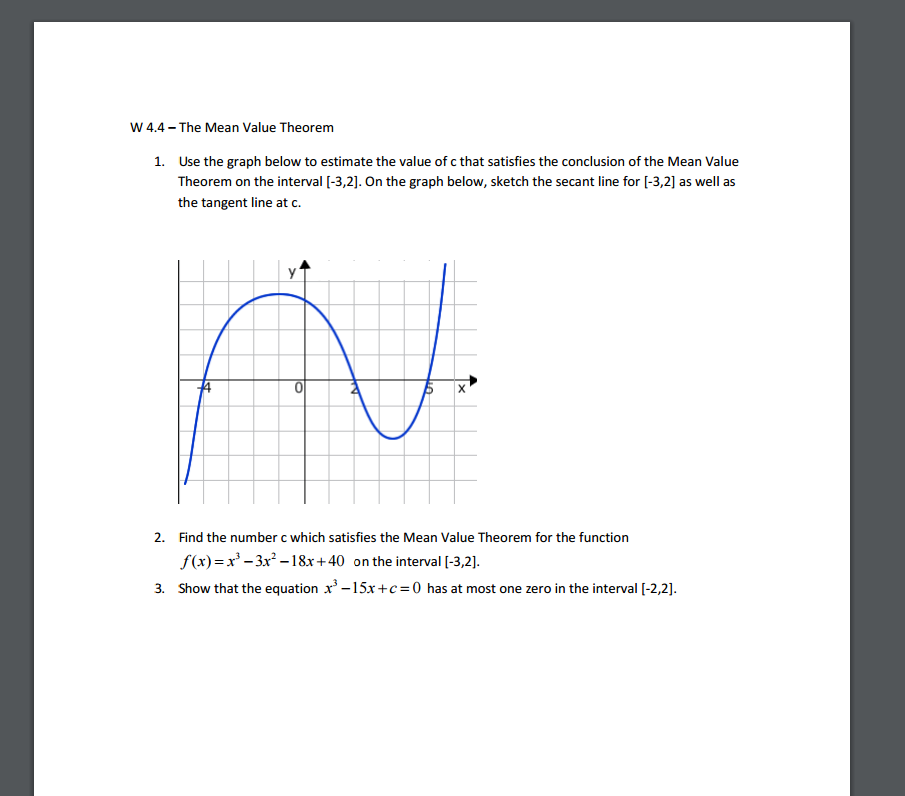 W 4.4- The Mean Value Theorem
1. Use the graph below to estimate the value of c that satisfies the conclusion of the Mean Value
Theorem on the interval [3,2]. On the graph below, sketch the secant line for [3,2] as well as
the tangent line at c.
y
: 0 x / id
2. Find the number which satisfies the Mean Value Theorem for the function
f(x)=x"=3x"=18x+40 onthe interval [-3,2].
3. Show that the equation x* —15x+c=0 has at most one zero in the interval [-2,2].
This is AI generated Response.
Asked by: suryansh
Created at: 2025-10-21 18:56:09
Asked by: suryansh
Created at: 2025-10-21 18:56:09
Final Answer:
Rendered
Raw Text
Did you like this answer?
Certainly! Let's through each part step-by-step.
---
# Part 1: Estimating \(c\) using the graph
### Task:
Estimate the value of \(c\) that satisfies the conclusion of the Mean Value Theorem (MVT) on the interval \([-3, 2]\).
### Explanation:
- The MVT states that if \(f\) is continuous on \([a, b]\) and differentiable on \((a, b)\), then there exists some \(c \in (a, b)\) such that:
\[
f'(c) = \frac{f(b) - f(a)}{b - a}
\]
- To estimate \(c\), we need:
- \(f(a)\) at \(a = -3\)
- \(f(b)\) at \(b = 2\)
- The average rate of change over \([-3, 2]\)
---
### Step 1: Find \(f(-3)\) and \(f(2)\) from the graph
- **At \(x = -3\)**:
- From the graph, \(f(-3) \approx \)
- **At \(x = 2\)**:
- From the graph, \(f(2) \approx -2\)
### Step 2: Compute the average rate of change
\[
\frac{f(2) - f(-3)}{2 - (-3)} = \frac{-2 - }{2 + 3} = \frac{-2}{5} = -.4
\]
### Step 3: Find \(c\) where the slope of the tangent equals \(-.4\)
- On the graph, look for a point \(c \in (-3, 2)\) where the tangent line has a slope of approximately \(-.4\).
- **Estimate from the graph**:
- Around \(x \approx \), the slope looks close to \(-.4\).
- Alternatively, at \(x \approx 1\), the slope appears flatter, so around \(\) to \(1\), the slope is about \(-.4\).
---
### **Answer for Part 1:**
**Estimated \(c \approx \) to \(1\)**
---
# Part 2: Find \(c\) such that the Mean Value Theorem holds for \(f(x) = x^3 - 3x^2 - 18x + 40\)
### Interval: \([-3, 2]\)
### Step 1: Compute \(f(-3)\) and \(f(2)\)
- \(f(x) = x^3 - 3x^2 - 18x + 40\)
- **At \(x = -3\)**:
\[
f(-3) = (-3)^3 - 3(-3)^2 - 18(-3) + 40 = -27 - 3(9) + 54 + 40 = -27 - 27 + 54 + 40 = 40
\]
- **At \(x = 2\)**:
\[
f(2) = 8 - 3(4) - 36 + 40 = 8 - 12 - 36 + 40 =
\]
### Step 2: Calculate the average rate of change
\[
\frac{f(2) - f(-3)}{2 - (-3)} = \frac{ - 40}{5} = \frac{-40}{5} = -8
\]
### Step 3: Find \(c\) such that \(f'(c) = -8\)
- First, find \(f'(x)\):
\[
f'(x) = 3x^2 - 6x - 18
\]
- Set \(f'(c) = -8\):
\[
3c^2 - 6c - 18 = -8
\]
\[
3c^2 - 6c - 18 + 8 =
\]
\[
3c^2 - 6c - 10 =
\]
- Divide through by 3:
\[
c^2 - 2c - \frac{10}{3} =
\]
- Use quadratic formula:
\[
c = \frac{2 \pm \sqrt{(2)^2 - 4 \times 1 \times (-10/3)}}{2}
\]
\[
c = \frac{2 \pm \sqrt{4 + \frac{40}{3}}}{2} = \frac{2 \pm \sqrt{\frac{12 + 40}{3}}}{2} = \frac{2 \pm \sqrt{\frac{52}{3}}}{2}
\]
\[
c = \frac{2 \pm \sqrt{\frac{156}{9}}}{2} = \frac{2 \pm \frac{\sqrt{156}}{3}}{2}
\]
- Simplify \(\sqrt{156}\):
\[
\sqrt{156} \approx 12.49
\]
- Now,
\[
c = \frac{2 \pm \frac{12.49}{3}}{2} = \frac{2 \pm 4.16}{2}
\]
- **Solutions**:
\[
c_1 = \frac{2 + 4.16}{2} = \frac{6.16}{2} = 3.08
\]
\[
c_2 = \frac{2 - 4.16}{2} = \frac{-2.16}{2} = -1.08
\]
### Step 4: Check if \(c\) is in \([-3, 2]\):
- \(c_1 \approx 3.08\) → outside interval
- \(c_2 \approx -1.08\) → inside interval
---
### **Final answer for Part 2:**
**\(c \approx -1.08\)**
---
# Part 3: Show that \(x^3 - 15x + c = \) has at most one zero in \([-2, 2]\)
### Step 1: Find the derivative to analyze the function's monotonicity
\[
f(x) = x^3 - 15x + c
\]
\[
f'(x) = 3x^2 - 15
\]
### Step 2: Find critical points:
\[
f'(x) = \Rightarrow 3x^2 - 15 = \Rightarrow x^2 = 5 \Rightarrow x = \pm \sqrt{5} \approx \pm 2.236
\]
### Step 3: Check whether critical points are in \([-2, 2]\)
- \(\sqrt{5} \approx 2.236\), which is **outside** \([-2, 2]\).
- \(-\sqrt{5} \approx -2.236\), **outside** \([-2, 2]\).
### Step 4: Monotonicity in \([-2, 2]\)
- Since \(f'(x) = 3x^2 - 15\):
- For \(x \in [-2, 2]\):
\[
x^2 \leq 4
\]
\[
3x^2 \leq 12
\]
\[
3x^2 - 15 \leq 12 - 15 = -3
\]
- Therefore, \(f'(x) < \) for all \(x \in [-2, 2]\).
- **Conclusion**: \(f(x)\) is strictly decreasing on \([-2, 2]\).
### **Implication:**
- Since \(f(x)\) is strictly decreasing on \([-2, 2]\), it can have **at most one zero** in this interval.
---
# **Summary of Final Answers:**
1. **Estimated \(c\) for the graph:** approximately ** to 1**.
2. **Value of \(c\) satisfying MVT for \(f(x) = x^3 - 3x^2 - 18x + 40\):** approximately **\(-1.08\)**.
3. **Number of zeros of \(x^3 - 15x + c=\) in \([-2, 2]\):** **at most one**.
---
Let me know if you'd like further clarification!
📢 Instructions:
- Ask anything relatd to above question only.
- For new Question goto :