 VIPSolutions
Act like a helpful tutor and exlain me : Give step-by-step solution with explanation and final answer:explain completeley= a 7 Mechanical Properties of Metallic Materials and Cortical Bone Young's Modulus Yield Strength ~~ Ultimate Tensile Materials Density (g/cm?) E (GPa) ©, (MPa) Strength (MPa) 316L stainless steel 7.8 200 200-700 500-900 CoCr alloys 8.8 240 450-1500 600-1600 Ti alloys 45 105-125 350-1050 600-1100 Magnesium 1.74 45 20 120 Cortical bone 1.8-2.1 10-30 100-120 130-150
Question:
Act like a helpful tutor and exlain me :
Give step-by-step solution with explanation and final answer:explain completeley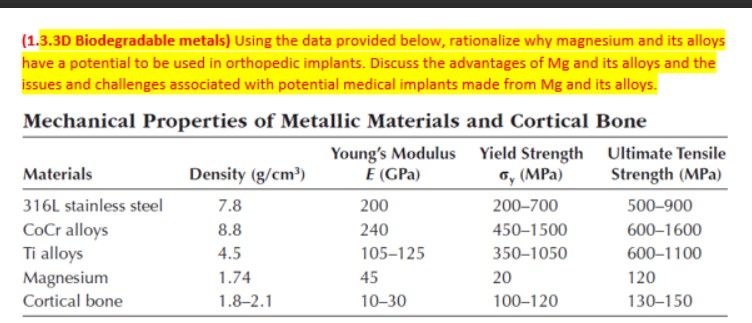 =
a 7
Mechanical Properties of Metallic Materials and Cortical Bone
Young's Modulus Yield Strength ~~ Ultimate Tensile
Materials Density (g/cm?) E (GPa) ©, (MPa) Strength (MPa)
316L stainless steel 7.8 200 200-700 500-900
CoCr alloys 8.8 240 450-1500 600-1600
Ti alloys 45 105-125 350-1050 600-1100
Magnesium 1.74 45 20 120
Cortical bone 1.8-2.1 10-30 100-120 130-150
This is AI generated Response.
Asked by: manish kumar
Created at: 2025-10-21 09:51:40
Asked by: manish kumar
Created at: 2025-10-21 09:51:40
Final Answer:
Rendered
Raw Text
Did you like this answer?
Certainly! I'll guide you through a step-by-step explanation of **why magnesium (Mg)** and its alloys have potential use in orthopedic implants, based on properties, and the advantages and challenges involved.
---
# Step-by-Step Explanation
## 1. **Understanding the Data**
The table provides the mechanical properties of various metallic materials, including magnesium (Mg) and its alloys:
| Material | Density (g/cm³) | Young’s Modulus \(E\) (GPa) | Yield Strength \(\sigma_y\) (MPa) | Ultimate Tensile Strength (MPa) |
|-------------------|-----------------|------------------------------|----------------------------------|---------------------------------|
| Magnesium | 1.74 | 45 | 20 | 120 |
---
## 2. **Why Magnesium and Its Alloys Are Considered for Orthopedic Implants**
### a. **Biodegradability**
- Magnesium is a **biodegradable metal**, meaning it can gradually dissolve in the body, eliminating the need for a second surgery to remove the implant.
- The biodegradable nature is advantageous for temporary support during healing.
### b. **Mechanical Compatibility**
- The **Young’s modulus** of magnesium (~45 GPa) is **closer to that of cortical bone** (~14–20 GPa) compared to other metals like titanium or stainless steel.
- This reduces **stress shielding**, a phenomenon where a stiffer implant carries more load, leading to bone resorption around the implant.
### c. **Lightweight**
- Magnesium has a **low density (1.74 g/cm³)**, making implants lighter and more comfortable.
---
## 3. **Advantages of Mg and Its Alloys in Orthopedics**
- **Biocompatibility**: Magnesium naturally occurs in the body; it is essential for many biological processes.
- **Biodegradability**: Gradual degradation minimizes the need for removal surgery.
- **Mechanical Compatibility**: Its elastic modulus reduces stress shielding effects.
- **Lightweight**: Improves patient comfort.
---
## 4. **Challenges and Issues**
- **Corrosion Rate**: Magnesium corrodes rapidly in physiological conditions, which could lead to premature loss of mechanical integrity.
- **Hydrogen Gas Formation**: During degradation, hydrogen gas is produced, which can form gas pockets around the implant.
- **Controlling Degradation**: Alloying magnesium with other elements (like calcium, zinc) can slow corrosion and improve mechanical properties.
- **Mechanical Strength**: Although adequate, magnesium's strength is lower than some alloys; further alloy development is needed.
---
## 5. **Potential of Magnesium Alloys**
- Alloying Mg with elements like **calcium, zinc, or rare earths** can enhance corrosion resistance, mechanical strength, and biocompatibility.
- This tailored approach aims to optimize the degradation rate, mechanical properties, and biological response.
---
# **Summary**
| Aspect | Explanation |
|---------|--------------|
| **Potential use** | Magnesium and its alloys are promising for biodegradable orthopedic implants due to their **biodegradability**, **closer elastic modulus to bone**, and **lightweight nature**. |
| **Advantages** | Reduce stress shielding, eliminate secondary removal surgery, biocompatible, lightweight |
| **Challenges** | Rapid corrosion, hydrogen gas production, controlling degradation rate, mechanical strength limitations |
---
# Final Note
The potential of magnesium and its alloys in orthopedic applications hinges on **balancing their biodegradability with sufficient mechanical integrity** and **controlling corrosion** to prevent adverse effects. Advances in alloy design and surface treatments are ongoing to address these challenges.
---
If you'd like, I can also provide more detailed information on **specific alloy compositions** or **biological interactions**!
📢 Instructions:
- Ask anything relatd to above question only.
- For new Question goto :