Act like a helpful tutor and exlain me :
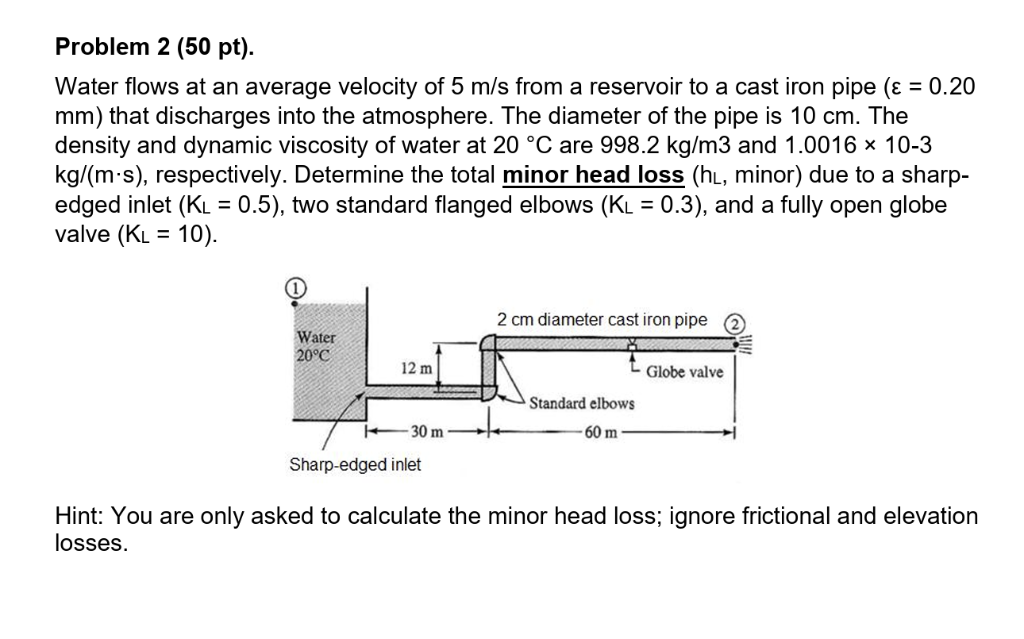
Give step-by-step solution with explanation and final answer:explain completeleyProblem 2 (50 pt).
Water flows at an average velocity of 5 m/s from a reservoir to a cast iron pipe (¢ = 0.20
mm) that discharges into the atmosphere. The diameter of the pipe is 10 cm. The
density and dynamic viscosity of water at 20 °C are 998.2 kg/m3 and 1.0016 x 10⁻³
kg/(m-s), respectively. Determine the total minor head loss (hi, minor) due to a sharp-
edged inlet (KL = 0.5), two standard flanged elbows (Kt. = 0.3), and a fully open globe
valve (KL = 10).
0)
. 2
pL diameter cast iron pipe Q
20°C w=
2m Globe valve |
Standard elbows
+—30m Pi 60m ——————|
Sharp-edged inlet
Hint: You are only asked to calculate the minor head loss; ignore frictional and elevation
losses.
Question:
Act like a helpful tutor and exlain me :
Give step-by-step solution with explanation and final answer:explain completeleyProblem 2 (50 pt).
Water flows at an average velocity of 5 m/s from a reservoir to a cast iron pipe (¢ = 0.20
mm) that discharges into the atmosphere. The diameter of the pipe is 10 cm. The
density and dynamic viscosity of water at 20 °C are 998.2 kg/m3 and 1.0016 x 10⁻³
kg/(m-s), respectively. Determine the total minor head loss (hi, minor) due to a sharp-
edged inlet (KL = 0.5), two standard flanged elbows (Kt. = 0.3), and a fully open globe
valve (KL = 10).
0)
. 2
pL diameter cast iron pipe Q
20°C w=
2m Globe valve |
Standard elbows
+—30m Pi 60m ——————|
Sharp-edged inlet
Hint: You are only asked to calculate the minor head loss; ignore frictional and elevation
losses.
This is AI generated Response.
Asked by: manish kumar
Created at: 2025-10-21 08:39:37
Final Answer:
RenderedRaw Text
Did you like this answer?
Certainly! Let's carefully analyze the problem step-by-step to determine the **minor head loss (h_L, minor)** in the piping system.
---
# **Problem Recap:**
- Water flow rate, \(Q = \text{unknown}\) (we'll find it from velocity)
- Velocity of water, \(V = 5\,m/s\)
- Pipe diameter, \(D = 10\,cm = .1\,m\)
- Density of water, \(\rho = 998.2\,kg/m^3\)
- Dynamic viscosity, \(\mu = 1.0016 \times 10^{-3}\,kg/(m \cdot s)\)
- Pipe length, \(L_{total} = 30 + 60 + 12\,m = 102\,m\)
- Inlet type: sharp-edged, \(K_{inlet} = .5\)
- Flanged elbows: \(K_{elbow} = .3\) each
- Globe valve: \(K_{valve} = 10\) (fully open)
- Cross-sectional area of pipe, \(A = \frac{\pi}{4} D^2\)
---
# **Step 1: Calculate the flow rate \(Q\)**
Using the velocity:
\[
Q = A \times V
\]
Where,
\[
A = \frac{\pi}{4} D^2 = \frac{\pi}{4} \times (.1)^2 \approx 7.854 \times 10^{-3}\, m^2
\]
So,
\[
Q = 7.854 \times 10^{-3}\, m^2 \times 5\, m/s = .03927\, m^3/s
\]
---
# **Step 2: Determine the Reynolds number (\(Re\)) to confirm flow regime**
\[
Re = \frac{\rho V D}{\mu}
\]
\[
Re = \frac{998.2 \times 5 \times .1}{1.0016 \times 10^{-3}} \approx 498,200
\]
Since \(Re > 400\), flow is turbulent, so Darcy-Weisbach equation applies for head loss calculations.
---
# **Step 3: Calculate the head loss due to friction (Darcy-Weisbach)**
\[
h_f = \frac{4fL}{D} \times \frac{V^2}{2g}
\]
Where \(f\) is the Darcy friction factor. For turbulent flow in smooth pipes, \(f\) can be estimated using the Colebrook equation or approximated with the Swamee-Jain equation:
\[
f = \frac{.25}{\left[\log_{10} \left( \frac{\varepsilon}{3.7 D} + \frac{5.74}{Re^{.9}} \right) \right]^2}
\]
Given:
\[
\varepsilon = .20\,mm = .0002\,m
\]
Calculate:
\[
f = \frac{.25}{\left[\log_{10} \left( \frac{.0002}{3.7 \times .1} + \frac{5.74}{(498200)^{.9}} \right) \right]^2}
\]
Compute each term:
\[
\frac{.0002}{3.7 \times .1} \approx .0002 / .37 \approx .00054
\]
\[
\frac{5.74}{(498200)^{.9}} \approx \frac{5.74}{(498200)^{.9}}
\]
Estimate \(498200^{.9}\):
\[
\log_{10}(498200) \approx 5.698
\]
\[
.9 \times 5.698 \approx 5.128
\]
\[
10^{5.128} \approx 1.34 \times 10^{5}
\]
Then,
\[
\frac{5.74}{1.34 \times 10^{5}} \approx 4.28 \times 10^{-5}
\]
Now, sum:
\[
.00054 + 4.28 \times 10^{-5} \approx .0005828
\]
Calculate \(\log_{10}\):
\[
\log_{10}(.0005828) \approx -3.234
\]
Calculate \(f\):
\[
f = \frac{.25}{(-3.234)^2} = \frac{.25}{10.46} \approx .0239
\]
---
# **Step 4: Calculate the total head loss (\(h_{loss}\))**
Total minor head loss is the sum of losses at inlet, elbows, valve:
\[
h_{minor} = h_{inlet} + 2 \times h_{elbows} + h_{valve}
\]
where each component is:
\[
h_{component} = K \times \frac{V^2}{2g}
\]
---
# **Step 5: Calculate each component**
- **Inlet:**
\[
h_{inlet} = .5 \times \frac{V^2}{2g}
\]
- **Elbows (2 elbows):**
\[
h_{elbows} = .3 \times \frac{V^2}{2g}
\]
Total for two elbows:
\[
2 \times .3 \times \frac{V^2}{2g}
\]
- **Valve:**
\[
h_{valve} = 10 \times \frac{V^2}{2g}
\]
---
### Calculate \(\frac{V^2}{2g}\):
\[
g = 9.81\, m/s^2
\]
\[
\frac{V^2}{2g} = \frac{(5)^2}{2 \times 9.81} = \frac{25}{19.62} \approx 1.275\, m
\]
---
### Now, compute each head loss:
- **Inlet:**
\[
h_{inlet} = .5 \times 1.275 \approx .637\, m
\]
- **Elbows (2):**
\[
h_{elbows} = .3 \times 1.275 \approx .383\, m
\]
Total for 2 elbows:
\[
2 \times .383 \approx .766\, m
\]
- **Valves:**
\[
h_{valve} = 10 \times 1.275 \approx 12.75\, m
\]
---
# **Step 6: Sum all minor head losses**
\[
h_{L, minor} = h_{inlet} + 2 \times h_{elbows} + h_{valve}
\]
\[
h_{L, minor} = .637 + .766 + 12.75 = \boxed{14.153\, m}
\]
---
# **Final Answer:**
\[
\boxed{
\text{Total minor head loss} \approx \mathbf{14.15\,m}
}
\]
This value represents the head loss due to all minor components (inlet, elbows, valve) in the system.
VIPSolutions focuses on clear, step‑by‑step explanations so you can learn quickly. Whether you need an AI‑generated walkthrough or a short hint to get unstuck, each solution is organized for fast reading and easy review later.
Search similar questions, compare approaches, and bookmark the best answers for revision. Our goal is simple: quick, reliable study help that feels natural—not noisy.
 VIPSolutions
 Problem 2 (50 pt).
Water flows at an average velocity of 5 m/s from a reservoir to a cast iron pipe (¢ = 0.20
mm) that discharges into the atmosphere. The diameter of the pipe is 10 cm. The
density and dynamic viscosity of water at 20 °C are 998.2 kg/m3 and 1.0016 x 10⁻³
kg/(m-s), respectively. Determine the total minor head loss (hi, minor) due to a sharp-
edged inlet (KL = 0.5), two standard flanged elbows (Kt. = 0.3), and a fully open globe
valve (KL = 10).
0)
. 2
pL diameter cast iron pipe Q
20°C w=
2m Globe valve |
Standard elbows
+—30m Pi 60m ——————|
Sharp-edged inlet
Hint: You are only asked to calculate the minor head loss; ignore frictional and elevation
losses.