 VIPSolutions
Act like a helpful tutor and exlain me : Give step-by-step solution with explanation and final answer:[BEQ fi i Hi H il i Bi i | ii i a i i io le 1 : TEI mes iM lil : i
Question:
Act like a helpful tutor and exlain me :
Give step-by-step solution with explanation and final answer: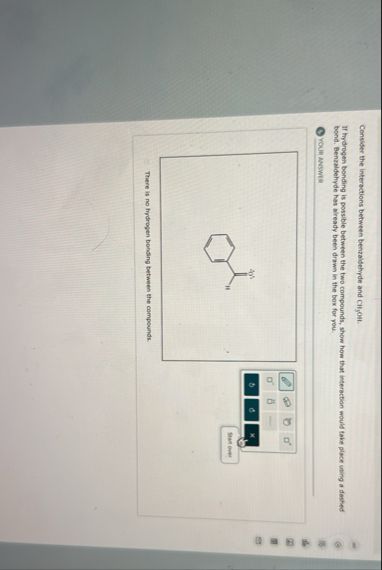 [BEQ
fi
i Hi
H il
i Bi
i | ii
i a i
i io
le 1
:
TEI
mes
iM lil
:
i
This is AI generated Response.
Asked by: Edu
Created at: 2025-10-19 03:58:47
Asked by: Edu
Created at: 2025-10-19 03:58:47
Final Answer:
Rendered
Raw Text
Did you like this answer?
Certainly! Let's analyze and solve the problem step-by-step.
---
# Step 1: Understand the question
- The question asks about the **resonance hybrid** of the given compound.
- The compound appears to **a benzene ring with a methyl group attached**, which is **toluene**.
- The goal is to **draw the resonance structures** for this molecule.
---
# Step 2: Identify the structure
- The structure contains:
- A benzene ring (aromatic ring with alternating double bonds).
- A methyl group (\(-CH_3\)) attached to the benzene ring at some position.
---
# Step 3: Recall resonance in benzene derivatives
- Benzene's resonance involves shifting π-electrons in the aromatic ring.
- When substituents are attached, their effects (electron-donating or withdrawing) influence the resonance.
- The methyl group (\(-CH_3\)) is an **electron-donating group** via hyperconjugation and inductive effects.
---
# Step 4: Draw possible resonance structures
- The resonance structures mainly involve the delocalization of electrons in the ring.
- For toluene, the methyl group donates electrons into the ring, stabilizing certain resonance forms.
- The key resonance structures are similar to benzene, with the negative charge (if any) delocalized among the carbons.
---
# Step 5: Draw the resonance structures
- **Structure 1:** The standard benzene ring with the methyl group attached.
- **Structure 2:** Move a pair of π-electrons from a double bond adjacent to the methyl group to form a new double bond, shifting the previous double bond.
- Continue shifting electrons around the ring, maintaining aromaticity.
---
# Final step: Understanding the resonance hybrid
- The resonance hybrid is a **blend** of all possible resonance structures.
- The **electron density** is higher at the ortho and para positions relative to the methyl group due to its electron-donating effect.
---
# **Summary:**
- The resonance in toluene involves shifting π-electrons around the aromatic ring.
- The methyl group donates electrons, activating the ortho and para positions.
- The resonance hybrid shows increased electron density at these positions.
---
Let me know if you'd like me to **draw the resonance structures** or explain further!
📢 Instructions:
- Ask anything relatd to above question only.
- For new Question goto :