 VIPSolutions
Act like a helpful tutor and exlain me : Give step-by-step solution with explanation and final answer:= Es ZL 3 = 5 z ° fo oe 8 = 5 8 = 0 = 4 P37? z0o = q Ht ~ fi pEE g d a £2 EE 2 g 1 Eels EY Eg go "By 58 FE js FB & = ec ® so fe 2878; ¥}. ® ST 8 £88 3 g Il BE 2 § E § 8 = Hc BS a Ae B x CE Bei Te F228 g 1 sels ds g gE Ta a © § psd 1 als Pil and [2] Nos ’ Tg oF ¥. 8 s 2 Es x 2 8 g Za - Wid, i od y = 95 TF ER >~ 8 g gE of || 8 o g [1 R 2 © og 2 & x 3 z B g g, g ; 2 3 E g : 2 JT — =k + a
Question:
Act like a helpful tutor and exlain me :
Give step-by-step solution with explanation and final answer: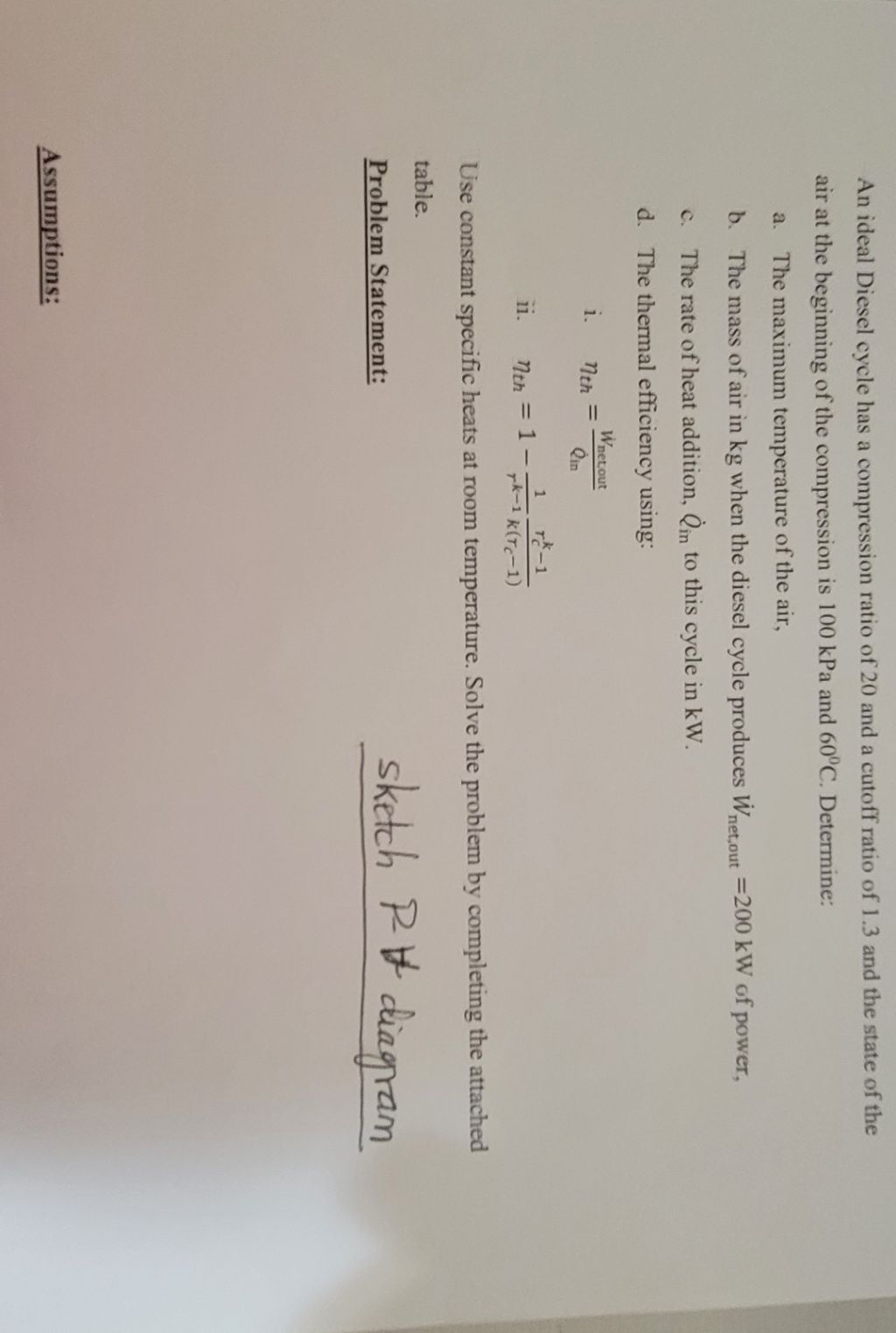 = Es
ZL 3 = 5
z ° fo oe 8 =
5 8
= 0 =
4 P37? z0o
= q Ht ~ fi pEE
g d a £2 EE 2
g 1 Eels
EY Eg
go "By 58 FE
js FB & = ec ®
so fe 2878;
¥}. ® ST 8 £88 3
g Il BE 2 § E § 8
= Hc BS a Ae
B x CE
Bei Te F228
g 1 sels ds
g gE Ta
a © § psd
1 als Pil and
[2] Nos
’ Tg oF
¥. 8 s 2
Es x 2 8
g Za -
Wid, i od
y = 95
TF ER
>~ 8 g gE
of || 8 o
g [1 R 2
© og 2 &
x 3 z B
g g, g
; 2 3 E
g : 2
JT — =k + a
This is AI generated Response.
Asked by: manish kumar
Created at: 2025-10-17 08:52:04
Asked by: manish kumar
Created at: 2025-10-17 08:52:04
Final Answer:
Rendered
Raw Text
Did you like this answer?
Let's break down and solve the **Diesel cycle** problem step by step.
---
# 1. **Problem Recap**
- **Compression ratio (\(r\))**: 20
- **Cutoff ratio (\(r_c\))**: 1.3
- **Initial pressure (\(P_1\))**: 100 kPa
- **Initial temperature (\(T_1\))**: 60°C = 333.15 K
- **Output power (\(\dot{W}_{\text{net, out}}\))**: 200 kW
- **Working fluid:** Air (ideal gas, use constant specific heats at room temp)
**Tasks:**
a. Find maximum temperature of the air
b. Find mass flow rate of air (\(\dot{m}\))
c. Find rate of heat addition (\(\dot{Q}_{\text{in}}\))
d. Find thermal efficiency (\(\eta_{th}\)) using given equations
e. Sketch P-v diagram
---
# 2. **Diesel Cycle Background and Useful Equations**
- **Compression ratio (\(r\)):** \( r = \frac{V_1}{V_2} \)
- **Cutoff ratio (\(r_c\)):** \( r_c = \frac{V_3}{V_2} \)
- **Ideal gas law:** \( PV = nRT \) or \( PV = mRT \)
- **Diesel cycle efficiency:**
\[
\eta_{th} = 1 - \frac{1}{r^{k-1}} \cdot \frac{r_c^k - 1}{k(r_c - 1)}
\]
where \( k \) (air) \(\approx 1.4 \)
- **Enthalpy for air:** \( h = c_p T \) (assume \( c_p \approx 1.005 \) kJ/kg·K)
---
# 3. **Step-by-Step Solution**
## **a) Maximum Temperature (\(T_3\))**
### **Step 1: State 1 (Initial State)**
- \( P_1 = 100 \) kPa
- \( T_1 = 333.15 \) K
### **Step 2: State 2 (End of Compression)**
- Isentropic compression:
\[
\frac{T_2}{T_1} = r^{k-1}
\]
\[
T_2 = T_1 \cdot r^{k-1}
\]
\[
T_2 = 333.15 \times 20^{.4}
\]
Evaluate \( 20^{.4} \):
\[
20^{.4} = e^{.4 \ln 20} \approx e^{.4 \times 2.9957} \approx e^{1.1983} \approx 3.314
\]
\[
T_2 = 333.15 \times 3.314 \approx 1103.6\ \text{K}
\]
### **Step 3: State 3 (End of Heat Addition)**
- At constant pressure: \( \frac{T_3}{T_2} = r_c \)
\[
T_3 = T_2 \times r_c = 1103.6 \times 1.3 \approx 1434.7\ \text{K}
\]
**Final Answer (a):**
\[
\boxed{T_3 = 1435\ \text{K}\ (\text{rounded})}
\]
---
## **b) Mass Flow Rate (\(\dot{m}\))**
Given: Net work output \( \dot{W}_{\text{net, out}} = 200 \) kW
- Work per cycle for Diesel cycle (per kg):
\[
w_{\text{net, out}} = \eta_{th} \cdot q_{in}
\]
### **First, Find Efficiency (\(\eta_{th}\))**
\[
\eta_{th} = 1 - \frac{1}{r^{k-1}} \cdot \frac{r_c^k - 1}{k(r_c - 1)}
\]
Calculate:
- \( r^{k-1} = 20^{.4} \approx 3.314 \)
- \( r_c^k = 1.3^{1.4} \approx e^{1.4 \ln 1.3} \approx e^{1.4 \times .2624} \approx e^{.3674} \approx 1.444 \)
- \( r_c - 1 = .3 \)
Plug in:
\[
\eta_{th} = 1 - \frac{1}{3.314} \cdot \frac{1.444 - 1}{1.4 \times .3}
\]
\[
= 1 - .3017 \times \frac{.444}{.42}
\]
\[
= 1 - .3017 \times 1.057
\]
\[
= 1 - .319
\]
\[
= .681
\]
\[
\eta_{th} \approx \boxed{.68}
\]
---
### **Find Heat Added (\(q_{in}\), per kg):**
\[
q_{in} = c_p (T_3 - T_2)
\]
\[
= 1.005 \times (1435 - 1104) = 1.005 \times 331 = 332.66\ \text{kJ/kg}
\]
### **Find Specific Work Output (\(w_{\text{net, out}}\)):**
\[
w_{\text{net, out}} = \eta_{th} \cdot q_{in} = .68 \times 332.66 = 226.2\ \text{kJ/kg}
\]
### **Mass Flow Rate:**
\[
\dot{m} = \frac{\dot{W}_{\text{net, out}}}{w_{\text{net, out}}}
\]
\[
= \frac{200,000\ \text{W}}{226,200\ \text{J/kg}}
= .884\ \text{kg/s}
\]
**Final Answer (b):**
\[
\boxed{\dot{m} = .88\ \text{kg/s}}
\]
---
## **c) Rate of Heat Addition (\(\dot{Q}_{\text{in}}\))**
\[
\dot{Q}_{\text{in}} = \dot{m} \cdot q_{in}
\]
\[
= .884 \times 332.66 = 294\ \text{kW}
\]
**Final Answer (c):**
\[
\boxed{\dot{Q}_{\text{in}} = 294\ \text{kW}}
\]
---
## **d) Thermal Efficiency (\(\eta_{th}\))**
Already calculated above:
\[
\boxed{\eta_{th} = .68}
\]
---
## **e) Sketch P-v Diagram**
A Diesel cycle P-v diagram consists of:
- 1-2: Isentropic compression
- 2-3: Constant pressure heat addition
- 3-4: Isentropic expansion
- 4-1: Constant volume heat rejection
```
3
/----\
/ \
2 4
\ /
\_____/
1
```
**Key Points:**
- 1-2: Steeply rising curve (compression)
- 2-3: Horizontal (constant pressure)
- 3-4: Downward (expansion)
- 4-1: Vertical (constant volume)
---
# **Summary Table**
| Part | Answer |
|------|--------------------------|
| a | \(T_3 = 1435\) K |
| b | \(\dot{m} = .88\) kg/s |
| c | \(\dot{Q}_{\text{in}} = 294\) kW |
| d | \(\eta_{th} = .68\) |
---
If you need the actual diagram, let me know or draw it by hand based on the description!
📢 Instructions:
- Ask anything relatd to above question only.
- For new Question goto :