 VIPSolutions
Act like a helpful tutor and exlain me : Give step-by-step solution with explanation and final answer:Student Name: Time: 70 Minutes. (30 Points) Problem #1. For powder metallurgy application, you want to choose from two. metallic powders of the same materials. One has particles in the form of cylinders with height (L) to diameter (D) ratio of 1 and the other one has particles in the form of cubes with side dimension (L). Which one do you choose?
Question:
Act like a helpful tutor and exlain me :
Give step-by-step solution with explanation and final answer: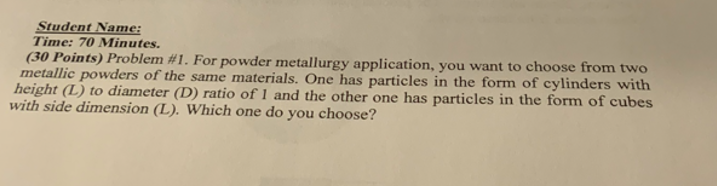 Student Name:
Time: 70 Minutes.
(30 Points) Problem #1. For powder metallurgy application, you want to choose from two.
metallic powders of the same materials. One has particles in the form of cylinders with
height (L) to diameter (D) ratio of 1 and the other one has particles in the form of cubes
with side dimension (L). Which one do you choose?
This is AI generated Response.
Asked by: manish kumar
Created at: 2025-10-16 22:28:29
Asked by: manish kumar
Created at: 2025-10-16 22:28:29
Final Answer:
Rendered
Raw Text
Did you like this answer?
# Step-by-Step Solution
## **Restating the Problem**
You need to choose between two metallic powders (same material) for powder metallurgy:
- **Option 1:** Cylindrical particles, height (L) = diameter (D)
- **Option 2:** Cubic particles, side dimension = L
**Which one do you choose, and why?**
---
## **Step 1: Understanding Powder Metallurgy Needs**
In powder metallurgy, **higher surface area per unit volume** is generally preferred because:
- It improves **sintering** (better bonding at lower temperatures).
- Increases **reactivity**.
So, **choose the particle with the highest surface area to volume ratio**.
---
## **Step 2: Calculate Surface Area to Volume Ratios**
### **A. Cylinder (height = diameter = L)**
- **Volume of cylinder:**
\[
V_{\text{cyl}} = \pi r^2 h
\]
Where \( h = L \), \( D = L \), so \( r = \frac{L}{2} \).
\[
V_{\text{cyl}} = \pi \left(\frac{L}{2}\right)^2 L = \pi \frac{L^2}{4} L = \frac{\pi}{4} L^3
\]
- **Surface Area of cylinder:**
\[
A_{\text{cyl}} = 2\pi r h + 2\pi r^2
\]
Substitute \( r = \frac{L}{2}, h = L \):
\[
A_{\text{cyl}} = 2\pi \frac{L}{2} L + 2\pi \left(\frac{L}{2}\right)^2 = \pi L^2 + \frac{\pi}{2} L^2 = \frac{3\pi}{2} L^2
\]
- **Surface Area to Volume Ratio:**
\[
\frac{A_{\text{cyl}}}{V_{\text{cyl}}} = \frac{\frac{3\pi}{2}L^2}{\frac{\pi}{4}L^3} = \frac{3\pi}{2} \cdot \frac{4}{\pi} \cdot \frac{1}{L} = 6 \cdot \frac{1}{L}
\]
---
### **B. Cube (side = L)**
- **Volume of cube:**
\[
V_{\text{cube}} = L^3
\]
- **Surface Area of cube:**
\[
A_{\text{cube}} = 6L^2
\]
- **Surface Area to Volume Ratio:**
\[
\frac{A_{\text{cube}}}{V_{\text{cube}}} = \frac{6L^2}{L^3} = \frac{6}{L}
\]
---
## **Step 3: Comparison and Final Decision**
- **Cylinder:** \(\frac{6}{L}\)
- **Cube:** \(\frac{6}{L}\)
**Both have the same surface area to volume ratio!**
---
## **Step 4: Any Other Considerations?**
Since the ratio is the same, either shape is **equally good** from a surface area to volume perspective.
In practice, other factors (like flowability, packing density, manufacturing cost) might matter, but **based solely on surface area to volume ratio, either is acceptable**.
---
## **Final Answer**
> **You can choose either the cylindrical or the cubic particles, as both have the same surface area to volume ratio (\(\frac{6}{L}\)).**
> **Both are equally suitable for powder metallurgy applications based on this criterion.**
📢 Instructions:
- Ask anything relatd to above question only.
- For new Question goto :