Act like a helpful tutor and exlain me :
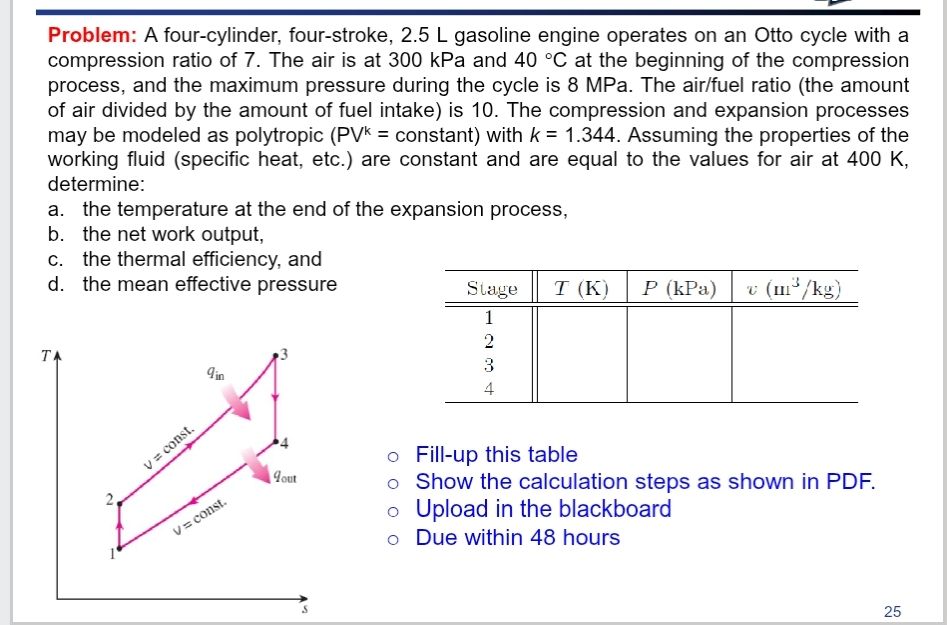
Give step-by-step solution with explanation and final answer:Problem: A four-cylinder, four-stroke, 2.5 L gasoline engine operates on an Otto cycle with a
compression ratio of 7. The air is at 300 kPa and 40 °C at the beginning of the compression
process, and the maximum pressure during the cycle is 8 MPa. The air/fuel ratio (the amount
of air divided by the amount of fuel intake) is 10. The compression and expansion processes
may be modeled as polytropic (PV = constant) with k = 1.344. Assuming the properties of the
working fluid (specific heat, etc.) are constant and are equal to the values for air at 400 K,
determine:
a. the temperature at the end of the expansion process,
b. the net work output,
c. the thermal efficiency, and
d. the mean effective pressure Stage [7 [Ppa v (u®/kg)
iT
5 2
d J 3
Sr 4 . &
4 o Fill-up this table
N Low o Show the calculation steps as shown in PDF.
f Co o Upload in the blackboard
) vr o Due within 48 hours
0 25
Question:
Act like a helpful tutor and exlain me :
Give step-by-step solution with explanation and final answer:Problem: A four-cylinder, four-stroke, 2.5 L gasoline engine operates on an Otto cycle with a
compression ratio of 7. The air is at 300 kPa and 40 °C at the beginning of the compression
process, and the maximum pressure during the cycle is 8 MPa. The air/fuel ratio (the amount
of air divided by the amount of fuel intake) is 10. The compression and expansion processes
may be modeled as polytropic (PV = constant) with k = 1.344. Assuming the properties of the
working fluid (specific heat, etc.) are constant and are equal to the values for air at 400 K,
determine:
a. the temperature at the end of the expansion process,
b. the net work output,
c. the thermal efficiency, and
d. the mean effective pressure Stage [7 [Ppa v (u®/kg)
iT
5 2
d J 3
Sr 4 . &
4 o Fill-up this table
N Low o Show the calculation steps as shown in PDF.
f Co o Upload in the blackboard
) vr o Due within 48 hours
0 25
This is AI generated Response.
Asked by: manish kumar
Created at: 2025-10-16 22:12:01
Final Answer:
RenderedRaw Text
Did you like this answer?
Let's break down and solve the Otto cycle problem step-by-step. **We'll first outline the process, list assumptions, and then solve each part.**
---
## **Given Data**
- Engine: 4-cylinder, four-stroke, 2.5 L gasoline
- Compression ratio (\( r \)): **7**
- Initial pressure (\( P_1 \)): **300 kPa**
- Initial temperature (\( T_1 \)): **40°C = 313.15 K**
- Maximum pressure (\( P_3 \)): **8 MPa = 800 kPa**
- Air/fuel ratio: **10**
- Polytropic exponent (\( k \)): **1.344**
- Assume air properties at **400 K** (constant cp, cv, R, etc.)
---
## **Stages in Otto Cycle**
| State | Description |
|-------|--------------------------|
| 1 | Start of compression |
| 2 | End of compression |
| 3 | End of heat addition |
| 4 | End of expansion |
---
## **Step 1: Fill the Table - State Properties**
### **1.1. Calculate Specific Volume at State 1 (\( v_1 \))**
- Displacement = 2.5L = \( .0025 \) m³ (total for 4 cylinders)
- For one cycle (since it's four-stroke), only half the displacement is filled per revolution:
- **Volume per cycle = \( .0025 / 2 = .00125 \) m³**
- Assume 1 kg of air for calculations.
Use the ideal gas law:
\[
v_1 = \frac{RT_1}{P_1}
\]
Where \( R = .287 \) kJ/kg·K (for air).
\[
v_1 = \frac{.287 \cdot 313.15}{300} = .299 \, \text{m}^3/\text{kg}
\]
---
### **1.2. State 2 (End of Compression)**
\[
\text{Compression ratio } r = \frac{v_1}{v_2} = 7 \implies v_2 = \frac{v_1}{7}
\]
\[
v_2 = \frac{.299}{7} = .0427 \, \text{m}^3/\text{kg}
\]
For **Polytropic Compression** (\( PV^k = \text{const} \)):
\[
\frac{T_2}{T_1} = r^{k-1}
\]
\[
T_2 = T_1 \cdot r^{k-1} = 313.15 \cdot 7^{1.344-1} = 313.15 \cdot 7^{.344}
\]
\[
7^{.344} \approx 1.870
\]
\[
T_2 = 313.15 \times 1.870 = 585 \, \text{K}
\]
\[
\frac{P_2}{P_1} = r^k = 7^{1.344} \approx 12.8
\]
\[
P_2 = 300 \times 12.8 = 384 \, \text{kPa}
\]
---
### **1.3. State 3 (End of Heat Addition, at Maximum Pressure)**
\[
P_3 = 800 \, \text{kPa}
\]
\[
v_3 = v_2 \quad (\text{constant volume process})
\]
\[
\frac{T_3}{T_2} = \frac{P_3}{P_2}
\]
\[
T_3 = T_2 \cdot \frac{P_3}{P_2} = 585 \times \frac{800}{384} = 585 \times 2.083 = 1218 \, \text{K}
\]
---
### **1.4. State 4 (End of Expansion)**
\[
v_4 = v_1 \quad (\text{constant volume})
\]
**Polytropic Expansion**:
\[
\frac{T_4}{T_3} = \left(\frac{v_3}{v_4}\right)^{k-1}
\]
But \( \frac{v_4}{v_3} = r \implies \frac{v_3}{v_4} = \frac{1}{r} \)
\[
T_4 = T_3 \cdot \left(\frac{1}{r}\right)^{k-1} = 1218 \cdot 7^{-.344} = 1218 \cdot .535 = 652 \, \text{K}
\]
\[
P_4 = P_3 \cdot \left(\frac{v_3}{v_4}\right)^{k} = 800 \times (1/7)^{1.344} = 800 \times .0781 = 625 \, \text{kPa}
\]
---
### **Summary Table**
| Stage | \( T \) (K) | \( P \) (kPa) | \( v \) (m³/kg) |
|-------|-------------|---------------|-----------------|
| 1 | 313 | 300 | .299 |
| 2 | 585 | 384 | .0427 |
| 3 | 1218 | 800 | .0427 |
| 4 | 652 | 625 | .299 |
---
## **Step 2: Answer the Questions**
### **a. Temperature at the end of expansion (\( T_4 \))**
**Answer:** \( T_4 = 652 \, \text{K} \)
---
### **b. Net Work Output per Cycle (per kg air)**
\[
w_{net} = q_{in} - q_{out}
\]
- For air (ideal gas), \( q = c_v (T_3 - T_2), \, q_{out} = c_v (T_4 - T_1) \)
- **At 400 K**, \( c_v \approx .718 \, \text{kJ/kg·K} \)
\[
q_{in} = c_v (T_3 - T_2) = .718 (1218 - 585) = .718 \times 633 = 454.6 \, \text{kJ/kg}
\]
\[
q_{out} = c_v (T_4 - T_1) = .718 (652 - 313) = .718 \times 339 = 243.6 \, \text{kJ/kg}
\]
\[
w_{net} = 454.6 - 243.6 = 211 \, \text{kJ/kg}
\]
---
### **c. Thermal Efficiency**
\[
\eta = 1 - \frac{q_{out}}{q_{in}} = 1 - \frac{243.6}{454.6} = .4639 = 46.4\%
\]
---
### **d. Mean Effective Pressure (MEP)**
\[
MEP = \frac{w_{net}}{v_{max} - v_{min}}
\]
\[
v_{max} = v_1 = .299 \, \text{m}^3/\text{kg}, \quad v_{min} = v_2 = .0427 \, \text{m}^3/\text{kg}
\]
\[
MEP = \frac{211}{.299 - .0427} = \frac{211}{.2563} = 823 \, \text{kPa}
\]
---
## **Summary Table of Results**
| Property | Value |
|----------------------------|------------------|
| \( T_4 \) | **652 K** |
| Net work (\( w_{net} \)) | **211 kJ/kg** |
| Thermal efficiency (\( \eta \)) | **46.4%** |
| Mean effective pressure | **823 kPa** |
---
### **Let me know if you need any clarifications or calculations for the total engine output (using 2.5 L, cycles per second, etc.)!**
VIPSolutions focuses on clear, step‑by‑step explanations so you can learn quickly. Whether you need an AI‑generated walkthrough or a short hint to get unstuck, each solution is organized for fast reading and easy review later.
Search similar questions, compare approaches, and bookmark the best answers for revision. Our goal is simple: quick, reliable study help that feels natural—not noisy.
 VIPSolutions
 Problem: A four-cylinder, four-stroke, 2.5 L gasoline engine operates on an Otto cycle with a
compression ratio of 7. The air is at 300 kPa and 40 °C at the beginning of the compression
process, and the maximum pressure during the cycle is 8 MPa. The air/fuel ratio (the amount
of air divided by the amount of fuel intake) is 10. The compression and expansion processes
may be modeled as polytropic (PV = constant) with k = 1.344. Assuming the properties of the
working fluid (specific heat, etc.) are constant and are equal to the values for air at 400 K,
determine:
a. the temperature at the end of the expansion process,
b. the net work output,
c. the thermal efficiency, and
d. the mean effective pressure Stage [7 [Ppa v (u®/kg)
iT
5 2
d J 3
Sr 4 . &
4 o Fill-up this table
N Low o Show the calculation steps as shown in PDF.
f Co o Upload in the blackboard
) vr o Due within 48 hours
0 25