 VIPSolutions
Act like a helpful tutor and exlain me : Give step-by-step solution with explanation and final answer:explain all sub parts clearlyQuestion 1 1s] LI. Mention 4 operations performed with metal tooling “) 12. A bending operation is to be performed on 8.00 mm-thick cold-rolled steel. IFR=10.5 mm and (10) @=60°.The steel has a tensile strength = 4340 MPa and a shear strength = 350 MPa. Determine the following: 12.1. Blank size required and bending force if the bend is performed in a V-dic with a dic opening dimension = 50 mm.
Question:
Act like a helpful tutor and exlain me :
Give step-by-step solution with explanation and final answer:explain all sub parts clearly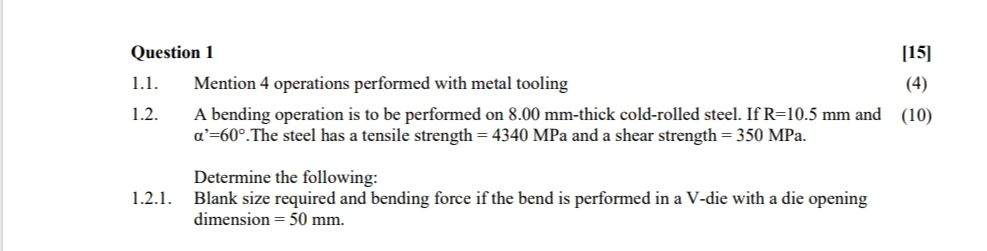 Question 1 1s]
LI. Mention 4 operations performed with metal tooling “)
12. A bending operation is to be performed on 8.00 mm-thick cold-rolled steel. IFR=10.5 mm and (10)
@=60°.The steel has a tensile strength = 4340 MPa and a shear strength = 350 MPa.
Determine the following:
12.1. Blank size required and bending force if the bend is performed in a V-dic with a dic opening
dimension = 50 mm.
This is AI generated Response.
Asked by: manish kumar
Created at: 2025-10-16 17:21:37
Asked by: manish kumar
Created at: 2025-10-16 17:21:37
Final Answer:
Rendered
Raw Text
Did you like this answer?
# Solution to Question 1
---
## **1.1. Four Operations Performed with Metal Tooling**
1. **Shearing:** Cutting sheet metal into pieces using a punch and die.
2. **Bending:** Deforming sheet metal along a straight axis (e.g., V-bending, U-bending).
3. **Drawing:** Forming sheet metal into a desired shape by stretching it over a die.
4. **Punching:** Creating holes in sheet metal by driving a punch through the material.
---
## **1.2. Bending Operation on Cold-Rolled Steel**
**Given Data:**
- Thickness of steel, \( t = 8.00\, \text{mm} \)
- Bend radius, \( R = 10.5\, \text{mm} \)
- Bend angle, \( \alpha' = 60^\circ \)
- Tensile strength, \( \sigma_t = 434\, \text{MPa} \)
- Shear strength, \( \tau = 350\, \text{MPa} \)
- Die opening, \( V = 50\, \text{mm} \)
---
### **1.2.1. (a) Blank Size Required**
The blank length for a bent section is calculated using the formula for the **bend allowance (BA)**:
\[
\text{BA} = \theta \left( R + K \cdot t \right)
\]
Where:
- \( \theta \) = bend angle in radians = \( 60^\circ \times \frac{\pi}{180^\circ} = 1.047\, \text{rad} \)
- \( R \) = inside bend radius = \( 10.5\, \text{mm} \)
- \( t \) = thickness = \( 8.00\, \text{mm} \)
- \( K \) = K-factor (typically .33 for V-bending)
\[
\text{BA} = 1.047 \times (10.5 + .33 \times 8)
\]
\[
\text{BA} = 1.047 \times (10.5 + 2.64)
\]
\[
\text{BA} = 1.047 \times 13.14
\]
\[
\text{BA} \approx 13.76\, \text{mm}
\]
**If you have straight legs before and after the bend, add those lengths to BA. For only a single bend, the blank size is the bend allowance.**
---
### **1.2.1. (b) Bending Force Required**
The bending force (\( F \)) for a V-die is calculated as:
\[
F = \frac{k \cdot \sigma_t \cdot t^2 \cdot L}{V}
\]
Where:
- \( k \) = constant (typically 1.33 for V-die bending)
- \( \sigma_t \) = tensile strength (MPa)
- \( t \) = thickness (mm)
- \( L \) = length of bend (assume 1 mm for per mm calculation, unless given)
- \( V \) = die opening (mm)
Assume \( L = 1\, \text{mm} \) (for per mm calculation):
\[
F = \frac{1.33 \times 434 \times 8^2 \times 1}{50}
\]
Calculate \( 8^2 = 64 \):
\[
F = \frac{1.33 \times 434 \times 64}{50}
\]
\[
F = \frac{1.33 \times 277760}{50}
\]
\[
F = \frac{369420.8}{50}
\]
\[
F = 7388.4\, \text{N} \quad \text{(per mm of bend length)}
\]
---
## **Final Answers**
### **1.1. Four Operations with Metal Tooling**
- Shearing
- Bending
- Drawing
- Punching
### **1.2.1.**
#### **(a) Blank size required (bend allowance)**
\[
\boxed{13.76\, \text{mm}}
\]
#### **(b) Bending force required per mm of bend length**
\[
\boxed{7388.4\, \text{N/mm}}
\]
**Note:** If the total length of the bend is given, multiply the bending force per mm by the total length.
📢 Instructions:
- Ask anything relatd to above question only.
- For new Question goto :