Act like a helpful tutor and exlain me :
Give step-by-step solution with explanation and final answer:+
Required Informetion
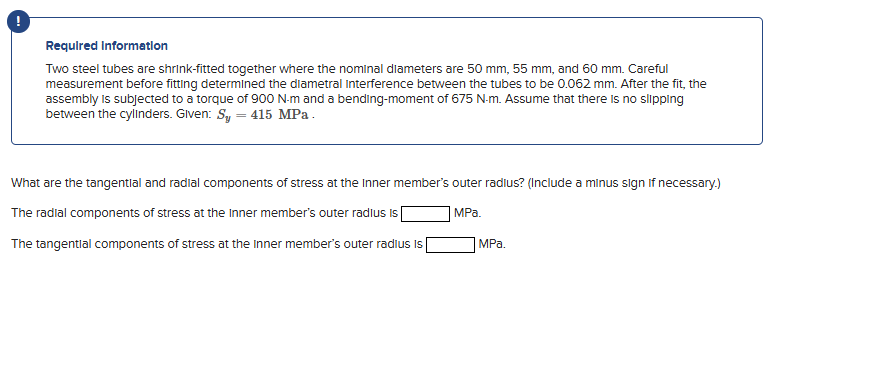
Two steel tubes are shiinicfitted together where the nominal diameters are 50 mm, 55 mm, and 60 mm. Careful
measurement before fing determined the diametral Interference between the tubes to be 0.062 mm. After the fi, the
assembly Is subjected to a torque of 900 Nim and a bending-moment of 675 N-m. Assume that there Is no slipping
between the cylinders. Given: 5, — 415 MPa.
What ore the tangential and radial components of stress at the Inner member's outer radius? (Include a minus sign If necessary)
The radial components of stress at the Inner member's outer radius Is] MPa,
The tangential components of stress at the Inner member's outer radius Is] MPa.
Question:
Act like a helpful tutor and exlain me :
Give step-by-step solution with explanation and final answer:+
Required Informetion
Two steel tubes are shiinicfitted together where the nominal diameters are 50 mm, 55 mm, and 60 mm. Careful
measurement before fing determined the diametral Interference between the tubes to be 0.062 mm. After the fi, the
assembly Is subjected to a torque of 900 Nim and a bending-moment of 675 N-m. Assume that there Is no slipping
between the cylinders. Given: 5, — 415 MPa.
What ore the tangential and radial components of stress at the Inner member's outer radius? (Include a minus sign If necessary)
The radial components of stress at the Inner member's outer radius Is] MPa,
The tangential components of stress at the Inner member's outer radius Is] MPa.
This is AI generated Response.
Asked by: manish kumar
Created at: 2025-10-15 22:46:07
Final Answer:
RenderedRaw Text
Did you like this answer?
Let's break this problem into clear steps:
---
## **Step 1: Problem Restatement**
- **Given:**
- Two steel tubes, diameters: 50 mm (inner), 55 mm (outer of inner tube), 60 mm (outer tube).
- Diametral interference: .062 mm.
- Applied torque: \( T = 900 \) N·m.
- Applied bending moment: \( M = 675 \) N·m.
- No slipping between cylinders.
- Yield strength: \( S_y = 415 \) MPa.
- **Required:**
- **Radial component** of stress at inner member's outer radius (i.e., at \( r = 27.5 \) mm).
- **Tangential (hoop) component** of stress at the same location.
---
## **Step 2: Identify Stress Sources**
There are three sources of stress at the outer radius of the inner member:
1. **Interference (shrink fit) pressure** — causes radial and tangential stresses.
2. **Torque** — causes shear stress (not needed here as question asks for normal stresses).
3. **Bending moment** — causes normal axial stress (not needed for radial/tangential at this radius).
We'll **focus on the interference fit for radial and tangential stresses** at the outer radius of the inner member.
---
## **Step 3: Stresses Due to Interference Fit**
For a **thick-walled cylinder** subjected to internal/external pressure (here, the pressure is from the shrink fit):
### **Radial Stress (\(\sigma_r\))**
At \( r = b \) (outer radius of inner tube):
\[
\sigma_r = -p
\]
Where \( p \) is the contact pressure due to the interference fit.
### **Tangential (Hoop) Stress (\(\sigma_\theta\))**
At \( r = b \):
\[
\sigma_\theta = \frac{a^2 + b^2}{b^2 - a^2} p
\]
Where:
- \( a = \) inner radius of inner tube = \(25 \) mm
- \( b = \) outer radius of inner tube = \(27.5 \) mm
---
## **Step 4: Find Contact Pressure \( p \)**
The **contact pressure** \( p \) for interference fit is:
\[
\delta = \delta_1 + \delta_2
\]
Where:
- \( \delta \) = total radial interference = \( \frac{.062}{2} = .031 \) mm (*since diametral interference is split between two radii*)
- \( \delta_1 \) = expansion of inner member's outer radius
- \( \delta_2 \) = contraction of outer member's inner radius
The formulas:
\[
\delta_1 = \frac{p b}{E} \frac{b^2 + a^2}{b^2 - a^2}
\]
\[
\delta_2 = \frac{p b}{E} \frac{c^2 + b^2}{c^2 - b^2}
\]
Where:
- \( b = 27.5 \) mm = .0275 m
- \( a = 25 \) mm = .025 m
- \( c = 30 \) mm = .03 m
- \( E \) (steel) ≈ \(210,000 \) MPa
Combine:
\[
\delta = \frac{p b}{E} \left[ \frac{b^2 + a^2}{b^2 - a^2} + \frac{c^2 + b^2}{c^2 - b^2} \right]
\]
Solve for \( p \):
\[
p = \frac{\delta E}{b \left( \frac{b^2 + a^2}{b^2 - a^2} + \frac{c^2 + b^2}{c^2 - b^2} \right) }
\]
Plug in values:
- \( \delta = .031 \) mm \( = .000031 \) m
- \( E = 210,000 \) MPa \( = 210 \times 10^9 \) Pa
- \( b = .0275 \) m
- \( a = .025 \) m
- \( c = .03 \) m
Calculate each term:
\[
b^2 + a^2 = (.0275)^2 + (.025)^2 = .00075625 + .000625 = .00138125
\]
\[
b^2 - a^2 = (.0275)^2 - (.025)^2 = .00075625 - .000625 = .00013125
\]
\[
\frac{b^2 + a^2}{b^2 - a^2} = \frac{.00138125}{.00013125} \approx 10.53
\]
\[
c^2 + b^2 = (.03)^2 + (.0275)^2 = .0009 + .00075625 = .00165625
\]
\[
c^2 - b^2 = (.03)^2 - (.0275)^2 = .0009 - .00075625 = .00014375
\]
\[
\frac{c^2 + b^2}{c^2 - b^2} = \frac{.00165625}{.00014375} \approx 11.53
\]
So the denominator is \( 10.53 + 11.53 = 22.06 \).
Now plug in:
\[
p = \frac{.000031 \times 210 \times 10^9}{.0275 \times 22.06}
\]
\[
= \frac{6,510,000}{.60665}
\]
\[
\approx 10,740,000 \text{ Pa } = 10.74 \text{ MPa}
\]
---
## **Step 5: Calculate Stresses**
### **Radial Stress at \( r = b \):**
\[
\sigma_r = -p = -10.74 \text{ MPa}
\]
### **Tangential (Hoop) Stress at \( r = b \):**
\[
\sigma_\theta = \frac{a^2 + b^2}{b^2 - a^2} p = 10.53 \times 10.74 = 113.1 \text{ MPa}
\]
---
## **Step 6: Final Answers**
\[
\boxed{
\begin{aligned}
\text{The radial component of stress at the inner member's outer radius is} & : \quad -10.7 \ \text{MPa} \\
\text{The tangential component of stress at the inner member's outer radius is} & : \quad 113 \ \text{MPa} \\
\end{aligned}
}
\]
(Rounded to one decimal place)
---
### **Summary Table**
| Stress Component | Value |
|------------------------|------------|
| Radial (\(\sigma_r\)) | \(-10.7\) MPa |
| Tangential (\(\sigma_\theta\)) | \(113\) MPa |
---
**Let me know if you want to include the effects of torque or bending, or need help with any other part!**
VIPSolutions focuses on clear, step‑by‑step explanations so you can learn quickly. Whether you need an AI‑generated walkthrough or a short hint to get unstuck, each solution is organized for fast reading and easy review later.
Search similar questions, compare approaches, and bookmark the best answers for revision. Our goal is simple: quick, reliable study help that feels natural—not noisy.
 VIPSolutions
 +
Required Informetion
Two steel tubes are shiinicfitted together where the nominal diameters are 50 mm, 55 mm, and 60 mm. Careful
measurement before fing determined the diametral Interference between the tubes to be 0.062 mm. After the fi, the
assembly Is subjected to a torque of 900 Nim and a bending-moment of 675 N-m. Assume that there Is no slipping
between the cylinders. Given: 5, — 415 MPa.
What ore the tangential and radial components of stress at the Inner member's outer radius? (Include a minus sign If necessary)
The radial components of stress at the Inner member's outer radius Is] MPa,
The tangential components of stress at the Inner member's outer radius Is] MPa.