 VIPSolutions
Act like a helpful tutor and exlain me : Give step-by-step solution with explanation and final answer:pe (0) Apply ean Teter tort ran the flowing cals ors in rms of deviation from an idealized octahedral structure: CuK Cre ©) Re(COM Explain your reasoning and cca what yo of distoon can bo expeced Be alm va
Question:
Act like a helpful tutor and exlain me :
Give step-by-step solution with explanation and final answer: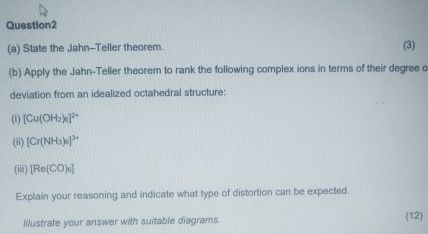 pe
(0) Apply ean Teter tort ran the flowing cals ors in rms of
deviation from an idealized octahedral structure:
CuK
Cre
©) Re(COM
Explain your reasoning and cca what yo of distoon can bo expeced
Be alm va
This is AI generated Response.
Asked by: Edu
Created at: 2025-10-15 19:46:22
Asked by: Edu
Created at: 2025-10-15 19:46:22
Final Answer:
Rendered
Raw Text
Did you like this answer?
Let's go step by step through your question about the **Jahn-Teller theorem** and its application to specific transition metal complexes.
---
# (a) State the Jahn–Teller Theorem
**Jahn-Teller Theorem:**
> "Any non-linear molecule in a degenerate electronic state will undergo a geometrical distortion that removes this degeneracy and lowers the overall energy of the molecule."
**Explanation:**
If a molecule/ion has an uneven distribution of electrons in degenerate (same energy) orbitals, it will distort (change shape) to remove the degeneracy and become more stable.
---
# (b) Apply the Jahn–Teller Theorem to Rank the Complex Ions
## Step 1: Write the Electronic Configurations
Let's consider the electron configuration of each metal ion in an **octahedral field**:
### (i) \([Cu(OH_2)_6]^{2+}\)
- **Cu(II):** Atomic number = 29 → Cu²⁺ = [Ar] 3d⁹
- In octahedral field: \( t_{2g}^6 e_g^3 \)
### (ii) \([Cr(NH_3)_6]^{3+}\)
- **Cr(III):** Atomic number = 24 → Cr³⁺ = [Ar] 3d³
- In octahedral field: \( t_{2g}^3 e_g^ \)
### (iii) \([Re(CO)_6]^3\)
- **Re(III):** Atomic number = 75 → Re³⁺ = [Xe] 5d⁴
- In octahedral field: \( t_{2g}^4 e_g^ \)
---
## Step 2: Predict Jahn–Teller Distortion
**Jahn-Teller distortion** is most significant when the \( e_g \) or \( t_{2g} \) levels are unevenly filled (degenerate and unsymmetrical).
### Analyze Each Complex
#### (i) \([Cu(OH_2)_6]^{2+}\): \( d^9 \)
- **Electronic configuration:** \( t_{2g}^6 e_g^3 \)
- **Degeneracy:** The \( e_g \) set is unevenly filled (3 electrons).
- **Jahn-Teller Effect:** **Strong**, as the unevenly filled \( e_g \) orbitals (especially for d⁹) cause significant distortion.
#### (ii) \([Cr(NH_3)_6]^{3+}\): \( d^3 \)
- **Electronic configuration:** \( t_{2g}^3 e_g^ \)
- **Degeneracy:** \( t_{2g} \) is half-filled (symmetrical), \( e_g \) is empty.
- **Jahn-Teller Effect:** **Negligible/none**, as there is no degenerate occupancy in \( e_g \) orbitals.
#### (iii) \([Re(CO)_6]^3\): \( d^4 \)
- **Electronic configuration:** \( t_{2g}^4 e_g^ \)
- **Degeneracy:** For strong field ligands like CO, electrons pair in \( t_{2g} \), so configuration is \( t_{2g}^4 \) (low-spin, paired).
- **Jahn-Teller Effect:** **Weak to moderate**. In a strong field (low spin), the \( t_{2g} \) orbitals are unevenly filled. However, the effect is less pronounced than for \( e_g \) degeneracy.
---
## Step 3: Rank by Degree of Jahn-Teller Distortion
1. **[Cu(OH₂)₆]²⁺** — **Strongest Jahn-Teller effect** (d⁹, uneven \( e_g \))
2. **[Re(CO)₆]³⁺** — **Moderate/Weak Jahn-Teller effect** (low-spin d⁴, uneven \( t_{2g} \))
3. **[Cr(NH₃)₆]³⁺** — **No significant Jahn-Teller effect** (d³, symmetrical \( t_{2g} \))
---
## Step 4: Type of Distortion Expected
- For \( d^9 \) ([Cu(OH₂)₆]²⁺): **Elongation** along one axis (usually z-axis), leading to tetragonal distortion.
- For \( d^4 \) low spin ([Re(CO)₆]³⁺): **Weak distortion**, possibly a slight elongation or compression.
- For \( d^3 \) ([Cr(NH₃)₆]³⁺): **No significant distortion**; remains nearly octahedral.
---
## Step 5: Diagram Illustration
### Typical Jahn-Teller Distortion (for d⁹)
```plaintext
Before distortion (octahedral):
O
|
O----Cu----O
|
O
After distortion (elongated along z-axis):
O
|
O----Cu----O
|
O
(longer Cu–O bonds along z)
```
---
# **Final Summary Table**
| Complex | d-electrons | Jahn-Teller Effect | Type of Distortion |
|--------------------------|-------------|--------------------|--------------------------|
| [Cu(OH₂)₆]²⁺ | d⁹ | Strong | Tetragonal elongation |
| [Cr(NH₃)₆]³⁺ | d³ | None/Negligible | None (octahedral) |
| [Re(CO)₆]³⁺ | d⁴ (low spin)| Weak/Moderate | Slight distortion |
---
## **Summary**
1. **Jahn-Teller theorem**: Nonlinear molecules with degenerate electronic states will distort to remove the degeneracy and lower the energy.
2. **Ranking Jahn-Teller distortion**:
- [Cu(OH₂)₆]²⁺ (**strongest**)
- [Re(CO)₆]³⁺ (**moderate/weak**)
- [Cr(NH₃)₆]³⁺ (**none**)
3. **Distortion type**: Mainly tetragonal elongation for d⁹ case.
Let me know if you want the diagrams sketched or have more questions!
📢 Instructions:
- Ask anything relatd to above question only.
- For new Question goto :