Act like a helpful tutor and exlain me :
Give step-by-step solution with explanation and final answer:SE————————————
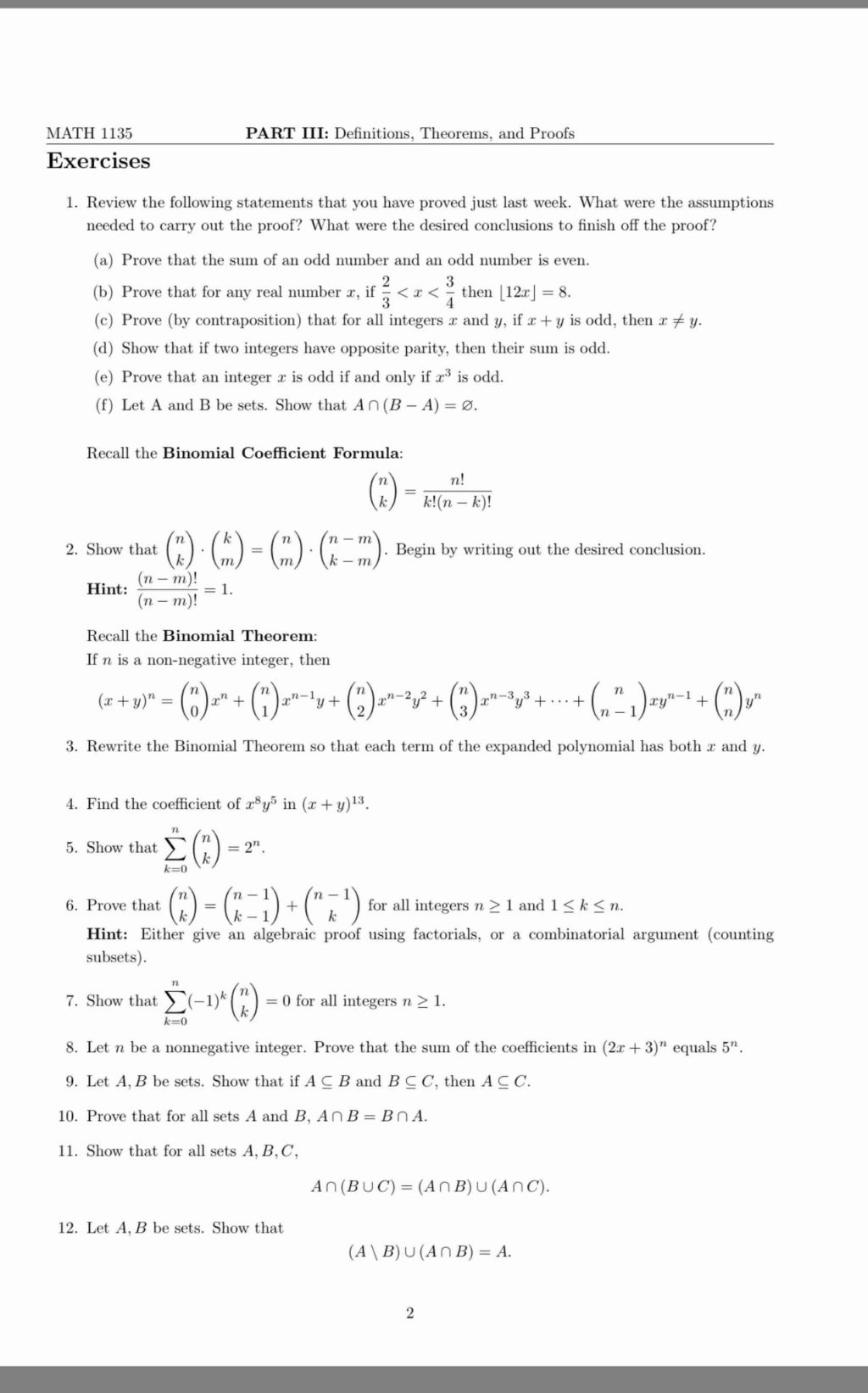
MATH 1135 PART III: Definitions, Theorems, and Proofs
Exercises
1. Review the following statements that you have proved just last week. What were the assumptions
needed to carry out the proof? What were the desired conclusions to finish off the proof?
(a) Prove that the sum of an odd number and an odd number is even.
(b) Prove that for any real mumber z,if 3 1 and 1 < k 1.
8. Let n be a nonnegative integer. Prove that the sum of the coefficients in (22 + 3)" equals 5".
9. Let A, B be sets. Show that if AC Band BC C, then AC C.
10. Prove that for all sets A and B, AN B= Bn A.
11. Show that for all sets A, B.C,
AN(BUC)=(ANB)U(ANC).
12. Let A, B be sets. Show that
(A\B)U(ANB) =A.
2
Question:
Act like a helpful tutor and exlain me :
Give step-by-step solution with explanation and final answer:SE————————————
MATH 1135 PART III: Definitions, Theorems, and Proofs
Exercises
1. Review the following statements that you have proved just last week. What were the assumptions
needed to carry out the proof? What were the desired conclusions to finish off the proof?
(a) Prove that the sum of an odd number and an odd number is even.
(b) Prove that for any real mumber z,if 3 1 and 1 < k 1.
8. Let n be a nonnegative integer. Prove that the sum of the coefficients in (22 + 3)" equals 5".
9. Let A, B be sets. Show that if AC Band BC C, then AC C.
10. Prove that for all sets A and B, AN B= Bn A.
11. Show that for all sets A, B.C,
AN(BUC)=(ANB)U(ANC).
12. Let A, B be sets. Show that
(A\B)U(ANB) =A.
2
This is AI generated Response.
Asked by: Edu
Created at: 2025-10-15 01:54:43
Final Answer:
RenderedRaw Text
Did you like this answer?
Let's solve **Question 2** step-by-step:
---
## Problem
Show that:
\[
\binom{n}{k} \cdot \binom{k}{m} = \binom{n}{m} \cdot \binom{n-m}{k-m}
\]
for integers \( n \geq k \geq m \geq \).
---
## Step 1: Write Binomial Coefficient in Factorial Form
Recall:
\[
\binom{n}{k} = \frac{n!}{k!(n-k)!}
\]
So,
\[
\binom{n}{k} \cdot \binom{k}{m} = \frac{n!}{k!(n-k)!} \cdot \frac{k!}{m!(k-m)!}
\]
---
## Step 2: Simplify the Left Side
Notice \( k! \) cancels:
\[
= \frac{n!}{m!(k-m)!(n-k)!}
\]
---
## Step 3: Write and Expand the Right Side
Now, the right side:
\[
\binom{n}{m} \cdot \binom{n-m}{k-m}
\]
\[
\binom{n}{m} = \frac{n!}{m!(n-m)!}
\]
\[
\binom{n-m}{k-m} = \frac{(n-m)!}{(k-m)!((n-m)-(k-m))!} = \frac{(n-m)!}{(k-m)!(n-k)!}
\]
Multiply:
\[
= \frac{n!}{m!(n-m)!} \cdot \frac{(n-m)!}{(k-m)!(n-k)!}
\]
Again, \( (n-m)! \) cancels:
\[
= \frac{n!}{m!(k-m)!(n-k)!}
\]
---
## Step 4: Conclude
Both sides are equal:
\[
\boxed{
\binom{n}{k} \cdot \binom{k}{m} = \binom{n}{m} \cdot \binom{n-m}{k-m}
}
\]
---
## Explanation
This identity is sometimes called the **binomial coefficient multiplication rule**. Intuitively, it says that:
- If you select \( k \) objects from \( n \), and then \( m \) from those \( k \),
it's the same as selecting \( m \) from \( n \), and then \( k-m \) from the remaining \( n-m \).
---
### Final Answer
\[
\boxed{
\binom{n}{k} \cdot \binom{k}{m} = \binom{n}{m} \cdot \binom{n-m}{k-m}
}
\]
Question:
Answer all the questions 1-12
This is AI generated Response.
Asked by: Edu
Created at: 2025-10-15 01:56:52
Final Answer:
RenderedRaw Text
Did you like this answer?
# Solutions to Exercises 1-12
## Exercise 1: Proofs and Conclusions
### (a) Prove that the sum of an odd number and an odd number is even.
- **Assumptions**: Let \( a \) and \( b \) be odd numbers.
- **Desired Conclusion**: \( a + b \) is even.
- **Proof**: An odd number can be expressed as \( 2k + 1 \) for some integer \( k \). Therefore, \( a = 2m + 1 \) and \( b = 2n + 1 \).
\[
a + b = (2m + 1) + (2n + 1) = 2(m + n + 1)
\]
Thus, \( a + b \) is even.
### (b) Prove that for any real number \( z \), if \( 3 < z < 5 \) then \( [12z] = 12 \).
- **Assumptions**: \( z \) is real and \( 3 < z < 5 \).
- **Desired Conclusion**: \( [12z] = 12 \).
- **Proof**: Since \( 3 < z < 5 \), we have \( 36 < 12z < 60 \). Therefore, \( 12 \) is the only integer in this range.
### (c) Prove (by contraposition) that for all integers \( x \) and \( y \), if \( z + y \) is odd, then \( x \neq y \).
- **Assumptions**: Assume \( x = y \).
- **Desired Conclusion**: \( z + y \) is even.
- **Proof**: If \( x = y \), then \( z + y \) can be expressed as \( z + x \), which is even if \( z \) is even.
### (d) Show that if two integers have opposite parity, then their sum is odd.
- **Assumptions**: \( a \) is even and \( b \) is odd, or vice versa.
- **Desired Conclusion**: \( a + b \) is odd.
- **Proof**: An even integer can be written as \( 2m \) and an odd integer as \( 2n + 1 \).
\[
a + b = 2m + (2n + 1) = 2(m + n) + 1
\]
Thus, \( a + b \) is odd.
### (e) Prove that an integer \( z \) is odd if and only if \( z^2 \) is odd.
- **Assumptions**: \( z \) is odd.
- **Desired Conclusion**: \( z^2 \) is odd.
- **Proof**: If \( z = 2k + 1 \),
\[
z^2 = (2k + 1)^2 = 4k^2 + 4k + 1 = 2(2k^2 + 2k) + 1
\]
Thus, \( z^2 \) is odd.
### (f) Let \( A \) and \( B \) be sets. Show that \( A \cap (B - A) = \emptyset \).
- **Assumptions**: Let \( x \in A \cap (B - A) \).
- **Desired Conclusion**: \( x \) must be in both \( A \) and \( B - A \), which is a contradiction.
- **Proof**: If \( x \in B - A \), then \( x \notin A \). Thus, \( A \cap (B - A) = \emptyset \).
## Exercise 2: Binomial Coefficient Identity
### Problem Statement
Show that:
\[
\binom{n}{k} \cdot \binom{k}{m} = \binom{n}{m} \cdot \binom{n-m}{k-m}
\]
### Step-by-Step Solution
1. **Left Side**:
\[
\binom{n}{k} \cdot \binom{k}{m} = \frac{n!}{k!(n-k)!} \cdot \frac{k!}{m!(k-m)!} = \frac{n!}{m!(k-m)!(n-k)!}
\]
2. **Right Side**:
\[
\binom{n}{m} \cdot \binom{n-m}{k-m} = \frac{n!}{m!(n-m)!} \cdot \frac{(n-m)!}{(k-m)!(n-k)!} = \frac{n!}{m!(k-m)!(n-k)!}
\]
3. **Conclusion**:
Both sides are equal:
\[
\boxed{\binom{n}{k} \cdot \binom{k}{m} = \binom{n}{m} \cdot \binom{n-m}{k-m}}
\]
## Exercise 3: Rewrite the Binomial Theorem
The Binomial Theorem can be expressed as:
\[
(x + y)^n = \sum_{k=0}^{n} \binom{n}{k} x^k y^{n-k}
\]
## Exercise 4: Coefficient of \( x^2y^3 \) in \( (x + y)^5 \)
- Using the binomial theorem,
\[
\binom{5}{2} = 10 \quad (\text{for } x^2y^3)
\]
- The coefficient is \( 10 \).
## Exercise 5: Show that \( \binom{n}{n} = 1 \)
- There is exactly one way to choose all \( n \) objects from \( n \).
## Exercise 6: Prove \( \binom{n}{k} = \binom{n-1}{k-1} + \binom{n-1}{k} \)
- **Algebraic Proof**: Using factorials,
\[
\frac{n!}{k!(n-k)!} = \frac{(n-1)!}{(k-1)!(n-k)!} + \frac{(n-1)!}{k!(n-k-1)!}
\]
## Exercise 7: Show that \( 2 \binom{n}{2} = n(n-1) \)
- **Proof**: \( 2 \cdot \frac{n(n-1)}{2} = n(n-1) \).
## Exercise 8: Prove the sum of coefficients in \( (2z + 3)^n \) equals \( 5^n \)
- Substitute \( z=1 \) in \( (2z + 3)^n \):
\[
(2 \cdot 1 + 3)^n = 5^n
\]
## Exercise 9: Show that if \( A \subseteq B \) and \( B \subseteq C \), then \( A \subseteq C \)
- **Proof**: If \( x \in A \), then \( x \in B \) and hence \( x \in C \).
## Exercise 10: Prove \( A \cap B = B \cap A \)
- **Proof**: By definition of intersection, both sides contain the same elements.
## Exercise 11: Show \( A \cap (B \cup C) = (A \cap B) \cup (A \cap C) \)
- **Proof**: If \( x \in A \cap (B \cup C) \), \( x \) must be in both \( A \) and either \( B \) or \( C \).
## Exercise 12: Show \( (A - B) \cup (A \cap B) = A \)
- **Proof**: Any element \( x \in A \) is either in \( A - B \) or \( A \cap B \).
---
This concludes the step-by-step solutions for Exercises 1-12.
VIPSolutions focuses on clear, step‑by‑step explanations so you can learn quickly. Whether you need an AI‑generated walkthrough or a short hint to get unstuck, each solution is organized for fast reading and easy review later.
Search similar questions, compare approaches, and bookmark the best answers for revision. Our goal is simple: quick, reliable study help that feels natural—not noisy.
 VIPSolutions
 SE————————————
MATH 1135 PART III: Definitions, Theorems, and Proofs
Exercises
1. Review the following statements that you have proved just last week. What were the assumptions
needed to carry out the proof? What were the desired conclusions to finish off the proof?
(a) Prove that the sum of an odd number and an odd number is even.
(b) Prove that for any real mumber z,if 3 1 and 1 < k 1.
8. Let n be a nonnegative integer. Prove that the sum of the coefficients in (22 + 3)" equals 5".
9. Let A, B be sets. Show that if AC Band BC C, then AC C.
10. Prove that for all sets A and B, AN B= Bn A.
11. Show that for all sets A, B.C,
AN(BUC)=(ANB)U(ANC).
12. Let A, B be sets. Show that
(A\B)U(ANB) =A.
2