 VIPSolutions
Act like a helpful tutor and exlain me : Give step-by-step solution with explanation and final answer:A fluid has velocity components u = (5y? — x) m/s and , v = (4x?) m/s where x and y are in meters. Determine the magnitudes of the velocity and total acceleration (in m/s and m/s?, with three significant figures) of a particle passing through point (2 m, 1 m).
Question:
Act like a helpful tutor and exlain me :
Give step-by-step solution with explanation and final answer: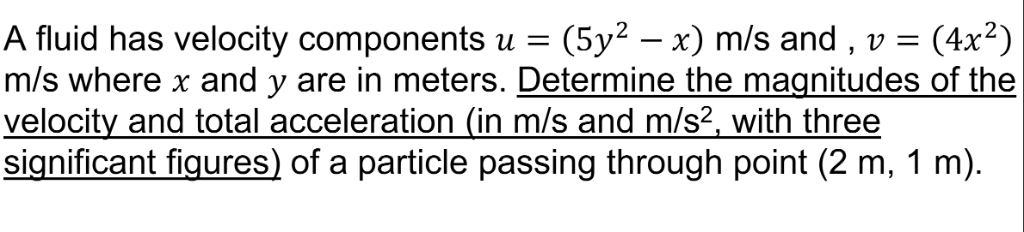 A fluid has velocity components u = (5y? — x) m/s and , v = (4x?)
m/s where x and y are in meters. Determine the magnitudes of the
velocity and total acceleration (in m/s and m/s?, with three
significant figures) of a particle passing through point (2 m, 1 m).
This is AI generated Response.
Asked by: manish kumar
Created at: 2025-10-14 23:31:39
Asked by: manish kumar
Created at: 2025-10-14 23:31:39
Final Answer:
Rendered
Raw Text
Did you like this answer?
Let's solve the problem step by step:
---
## **Given**
- Velocity components:
- \( u = 5y^2 - x \) (in m/s)
- \( v = 4x^2 \) (in m/s)
- Point: \( (x, y) = (2~\text{m}, 1~\text{m}) \)
---
## **Step 1: Find the Magnitude of Velocity**
The magnitude of velocity (\( V \)) is:
\[
V = \sqrt{u^2 + v^2}
\]
### **Calculate \( u \) and \( v \) at (2, 1):**
\[
u = 5y^2 - x = 5(1)^2 - 2 = 5 - 2 = 3~\text{m/s}
\]
\[
v = 4x^2 = 4 \times (2)^2 = 4 \times 4 = 16~\text{m/s}
\]
### **Magnitude:**
\[
V = \sqrt{3^2 + 16^2} = \sqrt{9 + 256} = \sqrt{265} \approx 16.3~\text{m/s}
\]
---
## **Step 2: Find the Acceleration Components**
Total acceleration in a velocity field is:
\[
\vec{a} = \frac{\partial \vec{V}}{\partial t} + (\vec{V} \cdot \nabla)\vec{V}
\]
Since the velocity field is steady (no explicit time dependence), only the convective term remains:
\[
\vec{a} = (\vec{V} \cdot \nabla)\vec{V}
\]
### **Calculate \( a_x \) and \( a_y \):**
\[
a_x = u \frac{\partial u}{\partial x} + v \frac{\partial u}{\partial y}
\]
\[
a_y = u \frac{\partial v}{\partial x} + v \frac{\partial v}{\partial y}
\]
#### **Partial Derivatives:**
- \( \frac{\partial u}{\partial x} = \frac{\partial}{\partial x}(5y^2 - x) = -1 \)
- \( \frac{\partial u}{\partial y} = \frac{\partial}{\partial y}(5y^2 - x) = 10y \)
- \( \frac{\partial v}{\partial x} = \frac{\partial}{\partial x}(4x^2) = 8x \)
- \( \frac{\partial v}{\partial y} = \frac{\partial}{\partial y}(4x^2) = \)
#### **Evaluate at (2, 1):**
- \( u = 3 \)
- \( v = 16 \)
- \( \frac{\partial u}{\partial x} = -1 \)
- \( \frac{\partial u}{\partial y} = 10 \times 1 = 10 \)
- \( \frac{\partial v}{\partial x} = 8 \times 2 = 16 \)
- \( \frac{\partial v}{\partial y} = \)
#### **Plug in values:**
\[
a_x = 3 \cdot (-1) + 16 \cdot 10 = -3 + 160 = 157~\text{m/s}^2
\]
\[
a_y = 3 \cdot 16 + 16 \cdot = 48 + = 48~\text{m/s}^2
\]
---
## **Step 3: Magnitude of Total Acceleration**
\[
a = \sqrt{a_x^2 + a_y^2}
\]
\[
a = \sqrt{157^2 + 48^2} = \sqrt{24649 + 2304} = \sqrt{26953} \approx 164~\text{m/s}^2
\]
---
## **Final Answers (Rounded to Three Significant Figures)**
### **Magnitude of Velocity:**
\[
\boxed{16.3~\text{m/s}}
\]
### **Magnitude of Total Acceleration:**
\[
\boxed{164~\text{m/s}^2}
\]
---
### **Summary Table**
| Quantity | Value | Units |
|-------------------|--------------|-----------|
| Velocity | 16.3 | m/s |
| Acceleration | 164 | m/s\(^2\) |
If you have any questions about any steps, feel free to ask!
📢 Instructions:
- Ask anything relatd to above question only.
- For new Question goto :