 VIPSolutions
Act like a helpful tutor and exlain me : Give step-by-step solution with explanation and final answer:A tank contains 2 kg of air at an absolute pressure of 400 kPa and a temperature of 20°C. If 0.6 kg of air is added to the tank and the temperature rises to 32 °C, determine the pressure in the tank in kPa with three significant figures. Assume that the gas follows the ideal gas law. Hint: Consider that the tank walls are rigid enough such that its volume will not change after the addition of 0.6 kg of air.
Question:
Act like a helpful tutor and exlain me :
Give step-by-step solution with explanation and final answer: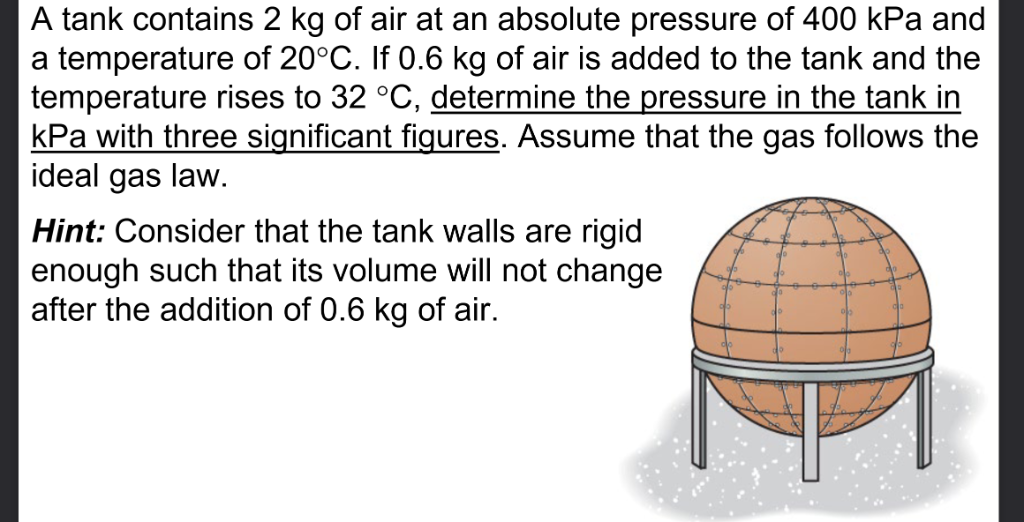 A tank contains 2 kg of air at an absolute pressure of 400 kPa and
a temperature of 20°C. If 0.6 kg of air is added to the tank and the
temperature rises to 32 °C, determine the pressure in the tank in
kPa with three significant figures. Assume that the gas follows the
ideal gas law.
Hint: Consider that the tank walls are rigid
enough such that its volume will not change
after the addition of 0.6 kg of air.
This is AI generated Response.
Asked by: manish kumar
Created at: 2025-10-14 00:35:21
Asked by: manish kumar
Created at: 2025-10-14 00:35:21
Final Answer:
Rendered
Raw Text
Did you like this answer?
Let's solve this step by step using the **ideal gas law**:
## Step 1: Write out the Ideal Gas Law
The **ideal gas law is:
\[
PV = nRT
\]
For mass-based calculations, it's often written as:
\[
PV = mRT
\]
Where:
- \(P\) = pressure (kPa)
- \(V\) = volume (m³)
- \(m\) = mass (kg)
- \(R\) = specific gas constant for air (\(R = .287 \, \text{kJ/kg·K}\))
- \(T\) = temperature (K)
---
## Step 2: Find the Volume of the Tank
Initial conditions:
- \( m_1 = 2 \, \text{kg} \)
- \( P_1 = 400 \, \text{kPa} \)
- \( T_1 = 20^\circ\text{C} = 293.15 \, \text{K} \)
From the ideal gas law:
\[
V = \frac{m_1RT_1}{P_1}
\]
Plug in the values:
\[
V = \frac{2 \times .287 \times 293.15}{400}
\]
\[
V = \frac{2 \times .287 \times 293.15}{400}
\]
\[
= \frac{168.4491}{400}
\]
\[
= .4211 \, \text{m}^3
\]
---
## Step 3: Write the Final State Equation
After adding air:
- \( m_2 = 2 + .6 = 2.6 \, \text{kg} \)
- \( T_2 = 32^\circ\text{C} = 305.15 \, \text{K} \)
- \( V \) (same as above, since the tank is rigid)
Use the ideal gas law for the final state:
\[
P_2V = m_2RT_2
\]
\[
P_2 = \frac{m_2RT_2}{V}
\]
---
## Step 4: Solve for the Final Pressure
Plug in all known values:
\[
P_2 = \frac{2.6 \times .287 \times 305.15}{.4211}
\]
Calculate numerator:
\[
2.6 \times .287 \times 305.15 = 228.095
\]
So,
\[
P_2 = \frac{228.095}{.4211}
\]
\[
P_2 = 541.7 \, \text{kPa}
\]
---
## Step 5: Final Answer (Three Significant Figures)
\[
\boxed{542\ \text{kPa}}
\]
---
### **Summary Table**
| Step | Value |
|----------------|----------------|
| Initial mass | 2 kg |
| Added mass | .6 kg |
| Final mass | 2.6 kg |
| Initial temp | 293.15 K |
| Final temp | 305.15 K |
| Initial pressure | 400 kPa |
| Final pressure | **542 kPa** |
---
**Final Answer:**
> The pressure in the tank after adding .6 kg of air and heating to 32°C is **542 kPa** (to three significant figures).
📢 Instructions:
- Ask anything relatd to above question only.
- For new Question goto :