 VIPSolutions
Act like a helpful tutor and exlain me : Give step-by-step solution with explanation and final answer:7.3.5 Assume that the flowrate, Q, of a gas from a smokestack is a function of the density of the ambient air, p,. the density of the gas, pg, within the stack, the acceleration of gravity, g. and the height and diameter of the stack, and d, respectively. Use p,, d, and g as repeating variables to develop a set of pi terms that could be used to describe this problem.
Question:
Act like a helpful tutor and exlain me :
Give step-by-step solution with explanation and final answer: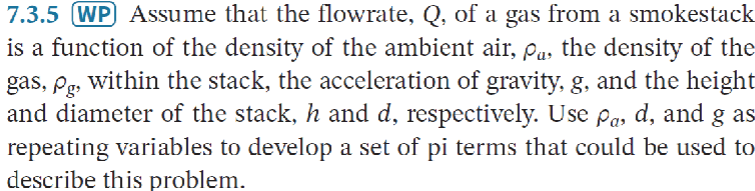 7.3.5 Assume that the flowrate, Q, of a gas from a smokestack
is a function of the density of the ambient air, p,. the density of the
gas, pg, within the stack, the acceleration of gravity, g. and the height
and diameter of the stack, and d, respectively. Use p,, d, and g as
repeating variables to develop a set of pi terms that could be used to
describe this problem.
This is AI generated Response.
Asked by: manish kumar
Created at: 2025-10-13 23:55:13
Asked by: manish kumar
Created at: 2025-10-13 23:55:13
Final Answer:
Rendered
Raw Text
Did you like this answer?
Sure! Let's the problem **step step** using **Buckingham Theorem**---
## **Step 1: List All Variables and Their Dimensions**
Given variables:
- \( Q \): Flowrate (unknown if mass or volumetric; assume **volumetric**: \( [L^3 T^{-1}] \))
- \( \rho_a \): Density of ambient air \([M L^{-3}]\)
- \( \rho_g \): Density of gas in stack \([M L^{-3}]\)
- \( g \): Acceleration due to gravity \([L T^{-2}]\)
- \( h \): Stack height \([L]\)
- \( d \): Stack diameter \([L]\)
---
## **Step 2: Express the Functional Relationship**
\[
Q = f(\rho_a, \rho_g, g, h, d)
\]
---
## **Step 3: Count Number of Variables and Fundamental Dimensions**
- **Variables (\(n\))**: 6 (\(Q, \rho_a, \rho_g, g, h, d\))
- **Fundamental dimensions (\(k\))**: 3 (Mass \(M\), Length \(L\), Time \(T\))
---
## **Step 4: Number of Pi Terms**
\[
\text{Number of } \pi \text{ terms} = n - k = 6 - 3 = 3
\]
---
## **Step 5: Choose Repeating Variables**
We are told to use **\(\rho_a\), \(d\), and \(g\)** as repeating variables.
---
## **Step 6: Form Pi Terms**
Each Pi term is dimensionless.
### **General Form**
\[
\pi = Q^a \, \rho_a^b \, d^c \, g^d \, X^e
\]
where \(X\) is the non-repeating variable in that Pi term.
Let's form the Pi terms for each remaining variable (\(Q, \rho_g, h\)):
---
### **Pi Term 1: Involving Q**
\[
\pi_1 = Q \cdot \rho_a^a d^b g^c
\]
Dimensions:
- \( Q: [L^3 T^{-1}] \)
- \( \rho_a: [M L^{-3}] \)
- \( d: [L] \)
- \( g: [L T^{-2}] \)
Combine:
\[
[L^3 T^{-1}] [M L^{-3}]^a [L]^b [L T^{-2}]^c
\]
\[
= M^a \, L^{3 - 3a + b + c} \, T^{-1 - 2c}
\]
Set exponents to zero for dimensionless:
\[
\begin{cases}
M: & a = \\
L: & 3 - 3a + b + c = \\
T: & -1 - 2c =
\end{cases}
\]
Solve:
- \(a = \)
- \( -1 - 2c = \implies c = -.5 \)
- \( 3 + b - .5 = \implies b = -2.5 \)
So,
\[
\pi_1 = \dfrac{Q}{d^{2.5} g^{.5}}
\]
Or, more commonly, rationalize the exponents:
\[
\boxed{
\pi_1 = \frac{Q}{d^{5/2} g^{1/2}}
}
\]
Alternatively, using \(\rho_a\) with exponent (so it does not appear).
---
### **Pi Term 2: Involving \(\rho_g\)**
\[
\pi_2 = \rho_g \cdot \rho_a^a d^b g^c
\]
Dimensions:
- \( \rho_g: [M L^{-3}] \)
\[
[M L^{-3}] [M L^{-3}]^a [L]^b [L T^{-2}]^c = M^{1+a} L^{-3 + b + c - 3a} T^{-2c}
\]
Set exponents to zero:
\[
\begin{cases}
M: & 1+a = \implies a = -1 \\
L: & -3 - 3a + b + c = \implies -3 + 3 + b + c = \implies b + c = \\
T: & -2c = \implies c =
\end{cases}
\]
So, \(a = -1\), \(c = \), \(b = \):
\[
\pi_2 = \frac{\rho_g}{\rho_a}
\]
---
### **Pi Term 3: Involving \(h\)**
\[
\pi_3 = h \cdot \rho_a^a d^b g^c
\]
Dimensions:
- \( h: [L] \)
\[
[L] [M L^{-3}]^a [L]^b [L T^{-2}]^c
= M^a L^{1-3a+b+c} T^{-2c}
\]
Set exponents to zero:
\[
\begin{cases}
M: & a = \\
L: & 1 + b + c = \implies b + c = -1 \\
T: & -2c = \implies c =
\end{cases}
\]
So, \(a=\), \(c=\), \(b=-1\):
\[
\pi_3 = \frac{h}{d}
\]
---
## **Step 7: Final Set of Pi Terms**
\[
\boxed{
\begin{align*}
\pi_1 &= \frac{Q}{d^{5/2} g^{1/2}} \\
\pi_2 &= \frac{\rho_g}{\rho_a} \\
\pi_3 &= \frac{h}{d}
\end{align*}
}
\]
## **Summary/Final Answer**
The set of dimensionless Pi terms describing the problem, using \(\rho_a\), \(d\), and \(g\) as repeating variables, is:
\[
\boxed{
\left\{
\frac{Q}{d^{5/2} g^{1/2}}, \quad
\frac{\rho_g}{\rho_a}, \quad
\frac{h}{d}
\right\}
}
\]
These terms can be used to write the functional relationship in dimensionless form:
\[
f\left( \frac{Q}{d^{5/2} g^{1/2}}, \frac{\rho_g}{\rho_a}, \frac{h}{d} \right) =
\]
📢 Instructions:
- Ask anything relatd to above question only.
- For new Question goto :