 VIPSolutions
Act like a helpful tutor and exlain me : Give step-by-step solution with explanation and final answer:7.1.4 The Reynolds number, oVD/u, is a very important parameter in fluid mechanics. Verify that the Reynolds number is dimensionless, using both the FLT system and the MLT system for basic dimensions, and determine its value for ethyl alcohol flowing at a velocity of 3 m/s through a 2-in.-diameter pipe.
Question:
Act like a helpful tutor and exlain me :
Give step-by-step solution with explanation and final answer: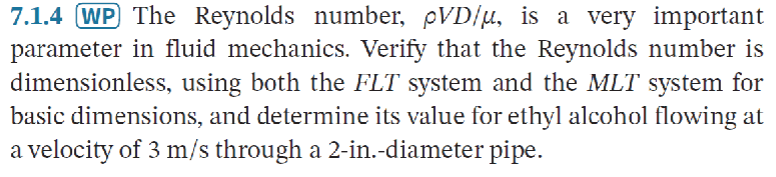 7.1.4 The Reynolds number, oVD/u, is a very important
parameter in fluid mechanics. Verify that the Reynolds number is
dimensionless, using both the FLT system and the MLT system for
basic dimensions, and determine its value for ethyl alcohol flowing at
a velocity of 3 m/s through a 2-in.-diameter pipe.
This is AI generated Response.
Asked by: manish kumar
Created at: 2025-10-13 23:45:24
Asked by: manish kumar
Created at: 2025-10-13 23:45:24
Final Answer:
Rendered
Raw Text
Did you like this answer?
Let's solve the problem step by step.
---
# **Step 1: Write the Reynolds Number Formula**
\[
Re = \frac{\rho V D}{\mu}
\]
where:
- \(\rho\) = density of fluid
- \(V\) = velocity of fluid
- \(D\) = diameter of pipe
- \(\mu\) = dynamic viscosity
---
# **Step 2: Dimensional Analysis**
## **A. Using the MLT System (Mass, Length, Time)**
Let's write the dimensions of each term:
- \(\rho\): density = \(\frac{\text{M}}{\text{L}^3}\)
- \(V\): velocity = \(\frac{\text{L}}{\text{T}}\)
- \(D\): length = \(\text{L}\)
- \(\mu\): dynamic viscosity = \(\frac{\text{M}}{\text{L}\,\text{T}}\)
Plugging these into the Reynolds number expression:
\[
Re = \frac{(\frac{M}{L^3}) (\frac{L}{T}) (L)}{(\frac{M}{L\,T})}
\]
Simplify numerator:
\[
(\frac{M}{L^3}) \cdot (\frac{L}{T}) \cdot (L) = \frac{M \cdot L \cdot L}{L^3 \cdot T} = \frac{M L^2}{L^3 T} = \frac{M}{L T}
\]
Denominator:
\[
\frac{M}{L T}
\]
So,
\[
Re = \frac{\frac{M}{L T}}{\frac{M}{L T}} = 1
\]
**Conclusion:** Reynolds number is dimensionless in the MLT system.
---
## **B. Using the FLT System (Force, Length, Time)**
First, recall:
- \(\rho = \frac{\text{F} \cdot \text{T}^2}{\text{L}^4}\) (since \(F = MLT^{-2}\))
- \(V = \frac{L}{T}\)
- \(D = L\)
- \(\mu = \frac{\text{F} \cdot \text{T}}{\text{L}^2}\)
Plug into Reynolds formula:
Numerator:
\[
\rho V D = \left(\frac{F T^2}{L^4}\right) \left(\frac{L}{T}\right) (L) = \frac{F T^2 \cdot L \cdot L}{L^4 \cdot T} = \frac{F T^2 L^2}{L^4 T} = \frac{F T L^2}{L^4} = \frac{F T}{L^2}
\]
Denominator:
\[
\mu = \frac{F T}{L^2}
\]
So,
\[
Re = \frac{\frac{F T}{L^2}}{\frac{F T}{L^2}} = 1
\]
**Conclusion:** Reynolds number is dimensionless in the FLT system.
---
# **Step 3: Calculate Reynolds Number for Ethyl Alcohol**
**Given:**
- \(V = 3 \ \text{m/s}\)
- \(D = 2 \ \text{in.} = .0508 \ \text{m}\)
- Properties of ethyl alcohol at about room temperature:
- \(\rho \approx 789 \ \text{kg/m}^3\)
- \(\mu \approx 1.20 \times 10^{-3} \ \text{kg/(m·s)}\)
## **Plug into Formula**
\[
Re = \frac{\rho V D}{\mu}
\]
\[
Re = \frac{789 \ \text{kg/m}^3 \times 3 \ \text{m/s} \times .0508 \ \text{m}}{1.20 \times 10^{-3} \ \text{kg/(m·s)}}
\]
Calculate numerator:
\[
789 \times 3 \times .0508 = 789 \times .1524 \approx 120.27
\]
So numerator ≈ **120.27 kg/(m²·s)**
Now divide by viscosity:
\[
Re = \frac{120.27}{1.20 \times 10^{-3}} \approx 100,225
\]
---
# **Final Answers**
## **1. The Reynolds number is dimensionless** in both the MLT and FLT systems.
## **2. Its value for ethyl alcohol (at 3 m/s, 2-in pipe):**
\[
\boxed{Re \approx 1. \times 10^5}
\]
---
**Let me know if you need more details or a breakdown of unit conversions!**
📢 Instructions:
- Ask anything relatd to above question only.
- For new Question goto :