Act like a helpful tutor and exlain me :
Give step-by-step solution with explanation and final answer:Problem 2 (6-20 in pg 284, 25 points).
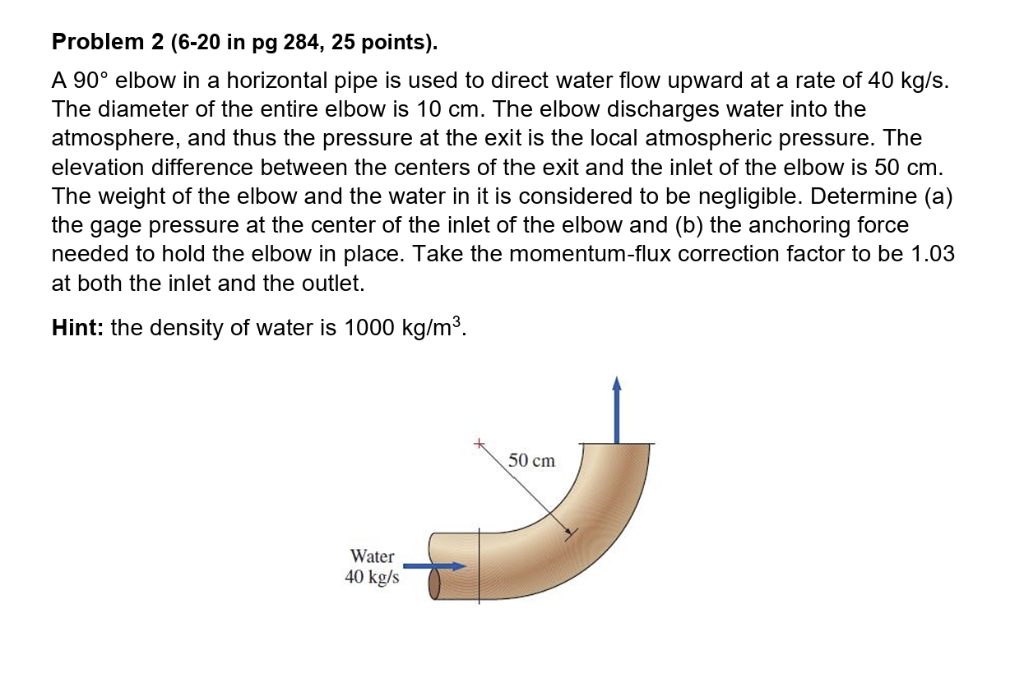
A 90° elbow in a horizontal pipe is used to direct water flow upward at a rate of 40 kg/s.
The diameter of the entire elbow is 10 cm. The elbow discharges water into the
atmosphere, and thus the pressure at the exit is the local atmospheric pressure. The
elevation difference between the centers of the exit and the inlet of the elbow is 50 cm.
The weight of the elbow and the water in it is considered to be negligible. Determine (a)
the gage pressure at the center of the inlet of the elbow and (b) the anchoring force
needed to hold the elbow in place. Take the momentum-flux correction factor to be 1.03
at both the inlet and the outlet.
Hint: the density of water is 1000 kg/m?®.
50cm
Water
40 kgs
Question:
Act like a helpful tutor and exlain me :
Give step-by-step solution with explanation and final answer:Problem 2 (6-20 in pg 284, 25 points).
A 90° elbow in a horizontal pipe is used to direct water flow upward at a rate of 40 kg/s.
The diameter of the entire elbow is 10 cm. The elbow discharges water into the
atmosphere, and thus the pressure at the exit is the local atmospheric pressure. The
elevation difference between the centers of the exit and the inlet of the elbow is 50 cm.
The weight of the elbow and the water in it is considered to be negligible. Determine (a)
the gage pressure at the center of the inlet of the elbow and (b) the anchoring force
needed to hold the elbow in place. Take the momentum-flux correction factor to be 1.03
at both the inlet and the outlet.
Hint: the density of water is 1000 kg/m?®.
50cm
Water
40 kgs
This is AI generated Response.
Asked by: manish kumar
Created at: 2025-10-13 22:12:36
Final Answer:
RenderedRaw Text
Did you like this answer?
Let's solve the problem step by step:
---
## **Given Data**
- **Mass flow rate (\(\dot{m}\))** = 40 kg/s
- **Density (\(\rho\))** = 100 kg/m³
- **Diameter (\(D\))** = .1 m
- **Elevation difference (\(\Delta z\))** = .5 m
- **Atmospheric pressure at exit (\(P_{atm}\))**
- **Momentum-flux correction factor (\(\beta\))** = 1.03
- **Neglect weight of elbow and water in it**
---
## **Step 1: Find Velocity at Inlet and Outlet**
Both inlet and outlet have the same diameter (.1 m):
- Area, \(A = \frac{\pi D^2}{4} = \frac{\pi (.1)^2}{4} = .00785 \, \text{m}^2 \)
- Volumetric flow rate, \(Q = \frac{\dot{m}}{\rho} = \frac{40}{100} = .04 \, \text{m}^3/\text{s}\)
- Velocity, \(V = \frac{Q}{A} = \frac{.04}{.00785} \approx 5.10 \, \text{m/s}\)
---
## **Step 2: Apply Energy Equation (Bernoulli) for Pressure at Inlet**
\[
\frac{P_1}{\rho g} + \frac{\alpha_1 V_1^2}{2g} + z_1 = \frac{P_2}{\rho g} + \frac{\alpha_2 V_2^2}{2g} + z_2
\]
Given:
- \(P_2 = P_{atm}\) (atmospheric at exit)
- \(z_2 - z_1 = .5\) m (exit is higher)
- \(\alpha_1 = \alpha_2 = 1.03\)
- \(V_1 = V_2\)
- Ignore losses
So,
\[
\frac{P_1}{\rho g} + \frac{1.03 V^2}{2g} = \frac{P_{atm}}{\rho g} + \frac{1.03 V^2}{2g} + .5
\]
\[
\frac{P_1}{\rho g} = \frac{P_{atm}}{\rho g} + .5
\]
\[
P_1 = P_{atm} + \rho g (.5)
\]
**Gage pressure** (relative to atmosphere):
\[
P_{gage,1} = P_1 - P_{atm} = \rho g (.5) = 100 \times 9.81 \times .5 = 4905 \, \text{Pa}
\]
---
### **(a) Gage Pressure at Inlet**
\[
\boxed{P_{gage,1} = 4905 \, \text{Pa}}
\]
---
## **Step 3: Find Anchoring Force (Control Volume Momentum Analysis)**
### **Momentum Equation (Control Volume, Steady Flow)**
\[
\sum F_{ext,x} = \dot{m} (V_{2x} - V_{1x})
\]
\[
\sum F_{ext,y} = \dot{m} (V_{2y} - V_{1y})
\]
Let’s define:
- \(x\)-axis: original pipe (horizontal)
- \(y\)-axis: vertical (upward exit)
### **Forces Acting:**
- Pressure force at inlet: \(F_{P1}\) (in \(+x\))
- Pressure force at exit: \(F_{P2}\) (in \(+y\))
- Force by the elbow anchor: \(F_{anchor}\) (opposes resultant)
- Ignore weight
#### **Pressure Forces:**
- At inlet: \(P_1 \cdot A\), in \(+x\) direction
- At exit: \(P_2 \cdot A\), in \(+y\) direction (\(P_2 = P_{atm}\), so cancels with atmospheric pressure outside)
#### **Net Pressure Forces (relative to atmospheric):**
- At inlet: \(P_{gage,1} \cdot A\), in \(+x\)
- At exit: (since \(P_2 = P_{atm}\))
#### **Momentum Flux:**
- \(V_1 = 5.10~\text{m/s}\) in \(+x\)
- \(V_2 = 5.10~\text{m/s}\) in \(+y\)
- Correction factor \(\beta = 1.03\)
\[
\dot{m} = 40~\text{kg/s}
\]
#### **x-direction:**
\[
\sum F_x = P_{gage,1} A - F_{anchor,x} = \beta \dot{m} ( - V_1)
\]
\[
P_{gage,1} A - F_{anchor,x} = -\beta \dot{m} V_1
\]
\[
F_{anchor,x} = P_{gage,1} A + \beta \dot{m} V_1
\]
#### **y-direction:**
\[
\sum F_y = - F_{anchor,y} = \beta \dot{m} (V_2 - )
\]
\[
-F_{anchor,y} = \beta \dot{m} V_2
\]
\[
F_{anchor,y} = -\beta \dot{m} V_2
\]
(Negative sign: the anchor must pull downward to counteract upward flow.)
---
### **Area Calculation**
\[
A = .00785 \, \text{m}^2
\]
---
### **Plug in Values:**
#### **x-direction:**
\[
F_{anchor,x} = (4905) \times (.00785) + 1.03 \times 40 \times 5.10
\]
\[
= 38.5 + 210.12 \approx 248.6\, \text{N}
\]
#### **y-direction:**
\[
F_{anchor,y} = -1.03 \times 40 \times 5.10 = -210.12 \, \text{N}
\]
---
### **Magnitude of the Anchoring Force**
\[
F_{anchor} = \sqrt{F_{anchor,x}^2 + F_{anchor,y}^2}
\]
\[
= \sqrt{(248.6)^2 + (210.12)^2}
\]
\[
= \sqrt{61803 + 44150}
\]
\[
= \sqrt{105953} \approx 325.5\, \text{N}
\]
---
## **Final Answers**
### **(a) Gage pressure at the inlet:**
\[
\boxed{P_{gage,1} = 4905~\text{Pa}}
\]
### **(b) Anchoring force needed:**
\[
\boxed{F_{anchor} = 325.5~\text{N}}
\]
(directed downstream and downward)
---
If you have any questions on the steps, let me know!
VIPSolutions focuses on clear, step‑by‑step explanations so you can learn quickly. Whether you need an AI‑generated walkthrough or a short hint to get unstuck, each solution is organized for fast reading and easy review later.
Search similar questions, compare approaches, and bookmark the best answers for revision. Our goal is simple: quick, reliable study help that feels natural—not noisy.
 VIPSolutions
 Problem 2 (6-20 in pg 284, 25 points).
A 90° elbow in a horizontal pipe is used to direct water flow upward at a rate of 40 kg/s.
The diameter of the entire elbow is 10 cm. The elbow discharges water into the
atmosphere, and thus the pressure at the exit is the local atmospheric pressure. The
elevation difference between the centers of the exit and the inlet of the elbow is 50 cm.
The weight of the elbow and the water in it is considered to be negligible. Determine (a)
the gage pressure at the center of the inlet of the elbow and (b) the anchoring force
needed to hold the elbow in place. Take the momentum-flux correction factor to be 1.03
at both the inlet and the outlet.
Hint: the density of water is 1000 kg/m?®.
50cm
Water
40 kgs