 VIPSolutions
Act like a helpful tutor and exlain me : Give step-by-step solution with explanation and final answer:Question 2 Saturate steam at 1 atm condenses on a 2-m-high and 10-m-wide vertical plate that is maintained at 80°C by circulating cooling water on the other side. Determine: (a) The rate of heat transfer by condensation to the plate, and (15) (b) The rate at which the condensation drips off the plate at the bottom (2) (171
Question:
Act like a helpful tutor and exlain me :
Give step-by-step solution with explanation and final answer: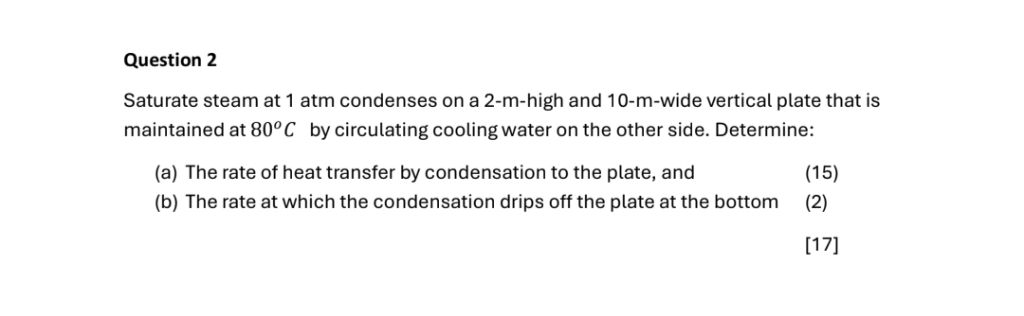 Question 2
Saturate steam at 1 atm condenses on a 2-m-high and 10-m-wide vertical plate that is
maintained at 80°C by circulating cooling water on the other side. Determine:
(a) The rate of heat transfer by condensation to the plate, and (15)
(b) The rate at which the condensation drips off the plate at the bottom (2)
(171
This is AI generated Response.
Asked by: manish kumar
Created at: 2025-10-13 14:16:48
Asked by: manish kumar
Created at: 2025-10-13 14:16:48
Final Answer:
Rendered
Raw Text
Did you like this answer?
Let's break down the problem step by step:
---
# **Given Data**
- **Plate height, \( L \) = 2 m**
- **Plate width, \( W \) = 10 m**
- **Plate temperature, \( T_s \) = 80°C**
- **Saturated steam at 1 atm (100°C)**
- **Condensation happens on the vertical plate**
---
# **Step 1: Get Steam Properties at 1 atm**
From steam tables at 1 atm (100°C):
- **Saturation temperature, \( T_{\text{sat}} \) = 100°C**
- **Latent heat of vaporization, \( h_{fg} \approx 2257 \) kJ/kg**
- **Density of liquid water, \( \rho_f \approx 958 \) kg/m³**
- **Dynamic viscosity, \( \mu_f \approx .282 \times 10^{-3} \) kg/m·s**
- **Thermal conductivity, \( k_f \approx .679 \) W/m·K**
- **Prandtl number, \( Pr_f \approx 1.75 \)**
---
# **Step 2: Use Nusselt's Equation for Film Condensation**
For a vertical plate (laminar film condensation):
\[
q = h \cdot A \cdot (T_{\text{sat}} - T_s)
\]
where \( h \) is the average heat transfer coefficient, and \( A = W \times L \).
Nusselt's correlation for average \( h \):
\[
h = .943 \left(\frac{\rho_f (\rho_f - \rho_g) g h_{fg} k_f^3}{\mu_f L (T_{\text{sat}} - T_s)} \right)^{1/4}
\]
Since \( \rho_g \ll \rho_f \), \( \rho_f - \rho_g \approx \rho_f \).
---
# **Step 3: Plug in the Values**
- \( g = 9.81 \) m/s²
- \( \rho_f = 958 \) kg/m³
- \( h_{fg} = 2,257,000 \) J/kg (convert kJ/kg to J/kg)
- \( k_f = .679 \) W/m·K
- \( \mu_f = .282 \times 10^{-3} \) kg/m·s
- \( L = 2 \) m
- \( T_{\text{sat}} - T_s = 100 - 80 = 20 \) K
\[
h = .943 \left(
\frac{
958 \times 958 \times 9.81 \times 2,257,000 \times (.679)^3
}{
.282 \times 10^{-3} \times 2 \times 20
}
\right)^{1/4}
\]
Let's calculate step by step:
### Numerator:
- \( 958 \times 958 = 917,764 \)
- \( 917,764 \times 9.81 = 9,003,209 \)
- \( 9,003,209 \times 2,257,000 = 20,322,744,013,000 \)
- \( (.679)^3 = .313 \)
- \( 20,322,744,013,000 \times .313 = 6,364,221,902,079 \)
### Denominator:
- \( .282 \times 10^{-3} = .000282 \)
- \( .000282 \times 2 = .000564 \)
- \( .000564 \times 20 = .01128 \)
### Full fraction:
\[
\frac{6,364,221,902,079}{.01128} \approx 564,454,427,215,425
\]
### Fourth Root:
\[
\left(564,454,427,215,425\right)^{1/4} \approx 875.7
\]
\[
h = .943 \times 875.7 \approx 825.5 \text{ W/m}^2\cdot\text{K}
\]
---
# **Step 4: Calculate the Total Heat Transfer Rate**
\[
q = h \cdot A \cdot \Delta T
\]
- \( A = W \times L = 10 \times 2 = 20 \) m²
- \( \Delta T = 20 \) K
\[
q = 825.5 \times 20 \times 20 = 330,200 \text{ W} = 330.2 \text{ kW}
\]
---
## **Final Answers**
### **(a) The rate of heat transfer by condensation to the plate:**
\[
\boxed{q = 330,200 \text{ W} = 330.2 \text{ kW}}
\]
---
### **(b) The rate at which the condensation drips off the plate at the bottom**
Use the heat transfer to find the mass flow rate:
\[
q = \dot{m} \cdot h_{fg}
\implies \dot{m} = \frac{q}{h_{fg}}
\]
\[
\dot{m} = \frac{330,200}{2,257,000} \approx .146 \text{ kg/s}
\]
---
## **Final Answers (Summary Table)**
| Item | Answer |
|------|--------|
| (a) Rate of heat transfer | **330,200 W (330.2 kW)** |
| (b) Condensation rate | **.146 kg/s** |
If you need more explanation or steps, let me know!
📢 Instructions:
- Ask anything relatd to above question only.
- For new Question goto :